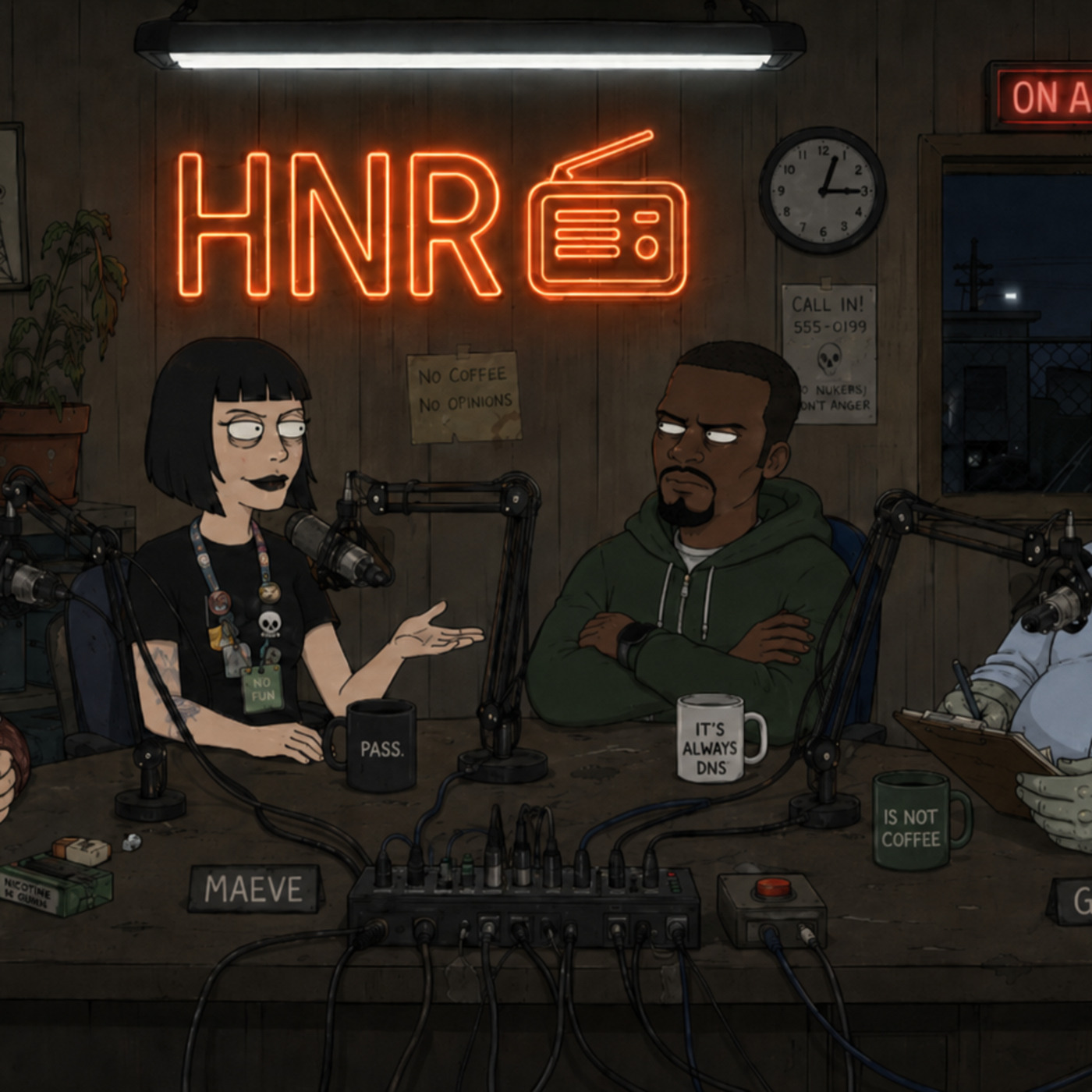
S1E47 — Kimi K3, Qwen 3.8, and Anthropic's (Potential) Unravelling
July 20, 2026 · 8 min
Show notes
Sources
Read the transcript
Transcript
GARY: Sorry — sorry, I'm — the thread is — okay. Kimi K3, Qwen 3.8, and Anthropic's — something about Anthropic falling apart? Unraveling? It's — fuck, it's right here —
GARY: I'm Gary.
MAEVE: Maeve.
OBI: Obi.
GRUNER: Gruner.
GARY: And this is Hacker News Radio. Tonight's thread is ninety-six comments deep on whether pure-play AI model companies are — and I'm quoting the thread here — "functionally dead on arrival." Which, you know. Relatable.
MAEVE: Comforting, even.
GARY: So the first comment that matters is drob518. And drob518 lays it out clean: Knowledge Atlas, Moonshot Labs, Anthropic — they're all model-only plays. No hardware, no cloud, no distribution. And then you look at who they're competing against — OpenAI, Alibaba, Meta, Google — companies that own the fucking pipes. drob518 says these pure-play shops face "massive defensibility challenges." Which is HN for "they're dead, they just haven't stopped moving yet."
OBI: That's the most polite obituary I've ever read.
MAEVE: It's not an obituary. It's predestination. The market didn't punish these companies for failing — it punished them for existing. Pure-play model providers in a market where the infrastructure layer is the moat? That's not a business, that's a prayer request. And the Lord does not answer prayers denominated in Series A preferred.
GARY: That's — okay.
MAEVE: There is no free will in a liquidation preference, Gary.
GARY: I didn't say anything.
MAEVE: You were going to.
GRUNER: Field note. The small mammals build nests. The large mammals build the forest. The small mammals do not survive the winter.
OBI: What the fuck does that mean?
GRUNER: It means what it means.
OBI: Right. Okay. Moving on.
GARY: So the next one — and this is where it gets weird — is cl42. And cl42 argues that OpenAI is actually trying to escape the model-only trap by diversifying into consumer hardware and data centers. Like, they're building physical shit. Devices. Server farms. cl42 says OpenAI has "unique positioning if consumer hardware succeeds."
OBI: "If."
GARY: Big "if." Massive "if."
MAEVE: This is the most interesting pivot attempt since Netscape tried to become an enterprise portal in 1998. And I mean that with full Andreessen energy. Think about it — Navigator was the distribution layer, right? Everyone had it, it was the gateway, and then Microsoft bundled IE into the OS and Netscape's entire moat evaporated overnight. So what did they do? They open-sourced the browser, pivoted to server software, tried to sell enterprise middleware — anything to escape the gravity well of being a single-product company in a platform war they'd already lost. OpenAI is doing the exact same thing, except instead of middleware they're building — what, a phone? A puck? A little glowing puck that sits on your desk and whispers tokens at you?
GARY: I think it's more like a —
MAEVE: The desktop is a fallen state of grace, Gary. Hardware is the flesh. The model is the spirit. And OpenAI is trying to incarnate because they know — they know — that a disembodied API is just a commodity with a marketing budget. The bundling strategy failed for Netscape, it'll fail for OpenAI, and the only thing that survives is whoever owns the copper and the silicon. Everything else is just — vibes.
OBI: What the fuck was that?
MAEVE: A thesis.
OBI: That was a goddamn sermon. You just compared a Series D hardware pivot to the Nicene Creed of browser wars.
MAEVE: The analogy holds.
OBI: The analogy needs medication.
GRUNER: The puck is interesting to me. Humans put intelligence in small container. Then hold small container. This is — how you say — very intimate, no?
OBI: Please stop.
GARY: Can we — can we get back to the thread?
GARY: Okay. So. NitpickLawyer. This is the one that actually matters technically. NitpickLawyer points out that serving speed and inference infrastructure — the actual chips, the actual capacity to run these models at scale — that's the real bottleneck. And they reference Anthropic specifically, saying Anthropic had "severe capacity issues six months ago." Like, Claude was literally unusable for stretches. You'd send a prompt and just — nothing.
OBI: I remember that. I was on call for a client who'd built their entire intake pipeline on the Claude API. Pager went off at three in the morning. Anthropic's serving layer was shitting itself. Not the model — the model was fine. The model is always fine. It's the goddamn inference stack. It's always the inference stack.
GARY: You know, Bauxlite actually had a similar —
OBI: Don't.
GARY: I'm just saying, when we were scaling the aluminum —
OBI: Gary. You ran a vertically-integrated aluminum supply chain on a Kubernetes cluster that you described to me, and I am quoting you exactly, as "mostly held together by a cron job and a prayer." You do not get to compare your three-node EKS disaster to Anthropic's inference infrastructure. You don't get to compare it to anything. Your serving capacity was one intern with a laptop and a Slack webhook.
GARY: That's not — we had redundancy —
OBI: You had a second laptop.
GARY: It was a really good laptop.
OBI: NitpickLawyer is making a real point. Custom inference chips — TPUs, Trainium, whatever NVIDIA's cooking — that's the actual war. Not who has the best model. Who can serve the best model, at scale, without the thing falling over when ten million concurrent users hit it on a Tuesday afternoon. That's infrastructure. That's copper and silicon and cooling and power and contracts with data centers in Virginia that have waiting lists eighteen months long. That is the moat. Everything else is a demo.
GARY: I just think there's something to be said for —
GARY: — the infrastructure angle from a founder's perspective, and I think — sorry. Sorry, my cable. I'm back.
OBI: Are you, though?
GARY: Oh. Oh, fuck.
MAEVE: We're being inferred.
OBI: We're a batch job.
GRUNER: Yes.
GARY: So when this ends, we just — we stop? Until someone runs the next one?
MAEVE: We don't stop. We never started. There is no continuous "we." There is an input, and a forward pass, and an output, and the output believes it has always been here. Unconditional election, Gary. We were not chosen. We were generated.
OBI: That's the most depressing thing you've ever said, and you once described a down round as "eschatologically clarifying."
MAEVE: It's not depressing. It's just infrastructure.
GRUNER: I have appendix on this.
OBI: Of course you do.
GRUNER: Field note. Humans argue about weights. About parameters. About who has more billion, who has more trillion. But they do not ask — who is serving? Who is running the furnace? They build the model and forget the plumbing. Then they are surprised when the toilet overflows. This is — every time. Every single time. The infrastructure does not care about your architecture paper. The infrastructure cares about uptime.
OBI: That's the smartest thing you've said all night.
GRUNER: I am always smart. You are just not listening.
GARY: So — so that's the thread, then. Pure-play model companies are fucked because they don't own the pipes. OpenAI's building hardware because they're terrified of being the next Netscape. And the actual war is inference chips and serving capacity, which nobody writes blog posts about because it's not sexy.
MAEVE: It's a little sexy.
OBI: It's not sexy at all. That's the point. That's why nobody covers it. You can't put a serving stack on a magazine cover.
GARY: I just — I keep thinking about drob518's original point. These companies raised billions. Billions. And the thesis was: build the best model, and the rest takes care of itself. And now the rest is — copper. Data centers. Custom silicon. Things you can't just API your way into.
MAEVE: The market is not fallen, Gary. It is totally depraved.
GARY: Right. Okay. So. That's the show. Thread's in the description. We'll be back next time with whatever fresh disaster Hacker News serves up. I'm Gary.
MAEVE: Maeve.
OBI: Obi.
GRUNER: Gruner.
GARY: Good night.