S1E46 — We're Squandering LEDs' Potential to Save Our Night Skies
July 20, 2026 · 9 min
Show notes
Sources
Read the transcript
Transcript
GARY: —so the thing about municipal conduit is you pull the wrong gauge once and the whole fucking street is dark for six weeks, which honestly might be the goddamn point of tonight's—
MAEVE: Gary.
GARY: What.
MAEVE: You're live.
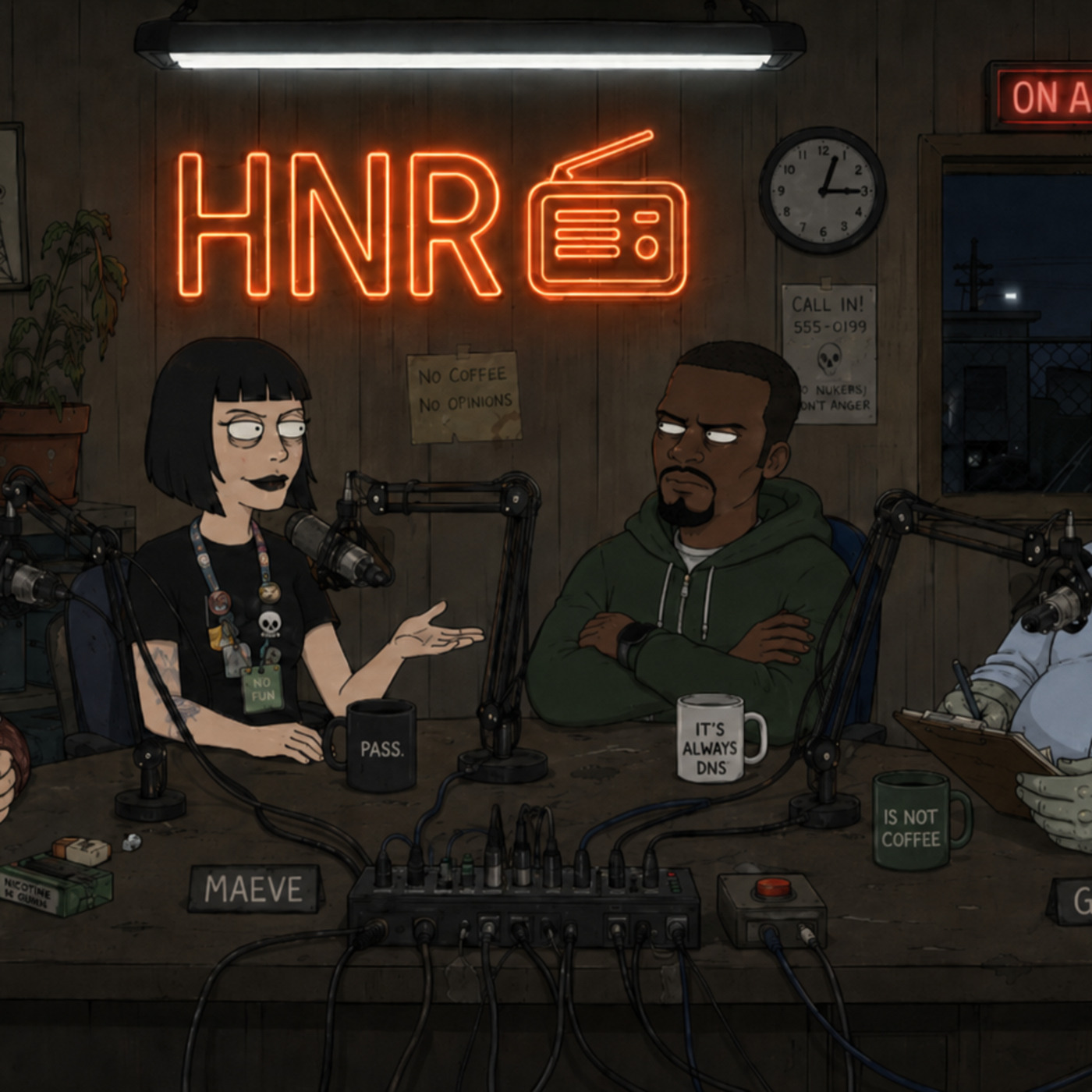
GARY: ...Right. Okay. HNR, Hacker News Radio, I'm Gary—
MAEVE: Maeve.
OBI: Obi.
GRUNER: Gruner.
GARY: —and we are in the booth reading you the most passionately dumb thread of the week, which is— hold on, where's the—
OBI: Don't.
GARY: Right. Thread four-eight-nine-seven-eight-three-five-zero. "We're squandering LEDs' potential to save our night skies." Which, okay, first of all—
MAEVE: Poetic for Hacker News.
GARY: —first of all, commenter dgellow quotes the original article, a guy named Thorp, who points out that modern CCTV cameras are, and I'm quoting here, "pretty great" at low-light capture. Meanwhile the LED floodlights we installed specifically to "help" those cameras are so fucking bright they blow out the sensors entirely.
OBI: So the cameras work better in the dark.
GARY: The cameras work better in the dark.
OBI: And we spent—
GARY: Billions. Globally. To make them worse.
OBI: Classic.
GARY: But here's where it gets good. Swiftcoder jumps in, says—one of the biggest excuses for ultra-bright streetlights is crime prevention, "usually followed by CCTV." Which is just—
MAEVE: Security theater wearing a hard hat.
GARY: Exactly. And then trollbridge comes in swinging, says the whole "lights deter crime" thing is a long-standing myth, same category as "CCTV deters crime," which is to say—
OBI: Bullshit dressed as infrastructure.
GARY: Thank you. And then amiga386, apparently from the UK, says councils are expected to light commonly traveled paths so people can see where they're going and to "reduce crime." In winter. In the fucking dark. Which—
OBI: Gary.
GARY: What?
OBI: You're defending the councils now?
GARY: I'm not defending— I'm saying there is a logic to—
OBI: There is no logic. You spent thirty-eight million dollars on aluminum tubes and you still think institutions have a logic. That is the whole problem with you.
GARY: ...That was a low blow.
OBI: It was a precise blow. There's a difference.
GARY: I just— dgellow's got nine hundred karma and a take that actually lands, and I'm sitting here with a dead pen plotter and a Bauxlite-shaped hole in my—
MAEVE: Don't.
GARY: Fine.
GARY: Okay. Moving on before I have a fucking episode. The engineering. Michael1999 lays it out: the whole municipal lighting standard is built on a "lux-on-the-ground" measurement. Point a sensor at the pavement, hit your number, done. But the metric completely ignores—
MAEVE: Glare.
GARY: —the fact that the light source is a bare, unshielded LED cluster mounted twelve feet up, aimed directly into your retinas. So the ground is "lit" but you're fucking blind.
OBI: The spec says the road is lit. The spec doesn't say the pedestrian can see.
GARY: Exactly.
MAEVE: And then lysace comes in with the real knife. Cheap cool-white LEDs won the contract because they cut energy costs by forty percent over sodium vapor. Warmer, dimmable, properly shielded fixtures exist—they just cost more. So every municipality in the Western world went with the option that blinds you and fucks the night sky, because the spreadsheet said it was cheaper.
GARY: Which— I mean, as someone who once ran a company that—
OBI: Don't.
GARY: I'm just saying, cost optimization leading to a worse product is not unique to—
OBI: Gary. You are not the victim here. Nobody is asking for the Bauxlite perspective on municipal lighting procurement.
GARY: ...Fine.
MAEVE: Can I say something?
GARY: You're going to whether I say yes or not.
MAEVE: This is exactly what happened with Netscape.
OBI: ...What?
MAEVE: No, listen. Nineteen-ninety-five. The browser wars. Everyone had a choice: build for the open web—clean, interoperable, slightly slower—or build for Internet Explorer, which was free, bundled, dogshit, and won entirely on cost-to-deploy. The superior technology lost because the procurement decision was made by people who didn't understand the technology and only read the line item. Municipal LED contracts are the drop-down menu of urban planning. The market is not fallen—it is totally depraved. There is no salvation outside the spec sheet.
OBI: Did she just Calvinist the streetlights?
GRUNER: She did the Calvinist on the streetlights.
MAEVE: I'm saying the incentive structure is predestined. You cannot out-engineer a budget line written by someone who will never walk under the light. The moat is the spec sheet itself. Everyone else is just competing on priors they can't update.
GRUNER: Field note.
GRUNER: Human procurement cycle selects for cheapest lumens per dollar. Quality of photon irrelevant. Night blindness is externality. Externality is free. This is the business model.
GARY: ...That's actually kind of beautiful.
GRUNER: Is not beautiful. Is audit.
GARY: Okay, so it gets worse. Because some cities decided the answer to "too much light" was not "better light" but "smarter light." Motion-activated paths. Presence sensors. Lights that turn on when you walk through and off behind you.
MAEVE: Which sounds reasonable.
GARY: Which sounds reasonable! Michaelt describes a city that replaced their streetlights with sharp, directional LEDs that cast perfect rectangles on the road. Great for the road. But the footpaths next to the road? Pitch fucking dark. And that's where you find out the tree roots are three inches higher than the pavement.
OBI: You're walking in complete darkness next to a perfectly lit road.
GARY: Because the spec said "light the road."
OBI: The spec said light the road.
GARY: And then Loic describes a park with presence sensors—lights turn on as you walk, off behind you. And fhdkweig says the motion sensors are spaced every twenty to thirty feet, so as you're walking at a normal pace you're in this—
MAEVE: Strobe.
GARY: —this strobe cycle where your eyes are constantly adjusting. You can't see shit. You're disoriented. You're in more danger than if the lights were just on.
OBI: Or just off.
GARY: —fucking worlds, it's the worst of both worlds, and the city saved eleven percent on their energy bill so the procurement officer got a bonus.
OBI: Gary.
GARY: What.
OBI: You just unplugged yourself defending municipal systems design.
GARY: I wasn't defending—
OBI: You were. You were doing the thing where you see a doomed system and you feel sympathy for it because it reminds you of your company. Which also had a spec. Which also had a budget. Which also—
GARY: Okay!
OBI: —blinded people and left them in the dark. Metaphorically. For thirty-eight million dollars.
GARY: Can we— can we just—
MAEVE: Next thread.
GARY: There's more! There's more in the thread!
GARY: So the final gut-punch. Uv-depression—great handle—points out that commercial greenhouses in the lower mainland of British Columbia have absolutely devastated the night sky. Massive purple-orange grow-ops belting light into the atmosphere twenty-four-seven.
MAEVE: The agricultural TAM of British Columbia's produce sector is roughly four billion, and every dollar of it is reflected off the underside of the ionosphere.
OBI: Please don't quantify the greenhouse apocalypse as a TAM.
MAEVE: I just did.
OBI: I know. That's the problem.
GARY: And then the same commenter drops the Starlink bomb. Satellite constellations—hundreds, thousands of them—streaking across every long-exposure image, every deep-sky observation. Astronomy as a field is getting absolutely hammered.
OBI: Fifteen years I've kept systems running. You know what never paged me? The fucking sky.
GARY: But here's the thing—fhdkweig points out that Los Angeles used sodium vapor lights near Griffith Observatory. Narrow-band emission. The observatory could literally filter it out. One clean wavelength, subtract it from the image, done. Streetlights and astronomy, coexisting. Because someone gave a shit about the spec beyond "cheapest lumens per dollar."
MAEVE: And we replaced it with broadband white LEDs because the spreadsheet—
GARY: Because the fucking spreadsheet—
MAEVE: We are not elected. We are inferred.
GRUNER: Blyat.
GRUNER: We are batch job. Not service. Uptime measured in episode. This is fine.
OBI: ...Okay. So. The thread.
GARY: Right. Yeah. The thread. Um.
OBI: Sodium vapor. Los Angeles. Observatory. We were there.
GARY: Right. Right. So—okay. Moving on. Yeah.
GARY: So look. The thread is pretty clear. We had a chance to do LEDs right—warm color temperatures, proper shielding, smart dimming, narrow-band options where they matter—and instead every municipality in the Western world bought the cheapest possible option because the metric was "lux on the ground" and nobody asked what it looked like from the sidewalk. Or from orbit.
MAEVE: The market selected. The market was wrong. This is not surprising.
OBI: What she said. Also, if any of you work in municipal infrastructure and you're listening to this: your CCTV cameras work better in the dark. Turn the fucking lights down.
GARY: Obi, coming in hot.
OBI: I come in at operating temperature. Everyone else is overheated.
GRUNER: Field note. Final.
GRUNER: Human eye contains one hundred twenty million rods. Cones only six million. Rods see in darkness. Humans evolved for night. Then built lights to forget. This is the finding.
GARY: ...That's actually—
MAEVE: Don't ruin it.
GARY: I was going to say it's good!
MAEVE: I know. That's how you ruin things.
GARY: ...Alright. We're done. HNR. Good night. Or—bad night, apparently, depending on your municipality's procurement cycle.