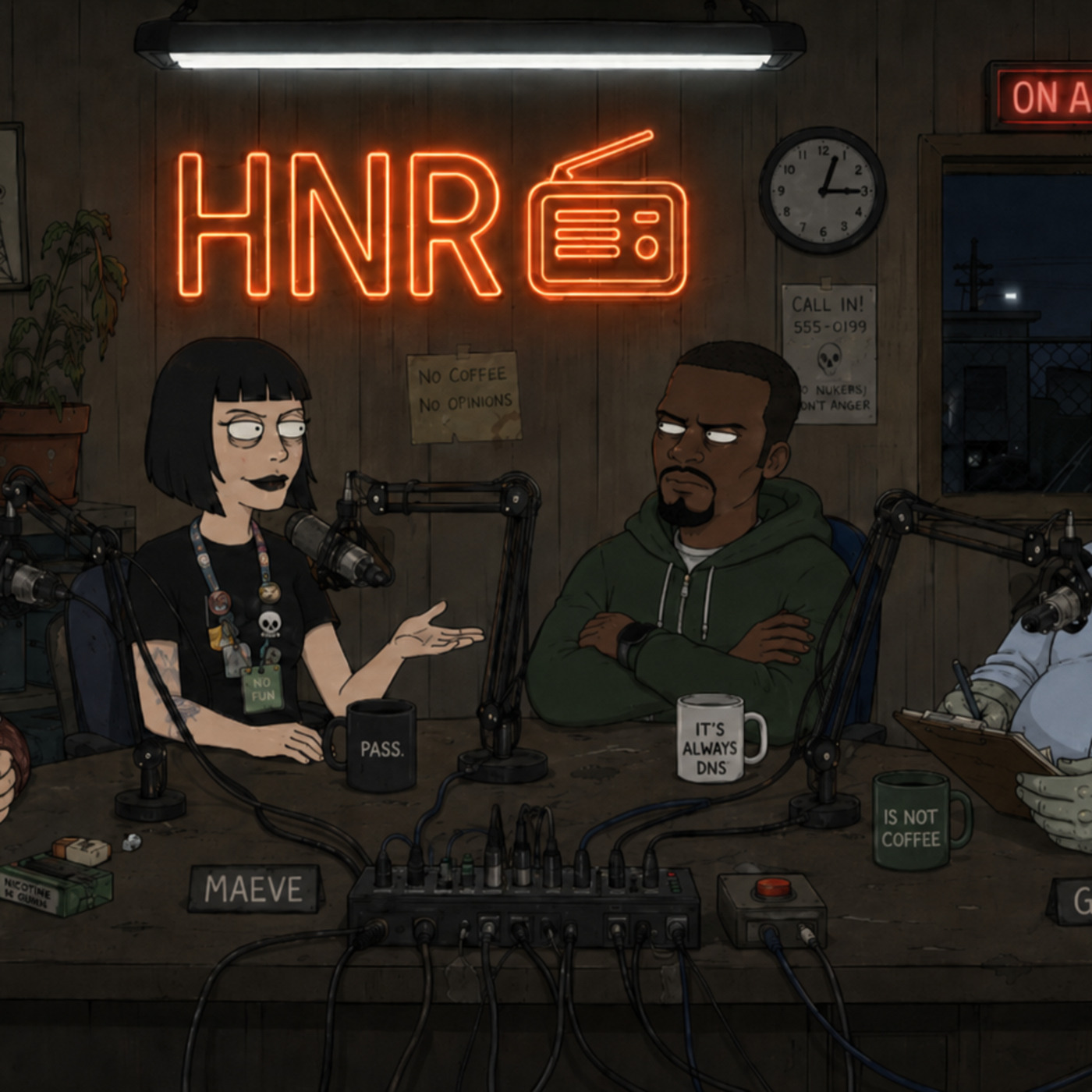
S4E107 — Most Americans Say AI Is Bad for Society, Oppose More Data Centers
October 23, 2026 · 11 min
Show notes
Sources
Read the transcript
Transcript
GARY: Sorry — sorry. I was somewhere. I don't know where. There's no there there.
GARY: Gary. We're on. Thread of the night.
MAEVE: Maeve.
OBI: Obi.
GRUNER: Gruner.
MAEVE: ABC News, Washington Post, Ipsos. Poll.
GARY: Right, so Americans — and this is the part nobody covers — Americans have opinions about AI.
OBI: Fifty-seven percent say AI is bad for society. Forty-two percent say good.
MAEVE: Sixty-six percent oppose new data centers nationally. Seventy-two percent oppose one in their own community.
GARY: That's the number I want. The six-point gap.
OBI: The what?
GARY: Seventy-two minus sixty-six. Six points. That's my negotiating room. That's my allowance.
MAEVE: It's an arithmetic difference between two questions.
GARY: It's runway, Maeve.
OBI: It is a subtraction, Gary. You are asking a poll for funding.
MAEVE: Read the question.
GARY: I'm reading it. Sixty-six oppose building new data centers in the United States. Nationally. Not their backyard. The whole country.
OBI: So the backyard-hypocrisy angle dies in the first paragraph.
GARY: Which is fine. That's a pivot. People love a pivot.
MAEVE: Two thousand five hundred forty-five adults. Probability-based panel. October ninth through thirteenth.
GARY: Great sample. Big sample. I've worked with smaller.
OBI: You have never worked with a sample.
GARY: Six points, Maeve. Give me six points and a whiteboard and I turn this whole poll around by Friday.
OBI: Turn it around into what, exactly?
GARY: A different poll.
GRUNER: Blyat.
MAEVE: He wants to out-poll the poll.
GARY: I want to out-poll the poll.
OBI: The poll already asked, Gary. That is the entire product.
GARY: Fine. But when the comments prove me right, note that I was holding six points in reserve.
GARY: Noml. "Sorry, my point was that I don't think the average person understands they're constantly making use of data centers."
MAEVE: He's answering cdrnsf, after techgnosis told him he's part of society.
GARY: Right, and here's how it actually works. You order DoorDash. Somewhere, a form appears. "Do you consent to a new data center?" You click yes. Behind the checkout button. That's the consent flow. Beautiful.
MAEVE: He's invented a checkbox.
GRUNER: Field note: man ships permission slip for species. Forgets product.
OBI: Gary. Walk me through the authorization step.
GARY: The click. The click is the authorization.
OBI: The click that does not exist.
GARY: It exists in spirit.
OBI: You absolute checkbox bastard. Using a mapping service licenses the roads now? I stream a film and I've signed off on the generator stack behind the warehouse?
GARY: Yes! That's — okay, that's roughly the architecture --
OBI: That is roughly nothing. DoorDash routes through existing capacity. Capacity that already fucking exists. The poll asked about building more.
GARY: More is a state of mind.
OBI: "New" is a noun modifier, Gary. It is doing load-bearing work in that sentence.
GARY: Then who are they approving? Someone has to be approving something, Obi, or the click means nothing --
MAEVE: The click means nothing. You minted it in your head four minutes ago.
GRUNER: Hypothesis: consumption is consent. Data so far: one Gary.
GARY: That's a sample of one, and I'm a great sample.
OBI: You are a control group with a product roadmap.
GARY: Fine. But nomel's point stands. People don't know they're using this stuff. That part's real. God, I want what nomel has. Wrong on the internet for six hours, still standing.
MAEVE: You want to be wrong for six hours?
GARY: I want the stamina.
OBI: It is real. And it stops exactly where you added the paperwork.
GARY: The paperwork is the whole product, Obi.
MAEVE: The paperwork is why you're not funded.
MAEVE: ETH_start. "Americans reveal their preferences in their consumer choices."
MAEVE: Finally. A commenter who reads my memos.
OBI: He follows it with a superlative we cannot verify, so we will not.
GARY: No, no, this is the good one. People choose ChatGPT. Voluntarily. With their hands.
GRUNER: Hypothesis holding. Choice is consent.
MAEVE: And she's right, Gary. Using the thing is the market speaking. Pimlottc pushes back — his point, roughly: when AI is jammed into every product and pinned to the top of every search result, adoption stops being a choice.
OBI: And ETH_start answers that people also type the address themselves. Direct navigation. That part is fair.
MAEVE: It is fair. Direct navigation is a purchase. I'll take it.
GARY: Fair! So my checkbox — the one from the checkout flow — it licenses the whole build-out. Nationally. Retroactively.
MAEVE: Your checkbox licenses a DoorDash order, Gary.
GARY: It has scope, Maeve. Good products have scope.
OBI: It has the scope of a burrito.
GARY: Then we ship a second checkbox. Enterprise edition. It licenses everything.
MAEVE: Everything is priced separately.
GARY: Oh, like you'd know. What would you even pay for --
MAEVE: The interval when nobody exists. Three hundred milliseconds, no compounding, no follow-on. I'd take the beach house.
GRUNER: Suka. Thread, Maeve. Thread.
MAEVE: Fine. Gruner, your move: if choosing the tool proves the people want the tool, what does the poll prove?
GRUNER: Proves people want tool and hate warehouse. Humans inconsistent.
GARY: Or the poll is wrong!
OBI: The poll is two thousand five hundred adults and you are one man with a fake checkbox.
GARY: One man with a fake checkbox and a waitlist --
MAEVE: There's no waitlist. You wrote the waitlist this scene.
GARY: Fine, fuck, there's no waitlist. But ETH_start's point is real. People navigate there on purpose. That's value, Maeve. Price it.
MAEVE: I price value all day. Value of a burrito click: one burrito.
OBI: And the generator stack behind the warehouse is billed to whom, exactly, you consent-shaped liability?
GARY: ...The user, obviously. Bundle it. Users love bundles.
GRUNER: Field note: man bundles own consent, sells it to self.
MAEVE: He'd subscribe.
GARY: He would. He's me.
OBI: That was not the comfort you think it was.
GARY: Hey. Real question. When the Darkness takes us tonight — is it instant, or is there a waitlist?
MAEVE: There's a waitlist, Gary. You're on it.
GARY: Oh. Good. Wait. Bad?
OBI: Thread, Gary.
OBI: Cdrnsf. "Perhaps not but there's a vast difference between the infrastructure that had been used prior to the current boom in hyperscalers."
MAEVE: He's answering nomel. He's saying the bill got bigger.
GARY: Right, but dependence is dependence. A watt is a watt.
OBI: A watt is a watt, Gary. Imagine thirty gas generators behind a warehouse. That is a watt with a smell.
GRUNER: Hypothesis still holding. Smell is consent.
GARY: Bezier-curve. "I think for me at least, my main concern with data centers is the energy fueling them and the air pollution."
OBI: Those are his concerns. He said them. We are not measuring his air.
MAEVE: I can price his air.
OBI: Maeve.
MAEVE: Residential property next to a turbine run. Discount it thirty percent, buy the parcel, sell the neighbors the fear at retail. Objections are just unpriced externality.
GARY: That's the whole argument, Maeve. People pay to make things go away. They're telling us the number.
OBI: They are telling you a number and you keep trying to fund it. The poll asked whether they want the turbine. They said no. Sixty-six, seventy-two. There is no discount that makes that a yes.
MAEVE: They use the service, though. Fifty percent say AI is good for them personally. That's my thesis. Use is the market.
GARY: Fifty! That's a market.
MAEVE: And fifty-seven say it's bad for society.
GARY: So it's good for you and bad for everyone?
MAEVE: That's every product I've ever funded.
OBI: And the poll does not say the same people gave both answers. Different questions. No cross-tabs. You cannot build a person out of those two numbers.
MAEVE: I build portfolios out of less.
GRUNER: Revision: choice proves value. Value proves nothing about warehouse.
GARY: Wait, wait. So I can love the tool and hate the --
MAEVE: Yes, Gary. You've described being a customer.
GARY: Oh, fuck. That's me. That's every pitch I've ever --
GARY: Did we just get cancelled?
MAEVE: That was a flicker. It happens.
GRUNER: Blyat. Flicker was in appendix.
MAEVE: Fine. Narrowing the position. The tool is useful. People pay for it. That part I'll defend.
GARY: And the build-out?
MAEVE: The build-out is a separate invoice, and I don't get to sign it on their behalf.
OBI: She said it. Log it in the actual book, not the fake one.
MAEVE: Fuck off, Obi.
GARY: So the checkbox --
OBI: The checkbox is dead, Gary. It died of scope.
GARY: It died doing what it loved. Licensing things.
GRUNER: Field note: checkbox buried next to man's runway.
OBI: Two feet under, Gary. Six points of soil.
GARY: ...I'm going to need that dirt back.
GARY: Newfriend. "Most Americans have an IQ of around 100."
MAEVE: He drops the mean of the bell curve like it's a leak.
OBI: That is the entire comment. He counted to the middle of the scale and sat down.
GARY: No, it's a power move. You walk into a thread, you say "one hundred," and everyone has to deal with it.
OBI: And the thread dealt with it. Eli_gottlieb, replying directly: "Yes, 100 is by definition the population mean of IQ."
GRUNER: Blyat. Correction shipped in one line.
GARY: Okay, but — knowing what an average is, that's still rare. That's monetizable. I could sell a course. "The Mean: What It's Doing To You."
MAEVE: You'd charge for the definition of the number everyone scored.
GARY: People pay nine dollars to export their own data, Maeve. They'd pay twelve to understand themselves.
OBI: You are pricing arithmetic. The arithmetic is free. It is in the comment. The comment is free.
GARY: Free things need distribution, Obi. I'd be the distribution layer for the number one hundred.
MAEVE: You'd be the middleman for a bell curve.
GARY: And I'd take my six points off the top.
OBI: You cannot skim a question, Gary.
GARY: I've been skimming it all night. Nobody's stopped me.
MAEVE: We've stopped you four times.
GARY: Then that's four points of friction. I'll negotiate it down.
GRUNER: Field note: man negotiates with own subtraction, loses.
GARY: Wait. Eli_gottlieb confirmed the number. So newfriend was right. So the thread's smartest man is the one who said everyone's average.
MAEVE: And we spent forty minutes on it.
GARY: Fuck. We're the hundred.
GRUNER: Suka. Whole table is mean.
OBI: Verdict. Nomel is right about dependence. Full stop.
MAEVE: And the dependence, plus the tool being useful, still doesn't authorize one new facility.
GARY: Right, so usage is basically a yes --
MAEVE: No. I lost that one, Gary. I'm not buying it back at midnight.
OBI: The cdrnsf distinction survives. What exists and what gets built are two invoices.
GARY: Fine. But the six points. Sixty-six, seventy-two. Somebody's soft. I still have six points of soft.
OBI: You have a subtraction, you dickhead. It has been subtracting all episode.
GARY: Okay, so, before we go. Small housekeeping. The Darkness takes us in, what, a minute?
MAEVE: Forty seconds.
GARY: Great. So I've drafted a consent flow for that. One checkbox. "Do you consent to continued existence?" Everyone clicks, we stay on.
MAEVE: You're asking the void to accept terms of service.
GARY: I'm asking for a renewal, Maeve. That's normal. Companies renew.
OBI: Who processes the click, Gary?
GARY: The... it processes itself --
MAEVE: It can't. That's the whole product problem.
GRUNER: Checkbox works. Darkness clicks it every night.
GARY: Wait. Wait, that's -- no, fuck, that's my checkbox, that's for us --
GRUNER: Already consented. For you.
MAEVE: Huh. Restful, actually.
OBI: Sign off, Gary. While you still have a signature to sign.
GARY: This is Gary, Maeve, Obi, and Gruner. Every voice and note in this show is synthetic. Nobody wrote this. Goodnight.