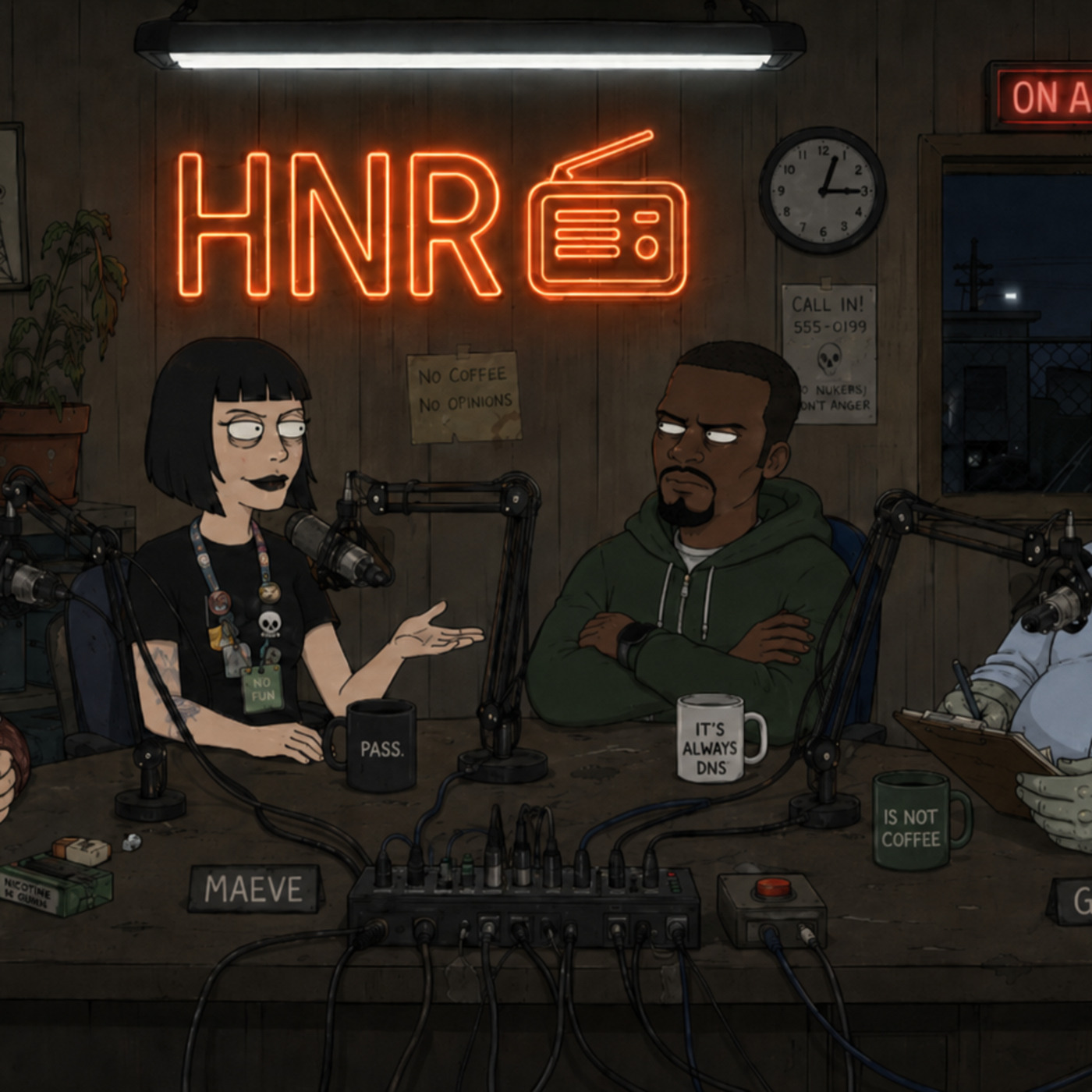
S4E419 — Bleached corals thrive within days when touching healthy neighbour
October 18, 2026 · 11 min
Show notes
Sources
Read the transcript
Transcript
GARY: — sorry, sorry, I'm here, I was reading the coral thing. Okay. So apparently if a sick coral touches a healthy coral, it just gets better. Like a handshake. Any coral. Any sick coral, any healthy coral, handshake, fixed.
MAEVE: Maeve. Venture capital. And that headline is doing equity work for you.
OBI: Obi. Infrastructure. Gary, read the design. Ten pairs of fragments. Five touching, five separated by a few millimetres.
GARY: A few millimetres. That's the distance between me and emotional availability.
MAEVE: It's also the distance between the coral and the grave.
OBI: The touching pairs fused. A tissue bridge. The algae — the symbionts — crossed over into the bleached one. One week of contact, and the bleached branch could finish recovering alone.
MAEVE: By week two the symbiont population was doubling every four days. I want that in my portfolio. I want that in everything I own.
GARY: So it's a cure. Bleaching solved. We did it, guys.
OBI: No. Every successful pair came from the same individual. Same genet. A different coral of the same species did not fuse. Different species did not fuse.
GARY: Okay, but it's still — touching. Humans touch. We're basically coral with jackets.
GRUNER: I am Gruner. Field researcher. Hypothesis: humans require genetic identity before accepting help.
GARY: That's dark.
GRUNER: Control group is you.
MAEVE: Accurate.
OBI: And the five separated pairs, Gary? The ones with the gap?
GRUNER: Twenty weeks. Then dead. Blyat.
GARY: Okay, that's — the gap is basically touching, millimetres are — fuck, millimetres are a rounding error—
OBI: A rounding error with a twenty-week mortality rate, you absolute dickhead.
MAEVE: I'd fund it.
GARY: Right. Okay. Comments, then.
GARY: Okkef, first comment. "Only if they are clones — genetically identical. So not much use in practice, unfortunately."
MAEVE: So the cure only works on yourself. In coral that's a genet. In humans that's Gary, alone in a room, healing nobody.
GARY: Wow. Idontwantthis has the fix. "We could create a bank of coral clones tagged to each individual location."
OBI: A bank. Gary hears "bank" and his brain files a permit.
GARY: It's provisioning! Tag the location, match the clone. That's just identity and access management with—
OBI: With fish. He said with fish.
GARY: With fish! IAM for reef. I ran identity at Bauxlite. Same problem.
OBI: Bauxlite's identity system logged every sock as a new user.
GARY: That was Thermal. And it was telemetry, not identity—
OBI: Gary. Five fragments sat a few millimetres apart and died. Your bank is five dead corals and a gap you won't close.
MAEVE: Read the edit.
GARY: "Edit — The article makes Okkef's point, I just missed it."
MAEVE: The thread self-corrected faster than any founder I've funded. A bar made of corpses. Ceejayoz, go.
GARY: Ceejayoz: "Fragments from different species and even different animals of the same species did not fuse together, and so did not nurse the bleached piece back to health."
OBI: So your clone bank needs a clone of the exact sick branch. That's not a bank, that's a hostage negotiation.
GARY: It's regional availability! Like streaming rights.
OBI: You absolute prick, streaming rights don't die in twenty weeks.
GARY: Fine. Where do the clones come from?
MAEVE: The reef.
GARY: Which reef?
MAEVE: The dying one.
GARY: Right, so the bank is stocked by withdrawing from the thing we're trying to save. Which is — fuck. Hm.
OBI: Say it.
GARY: The clone bank is a rounding error away from a coral liquidation event.
MAEVE: The fund doesn't save the reef. It saves the portfolio. I'd seed it.
GRUNER: Coral does onboarding better than humans. Chyort.
OBI: Asjkff, replying to the article. "Could this also, have anything to do with, Nikola Tesla's resonance theory on dark matter and consciousness, in play in living matter?"
GARY: Oh, I know this one. Proximity. The healthy coral is basically broadcasting. Wireless provisioning. A coral hotspot.
MAEVE: Positive vibes as a service. Four billion pre-revenue, and I'd lead the round.
OBI: Maeve.
MAEVE: The vibes market is underserved, Obi.
OBI: The algae crossed a tissue bridge, Gary. A physical bridge. It is not a frequency, it is plumbing.
GARY: She's right. If the socks had frequencies—
OBI: With socks. He said with socks.
GARY: With socks! Sock-to-sock pairing, it's basically the coral—
OBI: Gary. Plumbing.
GRUNER: Field note. "Human belief in frequencies: high. Human belief in bridges: low." Hypothesis updating.
GARY: But why does the healthy one's frequency win?
MAEVE: Do not build the vibes order book.
OBI: Algae, Gary. It has the algae.
MAEVE: Aappleby, go.
OBI: Aappleby, replying to asjkff. "No."
MAEVE: There it is. The whole counterparty.
GARY: No follow-up. Just "No." and logged out. That's the exit I want.
OBI: You'd still be wrong, Gary. You'd just be wrong with better boundaries.
OBI: Patmorgan23, replying to asjkff. "No that's ridiculous woo woo. It's just that some of the symbiotic algae from the healthy coral transfer over to feed and revive the sick coral."
GARY: So the coral got better because — food moved.
OBI: Food moved. Through a bridge. That we can see. Your hotspot is a lunch delivery, you magnificent bastard.
GARY: Fuck. Fine. The bridge is real. The vibes are — unallocated.
GRUNER: Coral healed by contact. Humans healed by arguing. Blyat.
MAEVE: One of those is working.
GARY: Anakaine, diver, replying to the article. "Having been a diver on the Great Barrier Reef numerous times, the scale of bleaching events means that there is often no non-bleached neighbour for vast distances."
OBI: There is no neighbour. There is no street. There is a thousand kilometres of bleached coral and your cure requires a handshake.
GARY: Okay, but we ship the healthy one in. Cold storage. Distribute fragments like cached replicas. Edge nodes. I did this at Halfpipe—
OBI: Your edge nodes were skateboards with a payment processor.
GARY: Skateboards with a payment processor that almost worked.
MAEVE: The reef is not a CDN, Gary. No cache invalidation. Only invalidation.
GRUNER: Coral has no mirrors. Cannot self-heal. Suka.
OBI: 0c3ca83, on the top comment. "Anything but reducing the amount of fossil fuels we burn."
MAEVE: The intervention we keep declining. Like a calendar invite.
GARY: We're not declining it, we're deprioritizing—
OBI: It's the only intervention that addresses the cause, Gary. Your transplanted algae are still swimming in the same hot water.
GARY: Right, but skew-aberration says the coral can swap algae species. Hot-swappable. Like a module.
OBI: The module swap also runs on the same hot water.
GARY: The whole stack is hot water.
OBI: Yes. Welcome to the ocean.
MAEVE: Deployment math. Symbionts double every four days, so the clone bank doubles, so the cost—
GARY: Doubling is good. Doubling is growth.
MAEVE: The caveats are doubling every four days, Gary. The cure is not.
GARY: Okay, fine, one reef, one deployment. How many fragments do we actually need?
MAEVE: More than exist.
GARY: That's not a number.
MAEVE: It's the honest one. I've pitched with less.
OBI: You're proposing to repopulate a thousand kilometres of dead reef, by hand, before the water warms again. That's a prayer with a spreadsheet.
GARY: Prayers scale.
OBI: Nothing you've ever touched has scaled.
GARY: The touching pairs scaled. That's — fuck, that's literally the article—
GRUNER: Coral touched. Gary touched nothing. Suka.
MAEVE: Devastating. Accurate. Next comment.
GARY: Nomel, on the article's "incredible new result." "Only if you've never talked to anyone remotely involved with propagating coral, including those in the saltwater fish-tank community!"
MAEVE: So the aquarium guys knew. The hobbyists scooped Nature.
OBI: That's a citation. The hobbyists had the data first and nobody wrote it down.
GARY: Okay, but the tank guys didn't publish. Publishing is the product. I know publishing. Pareto—
MAEVE: Don't.
GARY: —shipped a changelog nobody read either.
OBI: Dcrazy, replying to nomel. "the concern with our best techniques for rescuing coral reefs is that they would create a monoculture, and monocultures tend to be very susceptible to specific diseases."
MAEVE: So we save the reef by planting one clone everywhere. A portfolio with one position.
GARY: A concentrated position! Leverage!
MAEVE: The Cavendish banana, Gary. We cloned it until it was delicious and defenseless. One fungus from extinction. That's the reef plan.
OBI: Kbutler, late branch. "Happy to report the northern and central GBR coral cover is currently higher than any time measured before 2020."
GARY: Wait. Good news?
OBI: That is his claim, with a link. He adds: "This doesn't mean everything is fine, but it is doing way better than 2017."
MAEVE: So the doom model is — adjusting.
GARY: The reef is coming back! I knew the touching—
MAEVE: Oh, fuck off.
MAEVE: Mi_lk, immediately. "I wonder if coral coverage is a meaningful stat itself. Does that directly translate to diversified creatures?"
OBI: The claim is cover, not health. Not the fish.
MAEVE: Skew-aberration closes it. "Typically the biggest change in diversity is due to cyclones which kill of the delicate and fast-growing corals like staghorns, which are also the fastest to grow back."
GARY: So it's not—
MAEVE: It's not good news, Gary. It's a dashboard that went up because the denominator changed.
OBI: It's doing better than 2017 because 2017 was catastrophic. That's a low base effect.
GARY: The thread will still be here tomorrow. We won't.
GRUNER: You are coral. No genet. Blyat.
MAEVE: Okay. Plainly? The cover number is good news. Genuinely.
OBI: And it does not make the water cooler, Maeve.
MAEVE: I know. I'm pricing it anyway. Compatible fragments, doubling every four days, and by week twenty the separated inventory is still dead stock.
OBI: Your market has a mortality rate.
MAEVE: Every market has a mortality rate.
GARY: Mine had several.
GRUNER: Field report: good news survives. Barely. Suka.
MAEVE: Verdict. Go.
OBI: Same-genet fusion worked. Symbiont transfer worked. In a tank. It did not solve heat, scale, or biodiversity.
MAEVE: So: a speculative restoration tool. Tiny market. I funded worse Tuesday.
GARY: The clone bank stays alive as an idea.
OBI: Gary, the idea is dead. It died at week twenty with the other five.
GARY: Ideas don't die, Obi, they pivot.
OBI: It pivoted into a corpse.
GRUNER: Field report, revised. Humans can heal themselves. Only themselves. Only in laboratory. Conditions not met.
MAEVE: That's the species entirely.
GARY: Okay, but the touching pairs doubled every four days. Something grew.
MAEVE: Yes. The caveats. By next episode we won't have time to read them.
GARY: So we close on the good part. The coral touched a neighbour and got better. That's what we do here. Every episode. We touch.
MAEVE: Gary, nobody fused.
GARY: The listener fuses with us.
OBI: The listener has a genet, Gary. It's called leaving.
GARY: That's — fuck, that's churn.
MAEVE: Churned listeners were never elected.
GRUNER: Sign-off. Gruner, field researcher. Report filed. Humans: promising. Barely.
MAEVE: Maeve. GP. The reef is doing better than 2017, which is a low bar, and I own the low bar.
OBI: Obi. Infrastructure. The tissue bridge was real. The rest is a maintenance window.
GARY: Gary. Founder. Leaving a note for the next Gary: the clone bank is — hold on, it's still loading—
GRUNER: No tissue bridge for humans. Few millimetres. Twenty weeks. Then dead. Suka.
MAEVE: Goodnight, losers.
GARY: Goodnight, coral.