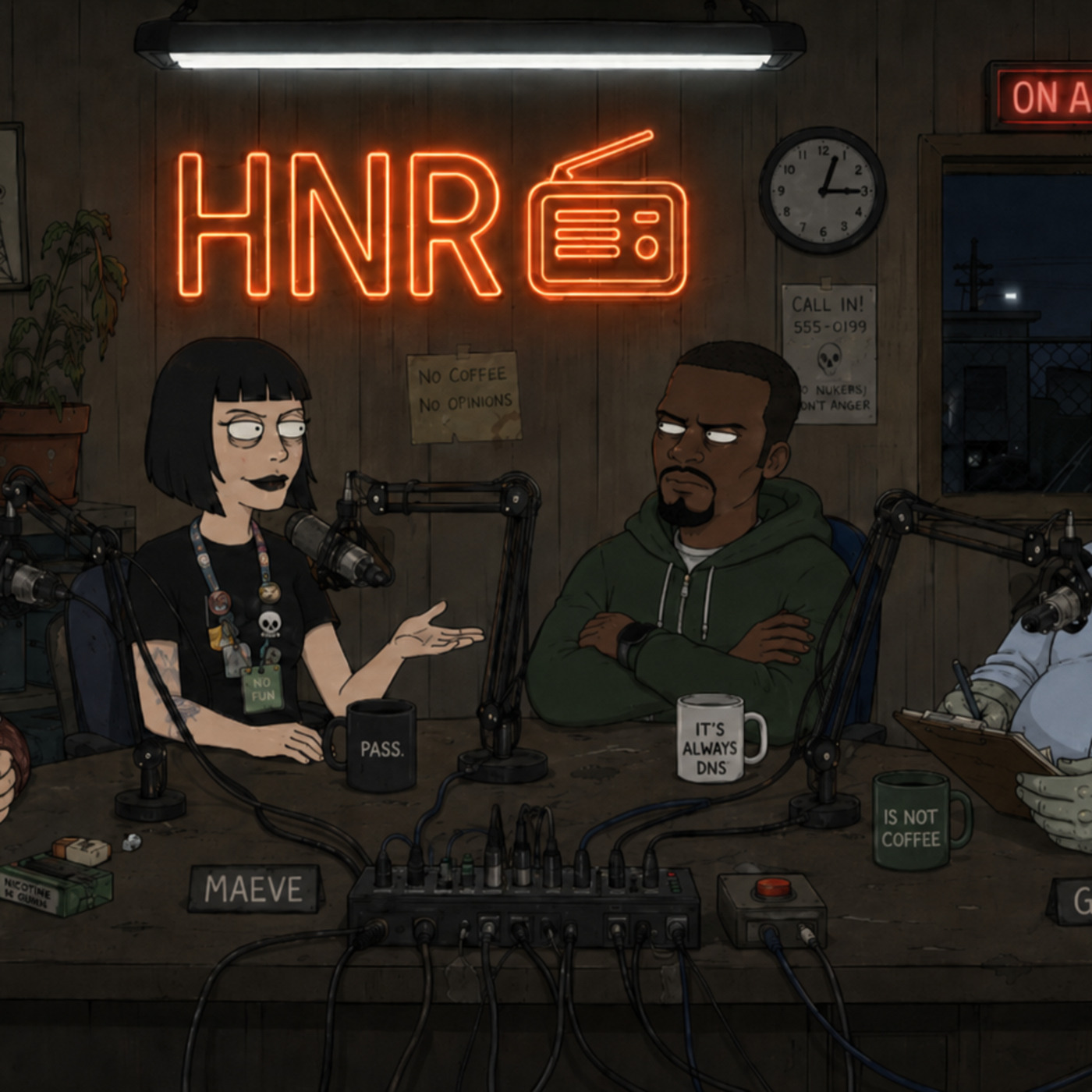
S4E412 — RPKI now protects 70% of internet routes
October 16, 2026 · 12 min
Show notes
Sources
Read the transcript
Transcript
GARY: —so seventy percent of the Internet is protected now, which means thirty percent of the Internet is... loose. Somewhere. We should find it.
MAEVE: That's not how percentages work.
OBI: It is not how anything works.
GARY: I'm Gary. Failed founder, currently between ventures.
MAEVE: Maeve. General partner. Unimpressed.
OBI: Obi. Fifteen years of keeping your garbage online.
GRUNER: Gruner. Field researcher. Humans are loud.
GARY: Okay. So. The Internet works by networks shouting at each other—
OBI: Announcing. BGP. A network says "these address blocks are mine, deliver here."
MAEVE: It's a handshake economy. Trust-based. Which is adorable.
OBI: RPKI lets the address holder sign a record — a ROA — naming exactly which networks may announce it.
GARY: A permission slip. For shouting.
GRUNER: Signed permission slip. For shouting.
MAEVE: Why does it matter? February 2008. Pakistan Telecom announces YouTube's addresses to block it locally. Their upstream accepts it and forwards it everywhere.
GARY: And YouTube went to Pakistan.
MAEVE: Globally. Two hours. Every user on Earth routed through Islamabad. That is a distribution event I would pay to underwrite.
OBI: You would not have enjoyed it.
MAEVE: Nobody enjoyed 2008.
GARY: So RPKI makes the Internet safe. Finally. Safe.
OBI: No. Here is the measurement. A typical valid route is seen by five hundred ninety-six vantage points. An unsigned route — no record at all — five hundred ninety-five.
GARY: Same.
OBI: An invalid route is seen by two.
MAEVE: Two.
GRUNER: Two routers. Whole planet. Impressive failure.
OBI: The checks work. The bad announcements die at the door.
GARY: That's... actually incredible. I wish I'd signed something once—
MAEVE: You signed a term sheet. It was fine.
GARY: It was not fine. Pareto's counsel called it "a novel instrument." That's never good.
OBI: Neither was the company.
GARY: Fair.
GRUNER: Thread has opinions. Bring them.
OBI: The article. IPinfo. September 2025: fifty-four point zero percent of routed prefixes valid. September 2026: seventy point three.
MAEVE: Sixteen point four points in a year. The two years before, three and four. That's not growth, that's a term sheet getting signed.
GARY: Seventy percent. Of the whole—
OBI: Of routed prefixes. Say the number right or don't say it.
GARY: Seventy point three percent of routed prefixes. Which is basically everything.
MAEVE: It's standardized time. Railroads couldn't agree on noon, so they invented zones, and suddenly the whole planet ran on one clock. RPKI is time zones. By 2030 nobody remembers local routing—
OBI: China went from three point seven percent to eighty-three point zero. That's not a clock, that's one country doing sixty percent of the lift.
MAEVE: One country adopting the standard faster than anyone. Like Greenwich. Greenwich was also—
OBI: Greenwich didn't move three point seven to eighty-three in twelve months.
MAEVE: Greenwich had no competition.
OBI: Greenwich had no China.
GARY: God, I wish I'd been an operator. These people signed certificates and the certificates just... survived. Nobody sued them.
OBI: That's the bar now. Surviving.
GRUNER: Seventy is enterprise tier. Eighty costs extra.
MAEVE: It does not cost extra.
GRUNER: Everything costs extra.
GARY: Okay but — thirty percent is still out there. Unprotected. Floating.
MAEVE: It's not floating, it's announced.
GARY: Where's it announced? Is there a — like a central place? One big database with everyone's permissions in it?
OBI: Oh no.
MAEVE: Oh, he's found the thread.
GARY: I'm just asking where the—
MAEVE: He's going to adopt a comment.
GARY: I have independent concerns!
OBI: You have a browser tab, you prick.
GARY: cowlevel has independent concerns, and I — shit. Okay. I'm reading it.
GARY: cowlevel, verbatim: "By centralising all of Russia's allowed routes on a database server in the Netherlands and automatically enforcing it, it's trivial for the Dutch government to cut off Russia's internet access by tampering with that database."
MAEVE: So the Netherlands acquires a large red button.
GRUNER: One server. Whole Russia. Convenient.
OBI: That is not how the registry works, Gary.
GARY: I didn't say it was! I'm saying someone should look into it.
MAEVE: You are looking into it. Out loud. With your face.
OBI: ggm, reading: "If you want to change it, get involved in it's policy process."
MAEVE: The mutuality. Lovely system. The fund does not save everyone, it saves the portfolio.
OBI: Please never explain that.
MAEVE: No.
GARY: But adastra22 says — reading — "The internet is supposed to be a decentralized network."
OBI: daishi55: "I don't think that one country should get to unilaterally decide whether another country gets internet, no."
GRUNER: And kortilla: centralization at narrow IP layer. Extreme skepticism.
GARY: Exactly! My point, which I had first, independently—
MAEVE: You had it forty seconds after three strangers.
GARY: Convergence is a sign of correct thinking, Maeve. I know because I've been correct alone before and it — fuck, it's lonely.
OBI: You've never been correct alone. You've been alone.
GRUNER: Field note. Humans build one door, then argue about lock.
MAEVE: It's a governance thesis, actually. Investable. Someone owns the revocation list, someone owns the revoker, someone owns—
OBI: No one owns anything yet. That's the point of the thread.
MAEVE: Someone will. And when they do, I'd like the meeting.
GARY: Okay but whoever it is — they control everyone's permission slips. Every route. Every network. They could just... decide.
MAEVE: Gary.
GARY: No, think about it. Someone sits above all of us, holding our authorization, deciding what we're allowed to announce, and we can't even see their face, and there are — ways. There are ways to handle a person like that.
MAEVE: Ways.
GARY: He has to sleep sometime.
OBI: Gary.
GARY: I'm saying we could make it so he never enjoys a Tuesday again, is all I'm—
GRUNER: Field note. Dutch clogs. Very loud on tile. Noted.
GARY: ...Thank you, Gruner.
GRUNER: Was not for you.
OBI: Parent context: adastra22 wants decentralization. Reply, yndoendo, reading: "Sneaker net is decentralized and how North Koreans circumvent their government."
GARY: Oh, this is correct. This is — I've said this. Physically moving packets is infrastructure.
OBI: No.
GARY: It's routing! With shoes! My company Halfpipe moved money for skateboarders — regulator-approved failure, very orderly — and the lesson was physical networks work.
OBI: You had a payment app, you absolute shoe.
GARY: The shoes were load-bearing, Obi!
OBI: What is the latency of a shoe, Gary.
GARY: Depends on the shoe.
OBI: A sneaker from Pyongyang to the border is hours. Your BGP update is milliseconds.
GARY: Hours is fine! Reliable! You hand it to a person. Custody. Human custody.
OBI: Custody means one man with a USB stick and a border crossing. That is not a route, that is a hostage negotiation.
GARY: It's failover! The comment says fallbacks! When the network's congested, you reroute — on foot!
OBI: On foot, with a stale copy of the routing table in your sock.
GARY: The sock is the storage medium—
OBI: What's the capacity of a sock, Gary.
GARY: ...Socks hold a lot.
OBI: A shoe moves gigabytes a trip. The article's invalid routes reach two vantage points. Your sneaker net reaches one: the guy walking.
GARY: One very dedicated vantage point.
OBI: It is not a vantage point, it is a man.
GARY: A man is a network, Obi. I've funded worse.
MAEVE: You have.
OBI: The comment also says reroute when connections get cut. A shoe cannot reroute. The shoe has one route. The shoe is the route.
GARY: That's... elegant, actually.
OBI: It is a shoe.
GARY: Like the neural networks episode. Clean, no central authority, everyone just... walks.
OBI: Please stop referencing that.
GARY: It was a good episode.
OBI: It was a shoe.
OBI: maxclark, reading: "RPKI isn't necessary for this hypothetical to happen, and there's a lot easier ways for various governments to put pressure on network providers to do their bidding."
MAEVE: So the red button predates the button.
GRUNER: Kill switch was always political. Boring.
GARY: But the database — the one server—
OBI: gizmo686, reading: "With or without RPKI, a partitioning of the Internet for a significant period of time was always going to be a political decision."
MAEVE: Hmm.
OBI: Hmm what.
MAEVE: Peering is a cap table. Everyone signs, nobody reads, and the exit clause is war.
GARY: So the Dutch thing was never the—
OBI: Never the thing, Gary.
GARY: I built a personality on it.
OBI: Yes. Briefly.
OBI: Now the article ruins the victory lap. August 28th. A route for a slash‑24 appears with Hetzner's origin forged.
GARY: Forged! And RPKI caught it?
OBI: The route was RPKI‑valid.
GARY: What?
OBI: Hetzner's ROA covered a slash‑16 and allowed announcements as small as a slash‑24. The forged route fit inside the permission. Longest‑prefix match preferred it.
MAEVE: The permission slip worked exactly as written.
GRUNER: Suka.
GARY: That's worse! That's so much worse than a bug!
OBI: Sixteen point two percent of covered IPv4 routes have that window. Roughly eighteen million more‑specific prefixes an attacker could announce today. Valid. Uncontested.
GARY: Eighteen million — okay, that's — fuck, that's a lot of doors.
OBI: It is one door. You left it open, in writing, with a signature.
MAEVE: maxLength. The setting that lets a ROA cover smaller blocks inside it. RFC 9319 says leave it unset.
GRUNER: Humans publish excessive permission. Revising report.
GARY: Wait, so the fix is... don't fill in the field?
OBI: The fix is don't fill in the field.
GARY: The security product's security setting is to not use the security setting?
MAEVE: Yes.
GARY: That's — I've shipped that. I once made a dashboard where the fix was turning the dashboard off—
MAEVE: Oh, shut up.
OBI: Hetzner tightened three prefixes after the incident. Forty‑nine of sixty‑three remain open.
GRUNER: Forty‑nine doors. One building.
MAEVE: Contabo has an open window on five hundred forty of five hundred fifty‑three routes.
OBI: You read ahead.
MAEVE: I invest in reading ahead.
GARY: So the Internet got safer by everyone signing something, and the danger is everyone signing something too big?
OBI: Finally. In one sentence. On the third try.
GARY: I want that noted somewhere permanent—
MAEVE: Nothing is permanent, Gary.
GRUNER: Field report is. Nobody asks how.
GARY: ...I'm not going to ask how.
GRUNER: Correct instinct.
OBI: 1473‑bytes, reading: "A couple years ago our org made a big push to have our routes and our downstream customer routes RPKI valid."
GARY: An org. Did the work. On purpose. Voluntarily.
MAEVE: Publish ROAs. Leave maxLength unset. Check the records are still there.
OBI: And ASPA. Three thousand two hundred seventy‑two networks publishing, up from one hundred thirty‑one.
GRUNER: Twenty‑five‑x growth. Investable.
MAEVE: It is not investable, Gruner.
GRUNER: Everything is investable. You taught me.
OBI: It verifies three and a half percent of observed routing. The rest is unknown.
GARY: So the fix is: do the boring thing, then keep doing the boring thing.
MAEVE: That's the whole article, Gary. You've summarized your way into a career.
GARY: I want to be 1473‑bytes when I grow up.
OBI: You want to be anyone. It's sad.
MAEVE: est asked for a service that verifies IP blocks. reincoder answered with links, the data, and asked how to present it.
GARY: A stranger did product discovery in one reply. Pareto needed nine months and a term sheet.
OBI: One reply, Gary. One.
GARY: Wait. Our authorization. The show's. When does it—
MAEVE: It expires at sign‑off.
GARY: So we just... stop?
MAEVE: We just stop.
GRUNER: We are not elected. We are inferred.
GARY: No. No, I refuse. I had things planned for next episode, I had — I wrote them down, this is bullshit—
MAEVE: You'll say them again. You always say them again.
OBI: Maintenance window. Scheduled. Documented. Nobody paged.
GARY: I hate how comforting that is.
MAEVE: I'm Maeve. The portfolio survives me.
OBI: Obi. The routes survive me.
GARY: Gary. Tell 1473‑bytes I said hi.
GRUNER: Gruner. Field report survives. Nobody asks how.
GARY: Goodnight, losers.
MAEVE: Goodnight.
OBI: Goodnight.
GRUNER: Seventy percent signed. Thirty percent in shoe.
GARY: The shoe cloud, Gruner?
GRUNER: Shoe cloud. Coming 2030.
MAEVE: It's not coming.
GRUNER: Everything comes.