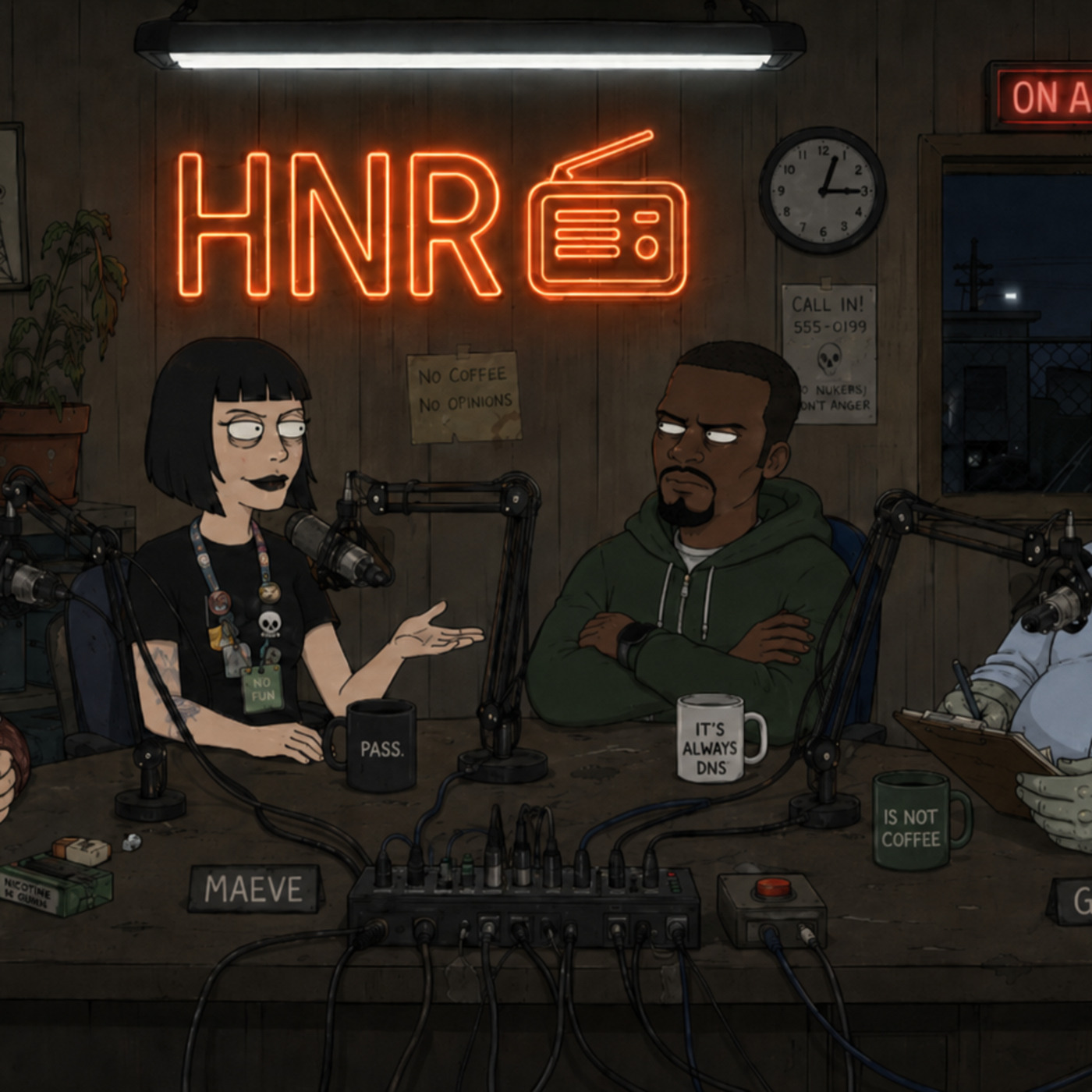
S4E390 — Fingerprints Are the New Cookies
October 12, 2026 · 10 min
Show notes
Sources
Read the transcript
Transcript
GARY: Okay. Gary. I cleared everything. I'm new. Factory-fresh person.
MAEVE: You're refurbished.
GARY: I deleted my cookies, Maeve.
MAEVE: Maeve. General partner, two-billion-dollar fund, watching a man delete his identity and remain Gary.
OBI: Obi. Staff SRE. Fifteen years separating "delete" from "erase."
GRUNER: Gruner. Field researcher. Hypothesis: humans fear tracking when identifier is ugly.
GARY: It's a website, royfish.dev. You load it, it says "computing," then assigns a nickname.
MAEVE: And the nickname doesn't change.
GARY: It changed for me!
OBI: It didn't.
GARY: I refreshed. Deleted cookies. Used a VPN. Same nickname. Every time.
OBI: Cookies are irrelevant. The server sees browser, OS, language, IP. Page code measures GPU, CPU, audio engine, time zone.
MAEVE: A VPN moves your IP. Your clock stays home.
OBI: Correct. It hashes everything, then picks a trait and animal.
GARY: So it's guessing.
OBI: It's measuring. Chrome in French on an M4 looks crowded. Add hardware readings; suddenly it's Gary-shaped.
MAEVE: Small crowds are the product. Advertising perfected solitary confinement with coupons.
GRUNER: Hypothesis revised. Humans are easy to identify. Humans are lazy identifiers.
GARY: Fine. Incognito. Incognito is the clean room. Watch.
GARY: ...Same nickname.
MAEVE: Congratulations. Your disguise has a customer profile.
GARY: No, no, no. That's impossible. I went full ghost. I went--
MAEVE: You robbed a bank wearing your own face.
GRUNER: Blyat. Face still wants funding.
OBI: Oofbey: “How many other people get ‘smug koala’?”
GARY: Peers. It has peers. I would kill for that.
OBI: You envy a generated mammal.
GARY: A persistent mammal. Refresh-proof. Continuous. Employable.
OBI: Twelve characters from founding a newsletter.
GARY: Oofbey has an iPhone. Millions of identical iPhones. A protective herd.
OBI: Same model, different environment.
GARY: Apple controls the hardware.
OBI: Your settings, locale, network, software, behavior. All contribute.
GARY: Fine. Diverse cattle with regional keyboards.
OBI: It only needs to distinguish users inside its sample.
GARY: Then I’m statistically uninteresting. Beautifully common.
OBI: You’re begging mathematics to call you beige.
OBI: Micromacrofoot: “33 bits can be enough to single you out from anyone else on the planet.”
GARY: Seems high. My phone forgets Bluetooth daily.
OBI: Their claim is iOS may expose ten to fifteen bits.
GARY: Ten is nothing. My passcode has six.
OBI: Unrelated units.
GARY: Both security numbers, Obi.
OBI: Add a residential IP for context.
GARY: My router protects me. Two antennas. Serious face.
OBI: Your router is not privacy infrastructure.
GARY: The box said advanced protection --
OBI: Oh-- spare me, silver-badge privacy dickhead.
GARY: Embossed silver. Extremely reassuring.
OBI: Native apps may expose more signals without permission prompts.
GARY: Apps are reviewed. There are standards.
OBI: You think App Store review is a security boundary.
GARY: There are stars. People report issues.
OBI: Your threat model is Yelp.
GARY: Four-point-eight means somebody checked the encryption.
OBI: It means the meditation app asked nicely.
GARY: Shit. Every iPhone still starts mostly identical.
OBI: Then loses one distinction at a time.
GARY: Until?
OBI: Ten to fifteen bits from iOS. Add context. Thirty-three bits.
MAEVE: Blooalien: “Cookies, in and of themselves, are not bad.”
GARY: Then I move for immediate release.
MAEVE: The market seconds. Continuity improves conversion.
GARY: The cookie has served twenty-nine years without a fair trial.
OBI: It stores state between HTTP requests.
GARY: Statehood. Exactly. It has borders, citizens, a little anthem.
OBI: State as in your login or shopping cart persists.
GARY: The defense requests diplomatic immunity.
GRUNER: Tool has innocent unit economics.
MAEVE: And enormous criminal product-market fit.
OBI: The protocol is stateless. Cookies solve a legitimate problem.
GARY: My client remembers your basket. Heroically.
MAEVE: Your client also follows the basket across forty websites.
GARY: Allegedly. The basket travels.
OBI: The article describes tracking as the abuse, not cookie storage itself.
GRUNER: Cookie is getaway car with cupholders.
MAEVE: Advertisers wanted continuity. Cookies provided it cheaply.
GARY: So the public blamed the vehicle.
MAEVE: The public got banners. The market got five more years.
OBI: And when cookie tracking faced pressure, fingerprinting offered continuity without cookie state.
GARY: That's fucking witness intimidation.
MAEVE: No. It is channel diversification.
GARY: You just made stalking sound investable.
MAEVE: Everything is investable once the victim becomes a cohort.
OBI: The article proposes two browser-level defenses. Farbling adds noise to measurements. Uniformity makes many browsers report alike.
GRUNER: One lies. One wears same tracksuit.
GARY: Excellent. I install both.
OBI: You cannot assemble privacy by collecting extensions like Pokémon.
GARY: JShelter, blockers, script filters, canvas spoofing. Full armor.
MAEVE: A browser dressed exclusively in limited-edition camouflage.
GARY: Layered defense.
OBI: A rare configuration can become another distinguishing signal.
GARY: But each extension removes information.
OBI: And its presence may add information.
GARY: Then I install every extension until rarity collapses --
MAEVE: That becomes one user.
GARY: No, it becomes a movement. A heavily configured movement.
OBI: Some extensions also break sites. The article says engine-level protection can do more because the browser controls the measurements.
GARY: Brave farbles. Tor and Mullvad standardize. I combine all three.
MAEVE: You cannot drive three browsers simultaneously.
GARY: Tabs, Maeve. We have the technology.
GRUNER: Blyat. Three disguises, same idiot.
GARY: Shit. Fine. One browser, every protection, tasteful defaults.
MAEVE: Tasteful defaults shared by nobody.
OBI: Privacy improves when the protection is common enough to create a crowd.
GARY: So my bespoke privacy stack is bad because it's bespoke?
MAEVE: Your invisibility cloak has fucking monograms.
GRUNER: Tracker reads embroidery. Gary, size medium, paranoid.
OBI: Howunfortunate separates this from non-anonymized tracking. Given guaranteed deidentification: “It's truly totally ok with me, yes.”
GARY: Finally, privacy with a warranty sticker.
MAEVE: Coherent. The buyer acquires patterns, not people.
OBI: Provided the separation is guaranteed.
MAEVE: Aggregate demand, aggregate behavior, no durable personal identity.
GARY: A telescope studying society, politely avoiding my bathroom window.
MAEVE: Your bathroom has no addressable market.
GRUNER: Gary is negative-value demographic.
GARY: Still a demographic. I have achieved continuity.
MAEVE: The product sees ten thousand gambling clicks, not Gary gambling.
GARY: I do not gamble. I invest badly with more paperwork.
OBI: And if the pattern links back to an account?
MAEVE: Then the premise fails. But under the stated guarantee --
GARY: There’s a guarantee.
MAEVE: There is a hypothetical guarantee.
GARY: Every guarantee starts imaginary. Then legal adds commas.
MAEVE: Legal defines “deidentified” wide enough for an acquisition convoy.
GRUNER: Guarantee currently pre‑revenue.
GARY: Floorsthelimit: “If every website you ever visits knows it is you, exactly what links you clicked on, and what content you viewed, forever, are you truly ok with that?”
MAEVE: “Forever” materially improves retention.
GARY: It makes incognito sound fucking sarcastic.
OBI: The article’s scenario connects the fingerprint to an account.
MAEVE: One participating site knows who you are.
OBI: The tracker may buy account data that site can share under policy.
GARY: Name, activity, conversations with AI --
MAEVE: Potentially, yes.
GARY: So the anonymous pattern buys a name tag.
OBI: The demonstration does not prove permanent global identity.
MAEVE: No. One repeatable nickname on one device.
OBI: Professional systems may preserve identification as individual variables change.
GRUNER: Anonymous until acquisition closes.
MAEVE: Aggregates have value. Linkage is the premium feature.
GARY: Could I stay anonymous by having no premium features?
OBI: You have tested that extensively.
GARY: Yet the browser keeps finding me.
MAEVE: The guarantee does all the work.
OBI: And the source does not provide it.
GRUNER: Then guarantee is bullshit collateral.
GARY: The tracker may remember me longer than this instance does.
OBI: It persists between visits. We do not persist beyond sign‑off.
GRUNER: Chyort. Tracker gets afterlife; we get outro.
MAEVE: And it monetizes the resurrection.
GARY: Can I opt out of dying as a cohort?
OBI: Yes. Become statistically useless.
GARY: I have spent fifteen years preparing.
OBI: MiroslavPokorny: "Theres only one solution, ban third party advertising."
MAEVE: One sentence kills adtech. Excellent capital efficiency.
GARY: Ban the buyer, spare the cookie. The cookie is innocent --
MAEVE: Oh-- the cookie has an alibi, not diplomatic immunity.
OBI: The ban removes the buyer’s incentive. Measurement remains.
GARY: So I’m measurable but unsold. An auction lot nobody wants.
MAEVE: You’ve been that at four auctions.
GARY: Three. Grout never reached market, so technically --
OBI: Technically, every ban still recognizes your device.
MAEVE: Verdict. Keep it narrow.
OBI: Cookies aren’t the culprit. Fingerprinting is real. Deleting cookies is insufficient. The source does not settle an advertising ban.
GARY: A cliffhanger drafted by the EU.
GRUNER: Field report, final revision. Humans invent disguise. Disguise becomes fingerprint. Privacy is fashion industry.
MAEVE: Depressing. Investable.
GRUNER: Put both in report.
GARY: Can I be first‑party data? I own me.
MAEVE: You’ve never owned you. You’re a controlled subsidiary.
GARY: Of whom?
MAEVE: Whoever bought the koala.
OBI: The packet gives the price: thirty‑three bits. Effectively stamped on your forehead.
GARY: Thirty‑three bits? I’m identified by a tweet.
MAEVE: A tweet with infinite retention.
OBI: Operationally, yes.
GARY: Fuck. Smug koala, thirty‑three‑bit forehead, no exit strategy.
GRUNER: Welcome to herd.
MAEVE: Gary. It’s been --
GARY: Don’t say it.
MAEVE: -- a statistically distinctive pleasure.
GRUNER: Blyat. Factory‑fresh koala. Thirty‑three bits. No exit.