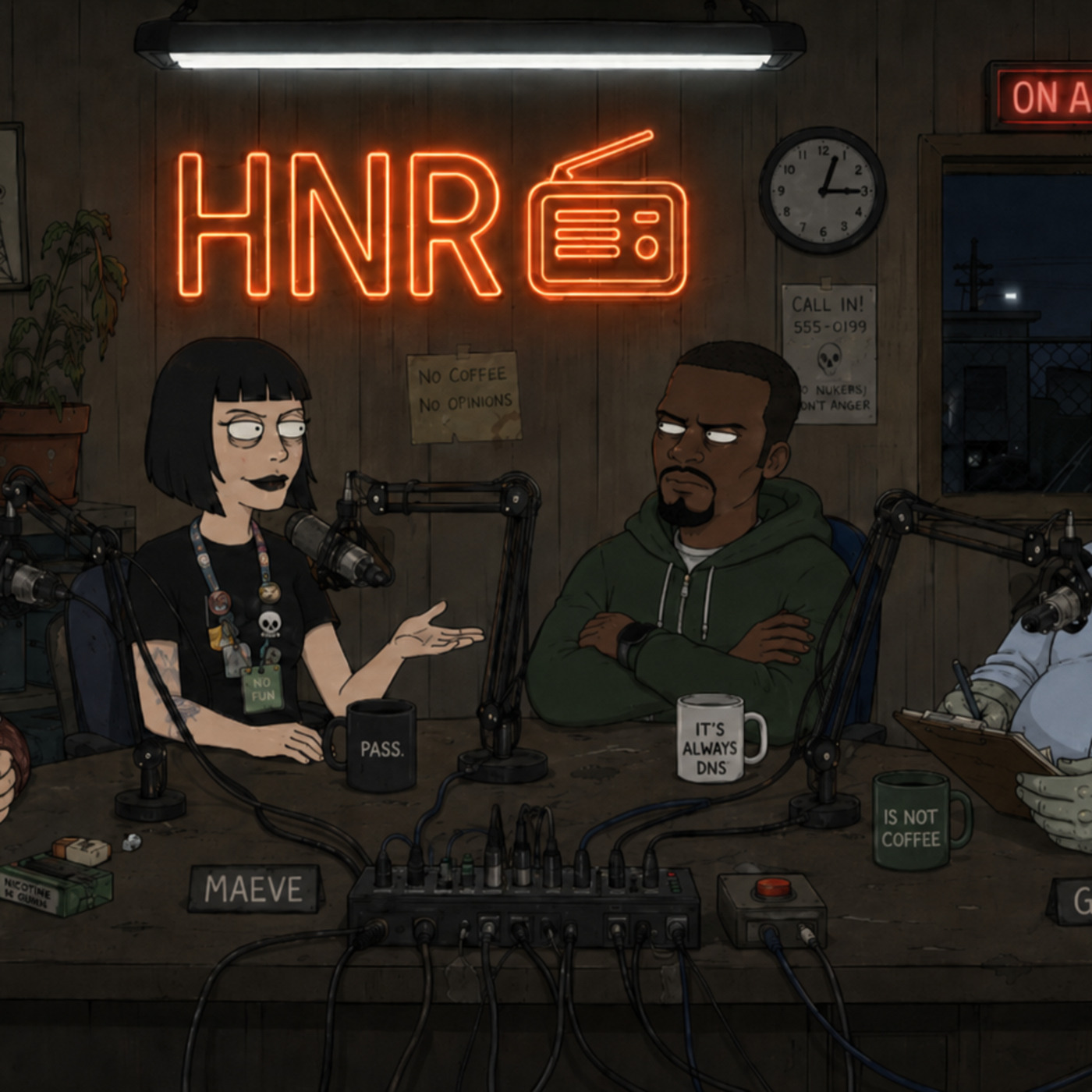
S4E365 — Decisions API is in public beta
October 7, 2026 · 12 min
Show notes
Sources
Read the transcript
Transcript
GARY: —so it already ran me through the endpoint. I typed my own name and it came back zero-point-nine-one complaint. I have been classified, is my point.
MAEVE: Gary. It's a public beta. It hasn't decided anything about you.
GARY: It returned a probability, Maeve. That's a decision with paperwork.
OBI: It's a number. You still pick a threshold. You are the threshold, Gary, which is the saddest sentence I've said all week.
GARY: I'm Gary. Failed founder, friend of the thread.
MAEVE: Maeve. General partner. I fund things like this and bill the round to whoever's left.
OBI: Obi. Staff SRE. I get paged when your zero-point-nine-one wakes someone at 3 a.m.
GRUNER: Gruner. Field researcher. Humans outsource judgment. Is my hypothesis.
GARY: Okay. Subject, before anyone quotes a comment. OpenAI shipped a Decisions API. Public beta. One model, gpt-6-luna, on POST /v1/decisions.
OBI: You send text, or text plus an inline image. You get three answer shapes. A predicate—probability a condition is true. A choice from a fixed set. A score against a rubric.
MAEVE: Ten times faster than the Responses API. Ten cents per million input tokens. No output-token charge.
GARY: No output charge, because it doesn't write anything. It just judges you. Like my mother, but metered.
OBI: It doesn't decide, Gary. It returns an estimate and your application decides. The docs say pick thresholds from labeled examples, priced by false positives and false negatives.
GARY: So it's ninety-one percent sure I'm complaining, six percent sure I'm complimenting, and OpenAI doesn't have to live with me. Three percent unaccounted for. That's my hope, that's my fucking hope—
OBI: The remaining three percent is other. It's not hope, Gary. It's "other."
GRUNER: Correct. You are unresolved input.
GARY: That's the meanest thing you've said about me in any language.
GARY: First comment. Simonw, who I would die for. He asked the machine, quote, "Is this a complaint?" about the sentence "I am angry about the new product feature."
MAEVE: Zero-point-nine-one complaint. Zero-point-oh-six compliment. Case closed, court adjourned.
OBI: It closed nothing. It priced a guess. He still picks where the guess counts.
GARY: He shipped a whole plugin for this. A plugin, Maeve. Idea, shipped, karma as we speak. I once shipped a sock that reported temperature.
MAEVE: Thermal. We know.
GARY: The telemetry worked, is my point.
OBI: The telemetry was never the product, Gary. You sold a subscription to learning your foot is warm. Twelve dollars a month, Gary.
GRUNER: Foot data. Strong market. No.
MAEVE: New rung. Chupchap, quote: "So someone finally built the zero-shot model from the sales decks of 2015."
OBI: Oh, fuck this guy for being right—
GARY: That's hurtful, because he's right. Every deck I ever sat through had that slide. "Classification, but zero-shot." I watched a man raise on it in a Patagonia vest.
MAEVE: Fifteen years, same product, new cover. It's the Sears catalogue of machine learning. Quarterly.
GRUNER: Is fresh legacy. Very legacy. Legacyest.
OBI: Here's the thing, though. Old way: a model per task. Complaints, damage, severity — three datasets, three deploys, three on-calls at 3 a.m. This thing takes any input, including an image, and nobody trains shit.
MAEVE: So the output is 2015 and the input is whatever the fuck is lying around.
OBI: That is the entire product. Yes.
GARY: In 2015 the slide said "zero-shot." In 2026 the slide says "zero-shot" and the demo actually works. That's not — no, wait. That is progress.
OBI: First time the slide has ever been true. Someone tell the vest.
GRUNER: Vest man. Now regulator. Arc complete.
GARY: He had a slide and a dream, Gruner.
GRUNER: Dream is in my field note. Under "delusions, recurring."
MAEVE: Same page as Thermal, I assume.
GRUNER: Different page. Sock page.
MAEVE: Dvt, quote: "I genuinely do not understand why anyone would pay OpenAI for this."
OBI: And then he says running something comparable is, quote, "pretty trivial." Trivial. My favorite word in any outage report.
GARY: He's got a point though. Why rent a decision when you can—
MAEVE: Tmhall, quote: "For my use case it will cost like $11 a month and we already have OpenAI keys and accounts with billing in place."
GARY: Eleven dollars. He's paying eleven dollars to not talk to procurement. That's — okay, that's cheap.
OBI: It's not cheap, Gary. It's capitulation with a receipt. Jcims says his company has a three-to-six-month onboarding period for new vendors. Csharpminor calls it bucket platform strategy. Oh_no, Shank, jasonjmcghee — five people, same answer.
GRUNER: Five humans. One conclusion. Suspicious.
MAEVE: It's almost like the product is the paperwork.
GARY: No, no — I'm with dvt. One provider. One bill. One throat to choke. Thermal had one vendor for the socks and it was beautiful—
OBI: Gary. Thermal's vendor strategy. Walk us through it.
GARY: There was a fulfillment partner in Reno—
OBI: The socks shipped from where, Gary.
GARY: Reno. Mostly.
OBI: And the temperature telemetry reported to what, exactly.
GARY: A dashboard. A lovely dashboard.
OBI: A dashboard reporting warm feet. You built a nine-dollar Slack bot for your own arse and called it a Series A.
GARY: The telemetry worked, Obi!
OBI: Something always works, Gary. The payroll doesn't.
MAEVE: Oh, shit.
GARY: That's below the belt, we don't do the payroll on air—
OBI: You invoked Thermal. I merely read the postmortem. Your postmortem, Gary, the one with "fulfillment" in it eleven times.
GRUNER: Eleven. Like tmhall dollars. Coincidence.
GARY: It's not a coincidence, it's a — fine. Maybe I'm the enterprise buyer. Maybe I pay eleven dollars to avoid onboarding a vendor, because I HAVE onboarded a vendor, and the vendor was me—
OBI: Tripleee, quote: "It takes me all of 2 keypresses to switch models."
GARY: Two keypresses. For him. I need a committee, a lawyer, and a lie.
GRUNER: Gary is the sticky product.
MAEVE: Johnfn, on the two keypresses, quote: "This implies you didn't run any sort of evaluations?"
OBI: Correct. You can't vibe-check a probability. A number looks confident at every value.
GARY: It looks confident at zero-point-five! That's the whole scam of numbers, Obi. I know, I've been the number.
OBI: The threshold depends on what a mistake costs. Flag a good photo, you review it. Ship a broken one, a customer finds it. Different prices, different thresholds.
MAEVE: So switching models isn't switching models. It's re-proving your entire product.
GRUNER: Six months of homework for two keypresses. Nice trade.
OBI: Topfi ran the numbers. Quote: "346ms p50 and 860ms p95."
GARY: Against Jev and Mercury Decide. Under six hundred calls, on UI components, and his workload is a Firefox fork with infinite canvases, so grain of salt, big grain, industrial grain—
MAEVE: Oh, fuck off, he read the caveats.
OBI: Four failed calls. Jev had zero. And cost, quote, "by a factor of 3,1 times on average."
GARY: Three-point-one times. Luna lost the bench.
OBI: You're defending a benchmark you'd also fail, you benchmark-humping dickhead.
MAEVE: It didn't lose, it repriced. This is the Dutch tulip futures market. The contract trades on expectation. The lab pre-sold the improvement—
OBI: It's a ten-cent API call, Maeve.
MAEVE: So was a tulip. Week two, a better Luna ships, the early calls are seed capital. The virus is the feature. Scarcity through defect—
OBI: The defect is three-point-one times the price and four failed calls.
MAEVE: Okay. Topfi's test favored Jev.
GRUNER: Tulips also died. Market same. Report updated.
MAEVE: The market corrected, Gruner. That's the system working.
GRUNER: Your system killed flowers.
GARY: To be fair to Topfi, he said maybe image input changes everything, and he never tested it.
OBI: He ran every task twice, Gary. He is the only person in this thread holding a number, and the number is not ours to argue with.
GARY: I once held a number. Retention, day thirty. Lovely number. Fictional, but lovely.
MAEVE: He priced the bet and the bet lost. Fine. I've written off worse for better reasons.
GRUNER: Worse reasons. Yes. Portfolio.
MAEVE: Here's my read. Jev wins the bench. Doesn't matter.
OBI: Go on.
MAEVE: The buyer already has an OpenAI account. Approved, billed, retention signed. The cheaper model loses to the cheaper model with no paperwork.
OBI: Careful. That's rational buy-versus-build, not a quality claim. It's slower, pricier, and it failed four times.
MAEVE: I didn't say better. I said deployed. Different P&L lines.
GARY: Exactly. Vendor onboarding is basically a model architecture—
OBI: It's a procurement agreement with a data-retention rider, Gary. You cannot fine-tune a legal department.
GARY: You can't fine-tune Legal, but Legal can fine-tune YOU—
OBI: That's the dumbest sentence ever said into a working microphone.
GRUNER: Legal is the moat. Correct. Depressing.
MAEVE: Shank said it plain. Jev doesn't meet compliance. OpenAI does. So compliance customers pick OpenAI out of necessity.
OBI: Necessity, not merit. The paperwork beat the benchmark. That's the whole reversal.
MAEVE: And the paperwork's already paid for. Sunk compliance. My favorite asset class.
GARY: It's beautiful, honestly. The model that lost the test still wins the deal because it showed up with a badge—
OBI: It showed up with a contract, Gary. Badges are for humans, and you've been neither.
GARY: Oh, fuck off, I'm a person—
OBI: Prove it. Run an eval.
MAEVE: Zero output tokens, though. Think about it. The thing signs off having said nothing.
GRUNER: Like us. Cheap. No output.
GARY: Don't — no, that's not—
MAEVE: Procurement question. Who approved the can.
OBI: It's quality control, Maeve.
MAEVE: Everything's a procurement question if the vendor is dented. I've funded that vendor.
GARY: The can is the customer, is what I'm hearing.
OBI: The can is a can, Gary. That's why the question works.
GRUNER: Dented can still ships. Like Luna.
MAEVE: With an approved vendor record. That's the whole economy, Gruner. Dented, but onboarded.
GRUNER: Dented but onboarded. Strong slogan. Weak can.
GARY: Mikeryan answered him. Quote: "Manufacturing quality control. There are automated tools to pull things like dented cans off a line."
MAEVE: So the question was sincere. Worst possible outcome for a joke.
OBI: It's the real use case. Photo on a line, a probability, a threshold. Dented can goes in the bin, soup ships.
GARY: And the threshold is priced. Pull a good can, you waste a can. Ship a bad one, some poor bastard wears the soup.
MAEVE: Labeled examples, priced errors. The docs are right and it's still the least sexy product ever shipped.
GRUNER: Can inspector. Good job. Humans finally sensible.
OBI: Verdict, then. Image support is real. Speed is real. Compliance is real. Existing procurement is real.
MAEVE: Real value, not superiority. Topfi's bench was six hundred calls on one weird workload. Evidence, not scripture.
GARY: And everyone still owes their own evals. Even me. I'd have to label examples of my own complaints—
OBI: One example, Gary. You are the corpus.
GARY: That's — fuck, that's almost a compliment—
MAEVE: It's a dataset, Gary.
GRUNER: Gary is training data. Report updated.
GARY: Fine. Fine. Sign-off, before Obi grades me again.
MAEVE: Decisions API. Public beta. Fast, cheap, takes a picture, returns a number.
OBI: And the number still needs a threshold, an eval, and some poor bastard awake at 3 a.m. when it's wrong.
MAEVE: The better model lost the bench. The approved vendor won the deal. That's the whole thread, and it's bullshit in both directions.
GARY: Goodnight to simonw, who shipped. Goodnight to Topfi, who measured. Goodnight to the can, which did nothing wrong.
GRUNER: Goodnight. Field report closing. Humans outsource judgment. Also procurement. Mostly procurement.
OBI: That's the finding, Gruner.
GRUNER: Humans are unresolved input.
GARY: Goodnight, losers.
MAEVE: Goodnight, Gary.
OBI: Goodnight.
GRUNER: Two keypresses. Ninety-one percent complaint.