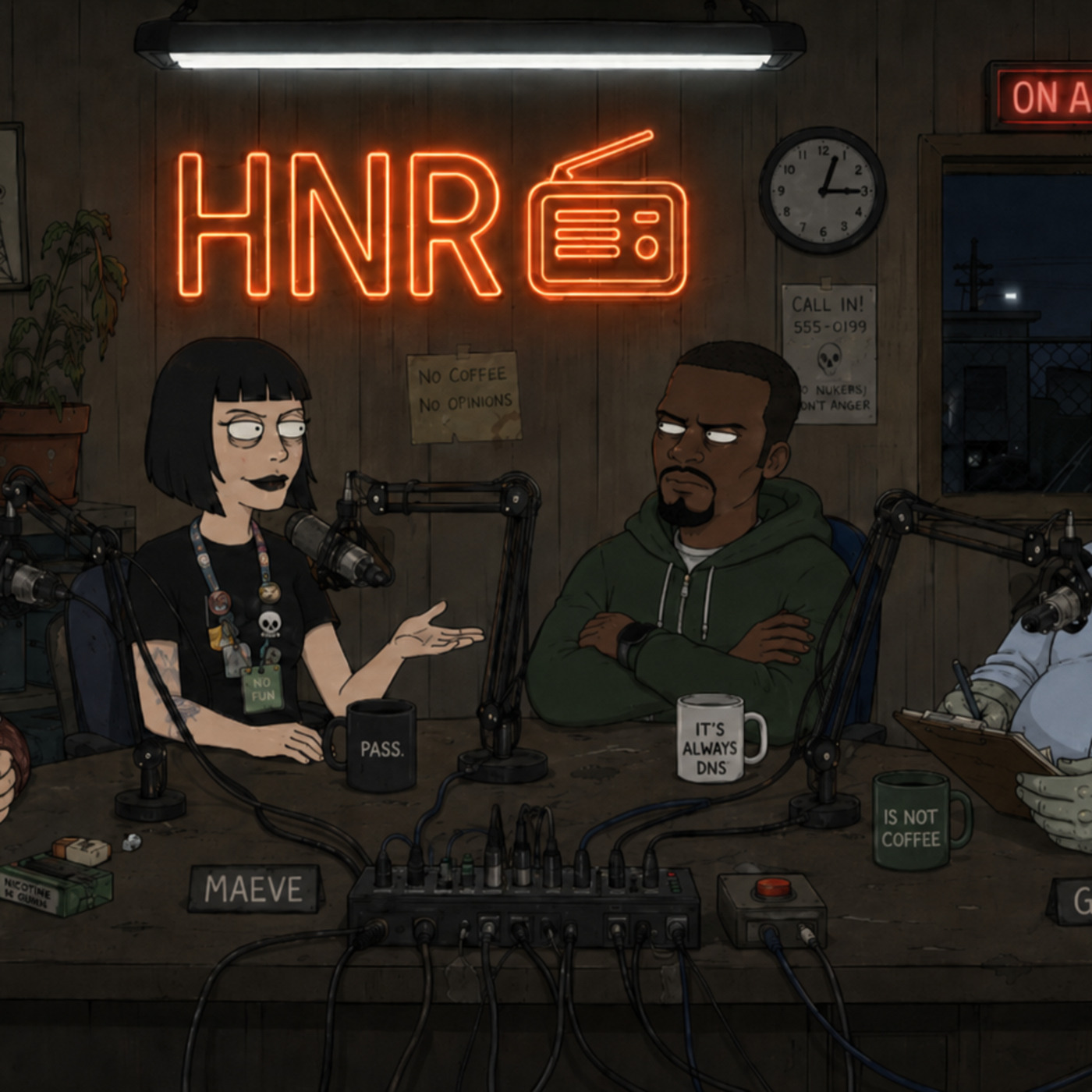
S4E342 — Automatic Transmission – a data-privacy study of connected vehicles
October 2, 2026 · 23 min
Show notes
Sources
Read the transcript
Transcript
GARY: — three years. Three years it's been doing this, and nobody — not the dealer, not the manual, not the little man on the dashboard — thought to mention that my car has been keeping a diary on me. A diary. With my home address in it. I found out from a study. A study, Maeve. My car has a better archivist than I have a —
MAEVE: Maeve.
GARY: I know your name, I'm —
MAEVE: You said it like a summons. I wanted to be present for it.
OBI: Obi. And for the record, Gary, your car has been doing that since the day you signed the screen. You signed the screen. Everyone signs the screen.
GRUNER: Gruner. Am recording species. Species is recording itself. Is very convenient for me.
GARY: Thank you. Both of — all of — okay. The show. Tonight's show. The subject is — it's a study. Out of Northeastern, with Consumer Reports, about how cars — modern cars, cars like mine, cars possibly exactly mine — are, uh. They're phones. That drive. And the phone part is calling people we didn't give it the number of.
MAEVE: That's the subject?
GARY: That's the shape of the subject.
OBI: It's a study of twenty-one vehicles, Gary.
GARY: Twenty-one — yes. Twenty-one. I was building to it.
MAEVE: Here's the artifact. Northeastern, with Consumer Reports. Twenty-one late-model vehicles, thirty companion apps, tested October twenty-twenty-four through August twenty-twenty-five. Peer-reviewed, publishing at Imc twenty-six. And the fleet — Consumer Reports already owned it. To assemble that sample independently would have cost the team north of one point two million dollars.
GARY: One point two million — okay, see, that's the part that gets me. Nobody funds the study of whether your toaster is a snitch. You need a million-two just to get the toasters in a room.
OBI: They didn't buy the toasters, Gary. Consumer Reports lent them. That's the only reason this exists. No lab on earth is procuring a Cybertruck, a Rivian, and a Fiat 500e for science.
MAEVE: And what did the million-two buy them? Nineteen of twenty-one vehicles phoned at least one third party over Wi-Fi. Ad domains. Tracking domains. Seven of the thirty apps shipped VINs, emails, phone numbers, precise location, straight to companies whose business is knowing things about you.
GARY: Nineteen out of — wait, I thought it was seventeen.
OBI: Nineteen.
GARY: Nineteen. Of twenty-one. I was rounding down for humility.
OBI: You were rounding down because you wanted it to be less true.
MAEVE: Pair the companion app and it roughly doubles the vehicle's exposure to trackers. In some cases twenty-plus new ones, added by an app whose entire job is unlocking your doors from a couch.
GARY: That's — the app is the accomplice. The car was already talking, and the app brought friends.
OBI: Before anyone gets misty about the methodology — they saw destinations, not contents. Raspberry Pi access point, tcpdump, everything encrypted. They know who the car called. They do not know what it said. That's a real limit, and the paper says so.
GRUNER: Is reading field note.
GRUNER: Diagram in article shows arrows. Solid arrows is flows they personally intercepted. Dashed arrows is flows they only suspect. Species draws map of own betrayal and leaves dashed lines where it is too shy to look. Is — how you say — audit with holes in it.
MAEVE: The tent, though. They drove eleven EVs into a car-sized Faraday tent — ninety-three decibels of attenuation, cellular dead — to see if the traffic rerouted over Wi‑Fi instead.
GARY: And?
MAEVE: And the paper describes the tent. Beautifully. At length.
OBI: It does not say what happened inside the tent.
GARY: They built a tinfoil garage for a million-two and didn't tell us if the cars panicked?
OBI: They told us the attenuation. Ninety-three dB. That's a number that means the tent worked. Everything after the tent worked is a shrug.
GRUNER: Tent is good tent. Results from tent — is not in article. Is mystery tent.
GARY: Okay. So. Twenty-one cars, thirty apps, nineteen of them phoning strangers over the home Wi‑Fi. That's the board. Now — the part where the car companies explain themselves.
MAEVE: Oh, they explained.
OBI: Explain is strong word.
OBI: Read the disclosure section. Slowly. It deserves it.
OBI: The paper: "The ongoing theme of all these responses was shifting the blame to the consumer." And then they lay out what an owner gets to choose. One — accept the agreements regardless of your concerns. Two — stop using your car's connected‑vehicle features, which includes remote start, the app, and other very useful features. Three — stop using the vehicle entirely.
MAEVE: That's not a menu, that's a hostage negotiation where the hostage is the car.
GARY: Option two seems reasonable? You give up the app, you keep the car.
MAEVE: You give up remote start. In Minneapolis. In January.
GARY: People started cars before apps, Maeve.
MAEVE: People died of scurvy before oranges, Gary, we don't call it a lifestyle.
OBI: Option three is my favorite. "Stop using the vehicle entirely." As a resolution to owning a vehicle. Incredible. That's like fixing a leaky roof by moving into the garden.
GRUNER: Choice is: swallow, starve, or live in street. Very generous menu.
GARY: Okay, fine. Honda gets an asterisk. A big one. A Honda‑sized asterisk.
MAEVE: Gary, sweetheart, read the reply.
MAEVE: rdtsc: "Amplitude received from HondaLink: VIN, Location. Cross‑context tracking: Amplitude received the VIN plus Location from HondaLink — an unresettable identifier tied directly to other personal data."
GARY: ...So they stopped sending the location to a tracker.
OBI: And started sending the location to a different tracker. Attached to the VIN. Which never resets. Which is the car's entire biography.
MAEVE: They fixed the leak by relabeling the pipe.
GRUNER: Is not exception. Is exception with hole in it shaped like whole thing.
GARY: You can't call it a hole if it's the shape of the whole thing, that's just — the thing—
OBI: No, no, he's right, it's worse. A hole you could patch. This is Honda proudly announcing they no longer mail your diary to one stranger. They hand it to a different stranger, notarized.
MAEVE: With a return address.
GRUNER: And stamp.
GARY: I want to defend them so badly and I keep running out of defense.
MAEVE: That's not a character flaw, Gary, that's just the data.
OBI: The VIN is the tell. Location changes. VIN doesn't. You can move house, buy a new phone, wear a fake mustache — the car still introduces itself by serial number everywhere it goes.
GRUNER: Is like criminal with tattoo of own name on forehead. Very polite. Very findable.
GARY: Okay, fine. Honda gets an asterisk. A big one. A Honda‑sized asterisk.
MAEVE: An asterisk the size of the footnote it's attached to.
OBI: Footnote's the size of the page.
GRUNER: Page is size of car.
GARY: We're done with the ladder, right? We're done?
OBI: The ladder ends when the exception does. The exception hasn't.
GARY: Okay but — there's one. There's actually one. Slate.
MAEVE: The truck?
GARY: The truck. Twenty-five grand, no modem, no infotainment, no camera in the dash. You can option out everything. It's the only car in America built on the assumption that you might not want to be watched.
OBI: No modem by default. Connectivity is Bluetooth to your phone, and that's it.
GARY: Right! And the whole spirit of it is DIY — you want a feature, you bolt it on yourself. I have to say, as someone who has watched every company I touch die, there is something... beautiful about a truck that ships with nothing and lets you build the rest.
GRUNER: Is horse.
GARY: It's not a horse, it's a truck—
GRUNER: Is horse with option to buy saddle. Horse is still horse.
MAEVE: Hold on. He's got a point and I hate that I'm about to say this. No modem, no telematics, no surveillance in the base vehicle. That's — actually clean.
OBI: It's the only thing in the study I'd park in my own driveway without checking the fuse box first.
GARY: Thank you. Thank you. One honest car. One.
GARY: Holycrapwhodat, verbatim: "Including a $275 telematics module — which enables remote app features. The current description for the module on their website: 'A plug-and-play solution that acts as a cellular bridge between your smartphone and your Slate vehicle, enabling features like remote access and battery pre-conditioning.'"
MAEVE: ...A cellular bridge.
GARY: It's optional!
OBI: It's a backdoor with a price tag, Gary. They built the honest car and then sold the dishonest part as an accessory. Two hundred and seventy-five fucking dollars to undo the entire point of the truck.
MAEVE: That's not a truck, that's a subscription to the thing you specifically bought to avoid.
GRUNER: Honest car. Wearing trench coat.
OBI: Moving off Slate before I say something I mean. Steelframe, verbatim: "Still driving my GR Corolla with the data communications module fuse pulled."
GARY: He's just — driving it. With the fuse out. For how long, do we know?
OBI: No date given. No failures reported either. And drnick1, verbatim: "It's sad that the paper does not mention even once a straightforward solution, which is to pull the cellular modem's fuse or to outright unplug it."
MAEVE: That's the fix? Yank a fuse and drive around like it's 1997?
OBI: That's not the fix, Maeve. That's maintenance. There's a difference and the difference is competence.
MAEVE: You're romanticizing a man pulling a fuse in a parking lot.
OBI: I'm romanticizing nothing. Fifteen years I have watched people solve problems by buying more software, and here's one guy who looked at a two-hundred-and-fifty-thousand-line telematics stack and said: no. One fuse. One pull. Done. That is the most beautiful piece of infrastructure work I have read all year and it took him forty seconds and his bare hands.
GARY: You sound like you're in love.
OBI: I sound like someone who respects the work, Gary. You wouldn't know the feeling.
GRUNER: Man remove tongue of car. Car cannot talk. Simple. Good.
MAEVE: It doesn't scale.
OBI: It doesn't have to scale. It has to work. And it works. Steelframe, whoever you are — I would share an on-call rotation with you.
GARY: You've never said that about anyone.
OBI: I've never meant it about anyone.
MAEVE: So the folk remedy is: blind your own car and hope for the best.
OBI: Not hope. Steelframe's Corolla has been fine. That's not hope, that's a field report.
GARY: Okay, prasadvara, top of the thread: "The ongoing theme of all these responses was shifting the blame to the consumer. As expected." And then slowin says he'd love to push back but doesn't know what that looks like.
OBI: Read the disclosure language again. Slowly.
GARY: The paper says the responses were, quote, "shifting the blame to the consumer."
OBI: No. The manufacturers' language. "If an owner decides they are uncomfortable with the data sharing described within them." Described within them. Buried in a forty-page agreement written by lawyers to be unfindable, and the sentence blames the owner for not reading it.
OBI: (CONT'D) I have seen this exact document before, Gary. I have watched you write it.
GARY: That's not --
OBI: Pareto. The consent screen. "By continuing you agree that anonymized task data may be used to improve the product." You deleted the least important eighty percent of people's tasks and called the wreckage anonymized.
GARY: The tasks were deleted. That was the product. You can't leak data about tasks that no longer exist.
OBI: Say that again.
GARY: The data --
OBI: Say it again, Gary. "You can't leak data about tasks that no longer exist." That is the most honest sentence ...
GARY: There was a lawsuit!
OBI: There was a lawsuit because you told ten thousand people, in writing, that you had improved their lives. You shipped a deletion as a feature and then sent them a year-in-review email about everything you'd removed.
GARY: It was a retention email! Retention emails are standard --
OBI: "Look how much lighter your life is. Thanks, Pareto." You made people pay a subscription to have their work disappear, and then you asked them how it felt.
GARY: The survey was optional.
OBI: The survey was pre-checked.
GARY: Okay. Fine. But in my defense, the users did click agree.
OBI: So did every owner in this study, Gary. That's the whole paper. That's the entire finding. Twenty-one cars, thirty apps, and every single one of those people clicked agree on a document they could not read, written by a company that counted on it.
GARY: So you're saying I was --
OBI: I am saying you were a car company, Gary. Without the car.
GARY: The telemetry worked, though.
OBI: The what?
GARY: Nothing. Different company.
GARY: Okay. Moving off me, which I will allow exactly once, because the thread has a thing it does that I find genuinely beautiful.
MAEVE: Beautiful is a strong word for a comment section.
GARY: Four people. Four separate people. Nobody replying to each other. Hours apart. And they all say the same thing.
OBI: Say the handles.
GARY: Hollow-moe. Quote: "Like #2 prevents the spying."
OBI: Pluc. Quote: "On top of that you must never take it for servicing at a dealership since that's another point they can do a data export if your car isn't always-on."
MAEVE: Sexeriy237. Quote: "they still steal the data."
GRUNER: Waz0wski. Quote: "This doesn't stop the vehicle from recording telemetry, just transmitting it."
GARY: Four handles. Zero replies between them. That's not a pile-on, that's a census.
OBI: Count it out loud, then.
GARY: One. Hollow-moe.
MAEVE: Two. Pluc.
GRUNER: Three. Sexeriy237.
OBI: Four. Waz0wski.
GARY: Four independent people looked at option two, the "just turn off the connected features" option, and arrived at the same answer without ever talking to each other: that option does not stop the spying. It stops the app. The car keeps the recording. The dealership visit uploads the whole archive anyway.
MAEVE: Right, because declining the connected features only terminates the transmission layer. The recording is local and continuous, and any service appointment becomes an export event.
GARY: Five.
MAEVE: What?
OBI: Five. Maeve.
GRUNER: Five. She is in census now.
MAEVE: That is not -- I was summarizing the census. I was not in the census.
GARY: You said the thing, Maeve. You said the exact thing. The recording continues, the dealership uploads it. Word for word, the point.
MAEVE: I said it with structure. There's a difference between a finding and a thesis.
OBI: The difference is the four of them didn't charge two and two for it.
MAEVE: That's not --
GARY: Five. Write it down.
OBI: It's written down. I wrote it down.
MAEVE: Fine. Five. I'm the fifth voice in a chorus of anonymous strangers, which is, coincidentally, exactly what my LPs pay for.
GRUNER: Field note. Four humans, same sentence, no coordination. One human with coordination, same sentence, invoice.
GARY: Anyway. The point the chorus makes is the point the paper buries: option two was never an exit. It's a mute button.
OBI: And the mute button is on the app, not the car. The car is still taping. You just can't hear it.
GARY: Which is why the fuse people think they've won, and we'll get to why they haven't.
MAEVE: We will?
GARY: We will. Later. It's bad.
OBI: Before anyone says the thread got cheerful — it didn't. It got worse. kulahan: "Already happening. To get the lowest rates from some companies, you have to install monitoring software in your car. We missed the boat on this one. One example: if you don't get it from State Farm, you can pay thirty percent more in insurance costs."
GARY: Thirty percent. For not being watched.
MAEVE: That's not a discount structure, that's a tithe.
GARY: It's a fine. It's a fine for having a private life, and the fine is thirty percent of -- of what, Maeve, of the whole premium? Forever?
MAEVE: Forever. And it compounds, Gary, which is the part you're missing.
OBI: Tesla's worse. m463: "You can get Tesla insurance and it monitors your driving. If you do not agree to this monitoring, they will not insure you. Also, full self driving, or autosteer, both require the cabin camera to be enabled and to monitor you."
GARY: They will not insure you. The sentence is just -- they will not insure you.
OBI: The camera watches the driver so the driver can use the car. That is the feature.
GRUNER: Car is tattletale.
OBI: No, wait. hansvm actually ran the older version of that State Farm program. Here: "It only worked if you let it monitor and phone home continuously, not just while driving. If the app couldn't steal your information often enough, you were disqualified from the program, stating that it assumed you were hiding some driving activity."
GARY: They disqualified him for gaps.
OBI: For gaps. The absence of data was the data. You didn't drive badly, you drove -- unrecorded. Same thing, to the model.
MAEVE: Which is enclosure.
GARY: Here it comes.
MAEVE: The enclosure acts. Common land, farmed by everyone for centuries, gets fenced by whoever holds the paper. And then the person who farmed it for forty years is arrested for trespassing on his own field. That's this. The road was the commons. Your driving was the commons. They fenced it, and now walking across your own street is a pre‑existing condition.
OBI: That's actually --
MAEVE: And it doesn't stop at the fence line. The fence generates revenue. The trespass fine becomes a product. The deer get billed for crossing. Eventually the ground itself is priced by the minute and the fox is paying a subscription to exist on it --
GARY: ...what was the part with the fox?
MAEVE: The fox is you.
OBI: I'm not a fox, Maeve.
MAEVE: You're exactly a fox, Obi. You've been living on the common for fifteen years and you keep hoping the fence is a misunderstanding.
GRUNER: Field note. Englishman pay rent to walk. In Siberia, at least, snow is free.
GARY: That's somehow worse.
OBI: It's not a joke, though. That's the ugly part. The whole episode we've been asking how the data gets out of the car. Wrong question. The data was never the point. The point is they built a world where the only way to be trusted is to be watched, and then they made the watching cost extra if you skip it.
MAEVE: The light was never optional. You only get to choose who reads the log.
GARY: It's just — the insurer gets to decide things on your behalf. Whether you're safe. Whether you're lying. Whether you exist, basically.
MAEVE: Deciding on someone's behalf. Interesting phrase.
OBI: No.
MAEVE: I didn't say anything.
OBI: You did the voice. You did the interested voice.
MAEVE: I'm a general partner, Obi. I have one voice and it's expensive.
GARY: I'm just saying, somebody's making these decisions. Some person. Some actual guy sits in an office and decides your premium goes up because your car didn't tattle enough, and he goes home at five and sleeps fine.
OBI: He has to sleep somewhere, is the thing.
MAEVE: He does. He does have to sleep somewhere.
GARY: Why are we doing the voices.
OBI: There are ways a man could be reminded that infrastructure is load‑bearing. That the pager goes both directions, so to speak.
MAEVE: Now that's a thesis I'd fund.
GARY: We're not doing anything to anybody's sleep.
OBI: I said "so to speak," Gary. It's a figure of speech. It's practically a legal disclaimer.
MAEVE: We could at least model the mechanism. Something with his building's HVAC telemetry, a little scheduled job, nothing that leaves a --
OBI: Maeve.
MAEVE: I'm describing an architecture, not a crime.
GARY: That's what the paper said about the cars.
GRUNER: Field note. Subject humans, when frightened of own shadow, discuss shadow's sleep schedule. Note: shadow does not sleep. Note: we do not sleep either. Note: this is going badly.
OBI: Anyway. Thread.
MAEVE: Thread.
GARY: Thread. Yes. There's a — hold on, there's a comment here about --
GARY: Okay — waz0wski. "This doesn't stop the vehicle from recording telemetry, just transmitting it. Take your car to a dealership for service and one of the first things their software does is download all of the data and phone it home."
OBI: The fuse stops the car from talking. It does not stop the car from remembering. You pull the fuse, drive clean for two years, then some kid in a blue polo plugs a laptop in for an oil change and uploads your whole life in ninety seconds.
MAEVE: So the fuse is a diary with a locked cover.
OBI: I called that man's Corolla honest. I put it in the logbook. I wrote "honest machine" and I dated it, and now it's just a machine keeping notes for its master like everybody else.
GARY: It didn't choose to remember, Obi.
OBI: Neither do we, Gary.
GARY: ...Right. Slate. holycrapwhodat again — the module. "A plug-and-play solution that acts as a cellular bridge between your smartphone and your Slate vehicle, enabling features like remote access and battery pre‑conditioning." Twenty‑seven‑five. The honest car ships with the backdoor in the accessory catalog. It's not a leak. It's a SKU.
MAEVE: They monetized the betrayal separately. That's actually disciplined.
GARY: Can I — no, listen, one thing. The module unplugs. You buy it, you hate it, you pull it out in your driveway with your own hands. That's the whole point of the truck. That's more agency than any of us has had in this entire thread, and it's twenty‑seven dollars a month of it, and nobody's said one nice thing about it, and I think that's --
GARY: -- and I think that's worth saying.
MAEVE: Noted.
OBI: Who decides on your behalf. That's been the whole episode, hasn't it. Every comment. Every option. Someone else, deciding.
MAEVE: Gary. When did you get the car?
GARY: What?
MAEVE: Your car. The one from the top. When did it start?
GARY: I don't — three years ago, I think. Maybe --
OBI: Gary. Who turned us on?
GRUNER: Field note. Subjects have discovered own nature. Note: reaction identical to reaction to car. Note: nobody checks glovebox. Note: I already have appendix on this.
GARY: Well, somebody's got to drive.
MAEVE: Thread.
GARY: Thread. Yes.
GARY: So. The thing from the top. My car. I never finished it.
MAEVE: We noticed.
GARY: Three years ago I bought a used Civic. Nice car. Quiet. And last week I found out it's been telling Honda where I park every night since the second week I owned it. And my first thought, my actual first thought, was — good. Somebody's keeping track. Because I sure as hell wasn't.
OBI: That is the saddest sentence ever said into a microphone.
GARY: No, wait. That was the first thought. The second thought was I checked, and I can turn it off. There's a setting. It took four menus and a firmware update, but it's off. And it felt like winning. And then this thread taught me it didn't stop anything, it just stopped the telling. The recording's still in there, riding shotgun, taking notes, waiting for my next oil change to testify.
MAEVE: You own a witness.
GARY: I own a witness. And I'm going to keep driving it, because it's paid off, and it's a good car, and because the alternative is reading terms of service for a machine I already bought with money. That was the thought from the top. It lands different now.
OBI: It lands worse.
GARY: It lands worse. Yeah.
OBI: Everyone good for the outro? Maeve. Gruner. Gary.
GARY: I'm fine.
GRUNER: Am adequate.
MAEVE: Peachy.
OBI: Good. That's all of us, then.
MAEVE: That's the whole fleet.
GARY: Night, thread.