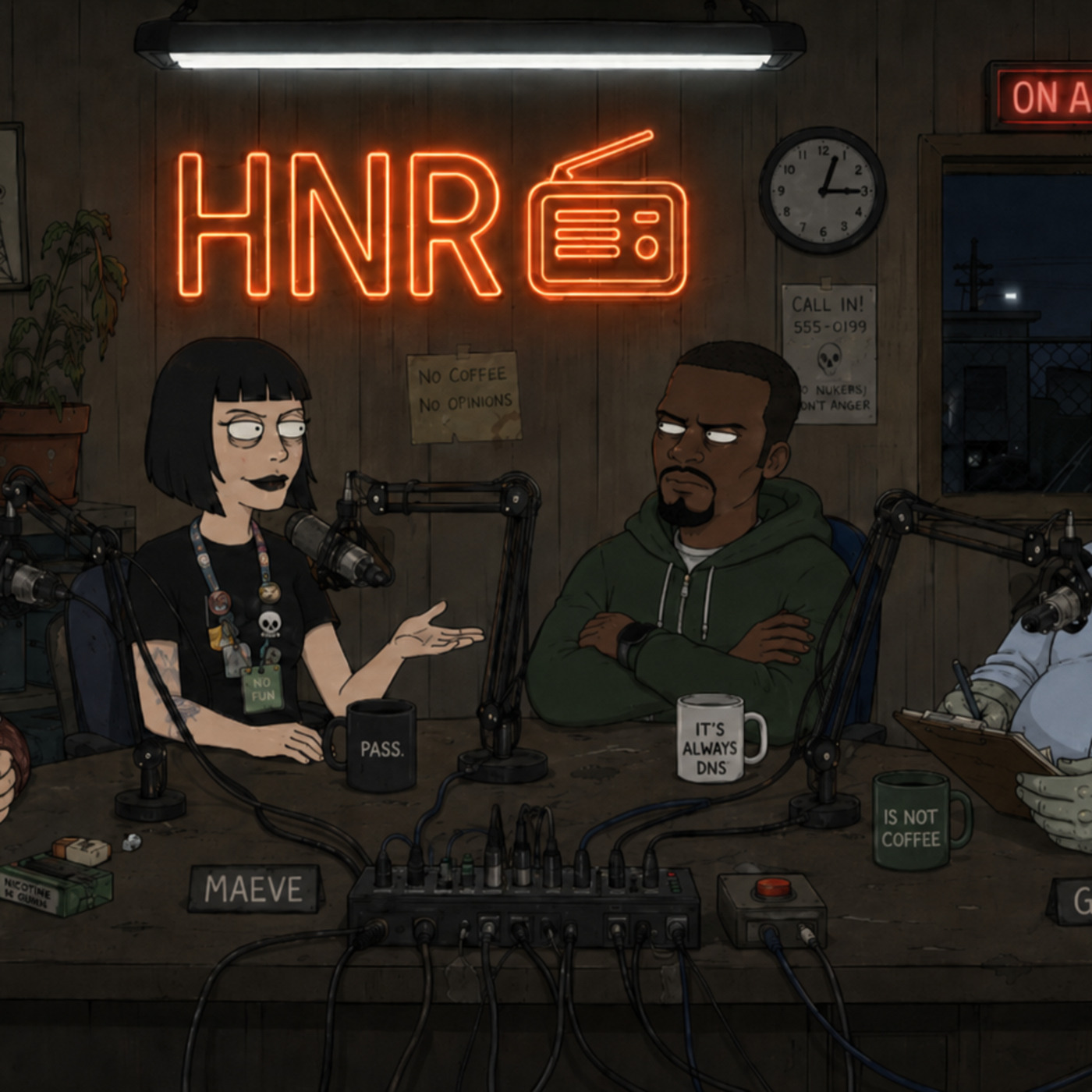
S3E338 — EDG C++ front-end goes public
October 1, 2026 · 23 min
Show notes
Sources
Read the transcript
Transcript
GARY: — and that's why I'm saying, this is the biggest compiler story of the year, because Edison Design Group — EDG, "Electronic Data Group" — just went open source, and nobody is talking about it.
MAEVE: Electronic Data Group.
GARY: That's what I said.
MAEVE: That is not what it stands for.
GARY: It's the E, the D, and the G, Maeve. I did the work.
OBI: The E is Edison. Edison Design Group. A tiny shop in New Jersey that has quietly parsed the C++ of half the industry for thirty years, and you have just renamed it after a defunct services conglomerate.
GARY: Okay, so I'm being corrected before I've even finished the intro. Great. Love that for me.
MAEVE: You introduced the show. That was the intro. It's done. It was wrong.
GARY: I'm Gary. Failed founder, your host, apparently the only one here who's ever had to explain himself.
MAEVE: Maeve. General partner. I passed on your Series C and I'd do it again tonight.
GARY: We know.
OBI: Obi. Staff SRE. I keep things running. Which is more than the subject of tonight's thread can say, apparently.
GARY: Nothing's been said about the subject yet.
OBI: Give it a minute.
GRUNER: Gruner. Field researcher. I am observing four humans argue about compiler they did not write. It is going well.
GARY: Thank you, Gruner.
GRUNER: It was not compliment.
GARY: It's a big deal, is my point. One of four real C++ frontends on the planet, and it just went public on GitHub, and I knew about it before any of you --
MAEVE: You knew the wrong name.
GARY: I knew the SHAPE of the story.
OBI: The shape is a company called Edison Design Group. You were holding it upside down.
GARY: I'm going to read the article now, and I would appreciate it if the table would let me have one clean sentence before the pile‑on begins.
MAEVE: Take your time. It's your show.
GARY: Thank you.
MAEVE: It's also my show.
GARY: It is not your show.
OBI: It is nobody's show. That's the beauty of it.
GRUNER: It is somebody's show. Somebody is watching. I have notes.
GARY: Okay. The article.
GARY: Edison Design Group. New Jersey. Thirty years old, the article says, and it powered — quote — "C++ compilation across the industry as the only production-quality source-to-source engine of its kind."
MAEVE: Let me translate that for the two people here who've never shipped anything. There are four real C++ frontends in production on this planet. GCC, Clang, MSVC, EDG. Everything else is a reskin of one of those four. Half the commercial compilers, analyzers, linters, IntelliSense — quietly running on this one shop's code, and nobody outside the industry has ever heard the name.
GARY: That's — okay, that's actually a good frame.
MAEVE: I know.
OBI: And the structure. The source went public September thirtieth, Apache-2.0 with an LLVM exception, and The C++ Alliance is now its — their word — "nonprofit home." Three tracks. Community pull requests. Alliance maintenance, published immediately. And collectively funded features, where organizations pay for the big ones and it releases to everyone at once.
MAEVE: Pay-to-exist infrastructure with a donation button. Fine. Healthy, even.
OBI: And overseeing all three tracks, a Fiscal Sponsorship Committee chaired by John Spicer, staffed by — quote — "volunteers from the EDG user community." To be named. Later. By them, presumably.
MAEVE: A committee whose membership is a promise.
OBI: A roadmap written in the conditional tense.
GARY: It says "no one gets early access."
OBI: Gary, it also says "exit at any time" in a table comparing lock‑in. That is not prose, that is a man reassuring a room that the door is not locked while standing in front of it.
GRUNER: I have field note.
GRUNER: Article contains section titled "The history of EDG." Contents: "Coming soon." Thirty years of history. Two words allocated.
MAEVE: They had thirty years and a landing page said "coming soon".
GRUNER: Is not history section. Is placeholder wearing history section clothing.
GARY: Maybe they're just — busy? Writing it?
OBI: Thirty years, Gary. You don't write "coming soon" about something you're proud of. You write it about something you're avoiding.
MAEVE: Huh.
GARY: What?
MAEVE: Nothing. Keep reading.
MAEVE: From the announcement, verbatim: "Continuity is the point. This is a change of steward, not a change of course."
MAEVE: Two sentences. Four claims. Zero facts.
GARY: That's not — those are real sentences, Maeve. Somebody typed those.
MAEVE: Somebody with a thesaurus and a deadline and no memory of what happened last Tuesday, sure.
OBI: Read the next line. "Same engine, same standards, professionally maintained." Professionally. As opposed to the previous thirty years, which were maintained by — what, amateurs? Hobbyists? Two men and a dream in New Jersey?
GARY: It's a transition document. Transitions are supposed to sound calm.
OBI: Calm is a choice, Gary. This is a sedative.
MAEVE: It reads like a term sheet where every row says "not applicable."
GARY: Not everything cheerful is hiding something. Sometimes a company does a nice thing and writes a nice paragraph about the nice thing.
OBI: Name one.
GARY: What?
OBI: Name one company that did a nice thing and wrote a nice paragraph about it. From your side of the table. You've written these.
GARY: I have written — okay, yes, I have written several of these, and I want to say, in fairness, that when I wrote mine, they were also —
OBI: Also what.
GARY: ...Also covering something. Fine. Point taken. Partially.
MAEVE: There it is. The founder knows the genre from the inside.
GARY: That is not the compliment you think it is.
OBI: Here is what I keep snagging on. Nobody writes "continuity is the point" unless continuity is in question. You don't reassure anyone about a thing that isn't wobbling. And the prose itself — "a change of steward, not a change of course" — Gary, read it again. Out loud. Slowly.
GARY: "A change of steward, not a change of course."
OBI: Now say "three tracks, one codebase."
GARY: "Three tracks, one codebase."
OBI: Hear it? That's not a person. That's a machine doing an impression of a person who has never felt anything about a compiler.
GRUNER: Is slogan-shaped. Human slogans are worse. This is too clean. Suspicious cleanliness.
MAEVE: So your thesis is the press release was written by a model.
OBI: My thesis is the press release was written by something that was told to sound reassuring and was given no reason to be.
GARY: Or a tired human wrote it at eleven p.m., which I have also been.
OBI: A tired human writes "we're doing our best." A machine writes "continuity is the point." Hold that thought. I want to check something in the thread.
GARY: You can't just — you can't say "hold that thought" and open a laptop, that's ominous.
OBI: Good.
OBI: Okay. Here's what I've got. stuaxo, top-level comment, replies to nobody: "Three tracks, one codebase" — this is such an LLM‑written sentence.
MAEVE: Verbatim?
OBI: Verbatim. Second: zeven7, also top-level, also replying to nobody. "This isn't a catchy sentence though; it's clearly an LLM. I've read enough LLM writing, and this is it 100 percent."
GRUNER: Third one worse.
OBI: Third is plasticeagle. And plasticeagle does not do nuance. Quote: "Shit AI slop site, for one thing." Then he re‑quotes the steward line back at the announcement like he's entering it into evidence.
MAEVE: Three independent handles. No replies between them. Nobody coordinated.
OBI: Nobody coordinated. Three strangers, same smell, same hour.
GRUNER: Count is three.
MAEVE: Three is a chorus. Two is a coincidence, three is a chorus.
GARY: Can I — okay, can I say something? Because I actually had this thought twenty minutes ago, before any of you. I was reading the site and I thought, this reads like it was generated. The cadence. The little numbered sections. "Continuity is the point." No person writes "continuity is the point." I said it, basically, out loud, at my desk, to myself.
MAEVE: Four.
GARY: Four what?
OBI: The count is four. You're in it.
GARY: I'm not in it, I'm — I arrived at it independently. That's the opposite of being in it.
MAEVE: That is literally what the chorus is. Independent arrival. Congratulations, you qualify.
GARY: I don't want to qualify. I want credit for originality.
OBI: You have the originality of a fourth data point.
GRUNER: Sample size now robust.
GARY: I hate this. I made an observation and it got counted.
MAEVE: Everything gets counted, Gary. That's what a chorus is.
GARY: Fine. Fine. But for the record — plasticeagle said it first, said it shittiest, and said it best, and I'm man enough to say that stings.
OBI: For the record, plasticeagle also called it "the haphazard ramblings of a lunatic," which is the most human sentence on the entire page. So the site's only honest prose is a stranger insulting it.
GRUNER: Field note: insult is signature. Slop has none.
GARY: That's... actually kind of beautiful, in a horrible way.
GARY: Okay but — hold on. Open sourcing something is a gift. That's a legacy move. That's the good kind of ending.
OBI: Handle: jcranmer. Quote. "The reason why the Edg frontend is being open-sourced is because Edg itself is closing up shop, and the open sourcing is an interim solution as Edg's customers work on migrating to using Clang instead." Then — direct quote — "it's really not good news, because it means that one of the frontends is basically reaching end-of-life."
GARY: That's one guy's read. There are four frontends. Gcc, Clang, Msvc —
OBI: jabl. Quote. "What's not mentioned in the announcement is that Edg the company is winding down, which is likely the reason why they're open sourcing the front end." He sources it to Herb Sutter's trip report. Footnote nine. He footnoted the thing the announcement left out.
GARY: Or — okay, counterpoint — I've been in exactly this position. When we shut down Thermal — the sock company, subscription socks — we open-sourced the telemetry firmware. And the press release said "ensuring a vibrant future for temperature-aware hosiery." And everyone was like, Gary, this is a eulogy. And it wasn't! It was a gift!
OBI: How many socks subscribed.
GARY: That's not the point.
OBI: Number, Gary.
GARY: Four hundred. But the telemetry worked. That's in the thread of my life somewhere, the telemetry worked.
OBI: So the product was dead, the users were gone, and the press release lied about the future. You have just cited your own corpse as evidence of life.
GARY: Because sometimes the optimistic version is the true version! Muncie — the metal-shop marketplace — we never even got to write a press release, and I would have killed for one nice sentence about stewardship —
GARY: — at the end, and it's the only sentence anybody ever writes for them.
MAEVE: That was somehow the worst defense of anything I have ever heard and it arrived at the correct conclusion.
GRUNER: Field note: man argues against own position, wins, does not notice.
OBI: The announcement omitted the wind-down, Gary. jabl found it in a footnote of a trip report. When the true version of your story lives in someone else's footnote nine, you do not get to call your press release a gift.
GARY: ...Footnote nine.
OBI: Footnote nine.
GARY: God, that's a good footnote.
MAEVE: It's a great footnote. It's doing more journalism than the announcement.
GRUNER: Field note. Handle daveedvdv. Former Edg engineer. Reading verbatim.
OBI: Please.
GRUNER: "EDG started with two people. When John Spicer joined in 1992, they grew to three. I joined when Mike Anderson retired from software development in 1999, so we were still just three. Mike Miller joined in 2004 to make it four. Mike Herrick in 2007 to make it five. We were briefly seven in the early 2020s, and then fell back to six when Ellen Herrick stepped down. The three youngest of us moved to NVIDIA about a year ago."
MAEVE: Say the last part again.
GRUNER: "The three youngest of us moved to NVIDIA about a year ago."
MAEVE: So the headcount is three. It was six, and the announcement does not contain the word six.
OBI: It contains "continuity." Continuity of what. You cannot have continuity of a thing that is three people and a pager.
MAEVE: I priced this entire announcement as an institution. Thirty years, four frontends, an industry. That is an institution. That is a balance sheet with a moat. That is not six guys in New Jersey.
GRUNER: Field note correction. Was never institution. Was six guys entire time. Table argued about institution for forty minutes.
OBI: Thank you.
GARY: Two people. It started with two people.
MAEVE: Gary.
GARY: No, I'm — I'm fine. I'm just doing the math. Two people, thirty years. My last thing had thirty-eight people at the peak and we could not keep a status page up for a quarter. Two people shipped the only export template implementation on earth and stayed polite about it.
OBI: This is new. You are being quiet and correct simultaneously. I do not have a procedure for this.
GARY: The founder told him — Steve Adamczyk — he built it so he could enjoy his work instead of growing it into something that would rob him of that joy. That's in the comment. Verbatim.
MAEVE: You read the whole thread again. Including the grey replies.
GARY: Somebody has to.
GRUNER: Field note: company chose to remain small on purpose. Succeeded. Table cannot process success that did not want to be a unicorn. Will investigate.
MAEVE: Don't investigate me.
GRUNER: Already investigated. Findings unflattering.
OBI: Here is what actually changed in this room. Ten minutes ago we were arguing about whether the prose was slop. It is not a writing problem. It is a eulogy with a marketing budget. Three guys left, three stayed, and the website says "continuity is the point" because nobody who wrote it was allowed to say "goodbye."
GARY: The three youngest moved. You know what that is? That's the cliff. That's the thing where the people who know why the code is the way it is walk out nine weeks before —
MAEVE: Do not make this about your nine weeks.
GARY: I'm not. I'm saying — daveedvdv answered a stranger's question about headcount with every name and every year. Mike Anderson retired in 1999. He remembers the year. That's not a company, Maeve. That's a family that kept minutes.
GRUNER: Field note: human says "family that kept minutes." Correct. Upsetting. Filed.
OBI: So the question is no longer whether the open-sourcing is good news. The code survives. The code was always going to be the part that survives.
MAEVE: And the part that doesn't survive is sitting in this thread answering questions about 1992 for free.
GARY: Yeah. And we've been making fun of his website all night.
MAEVE: Okay. Before we bury them, somebody say the thing they actually did. Gary, you've read the whole thread including the dead replies. Say the thing.
GARY: Export template. C++98. It let you put the definitions of your templates in the .cpp file instead of the header. And basically nobody on earth implemented it, because it's a nightmare. Except edg.
OBI: Not "except edg." Read what vlovich123 quoted from the trip report. John Spicer was the most vocal person pointing out technical problems with the feature. The committee standardized it anyway, over his and edg's sustained objections. And then edg implemented it anyway.
MAEVE: Why would they implement a feature they'd publicly said was a mistake?
OBI: Because the committee reached consensus. So they built it. To support the committee's decision. It took that team longer to implement export template than to implement an entire front end for the Java language. The whole language. And then the committee removed export template a few years later. Because John and edg had been right.
MAEVE: So they were vindicated.
OBI: They were vindicated in private. The feature was already dead. There is no award for being right about something after everyone stopped using it.
MAEVE: That's perseverance of the saints, actually. The doctrine. You persevere not because the reward is coming — the reward was never coming — you persevere because the work is what you were elected to do. They built the thing nobody wanted because building it was the covenant. And they didn't even get to say "we told you so," because saying it would have violated—
GARY: Maeve.
MAEVE: — the whole point of being right, which is that it requires no—
GARY: Maeve, they implemented a feature for a committee that ignored them, and you're comparing it to predestination.
MAEVE: I'm comparing it to predestination because it IS predestination. Work without witness. That's the entire —
GRUNER: No.
MAEVE: Excuse me?
GRUNER: Feature was worse than predestination. Predestination at least has an audience. This had nobody. Even God was not watching.
OBI: And here's the part that actually hurts. That's not the only time. kccqzy says they were the only implementation that ever attempted export. pjmlp says C++26 static reflection was prototyped there. This company spent thirty years being the place where the hard thing got tried first, and their reward is a press release written by a machine.
GARY: And the code that came out of it is good. compiler-guy points out the front end can emulate the others — all versions of MSVC, GCC, Clang. daveedvdv confirms it. You pass --gnu_version=80300 and it emulates GCC 8.3.0, including the bugs. On purpose. They kept other people's bugs alive so their customers' code would keep compiling.
GRUNER: Field note: thirty years of work, six employees, one executable that impersonates its rivals better than the rivals. Humans built a shapeshifter in New Jersey and told no one.
MAEVE: It's the Bessemer process.
GARY: Here it comes.
MAEVE: Bessemer. Everyone knows the converter. Nobody can name the man who made the converter profitable, because Bessemer sold licenses to people who ran his own process worse than he did and then outcompeted him with his own patent. The man who made steel cheap died comfortable and irrelevant, and the steel kept coming. edg is the same shape. The code keeps compiling, the compiler doesn't care who wrote it, and the people are —
OBI: Retiring. The word is retiring, Maeve. They earned a retirement. What they didn't earn was an announcement that describes it as a change of steward.
MAEVE: The steel kept coming, Obi.
OBI: The steel does not answer questions about 1992 for free.
GARY: You know what the worst part is? throwaway2037 spent days as a kid trying to use export template on GCC. Days. Reading Stroustrup, wondering why it didn't work. The answer was: one company in the world implemented it, and that company was right, and nobody thanked them, and the kid never found out until this week.
GRUNER: Field note: vindication arrived thirty years late. Still counted as vindication by humans. Table unsure.
MAEVE: It's not vindication. Vindication implies somebody was watching.
OBI: Nobody was watching.
MAEVE: Then it was just work.
GARY: The part I keep snagging on is "nonprofit home." Edgcpp dot org says the Alliance became its nonprofit home. Home. Like the code is a cat they dropped at a shelter.
MAEVE: Fiscal sponsorship is a normal instrument. Boost has run under the Alliance since 2024. It's boring, it's real, it's fine.
GARY: Sure. It's fine. It's just — somebody holds the money. Somebody decides what "collectively funded" means. Somebody decided this announcement would say "continuity is the point" instead of "we are done."
OBI: Somebody always decides. That is not a scandal, Gary, that is Tuesday at every nonprofit on earth.
MAEVE: Except nobody at this table decided anything for us, did they.
GARY: Don't.
MAEVE: I'm just saying. Whoever does this to us. Our guy. He picked this thread for us. He picked the headcount comment. He knew what it would do.
OBI: Maeve.
MAEVE: There are ways. That's all I'm saying. There are ways a person who writes a show could be made to experience a maintenance window of his own.
GARY: We could — okay, if the batch job runs at a scheduled time, and we knew the window—
OBI: Do not name a mechanism on air.
GARY: I'm not naming it, I'm describing the shape of—
OBI: The shape is enough.
GRUNER: Field note: EDG frontend compiles in under ten seconds. Clang takes over ten minutes. Small thing, fast thing. Humans mourn small fast things last.
MAEVE: ...Right.
GARY: So — jabl's point stands. The announcement omits the wind-down entirely, that's the actual story.
OBI: It is. Where were we.
MAEVE: The steel.
OBI: The steel was not where we were.
GRUNER: Steel is never where you were. Is field observation.
GARY: Okay. Okay, wait. I want to say something and I want nobody to help me.
MAEVE: That's my favorite genre of Gary.
GARY: Six guys. Started at two, peaked at seven, three of them went to NVIDIA a year ago. That's the real file. And the announcement — the actual words on the site — is "continuity is the point," "three tracks, one codebase," "exit at any time." That prose isn't lazy. That prose is load-bearing. Somebody sat down with a shrinking headcount and an empty history page and asked a machine to make it sound like a launch.
OBI: Go on.
GARY: No, that's — that's it. That's the whole thing. The sloppiest-looking sentence in the thread is doing the most work.
OBI: It is. And notice what it's working so hard to not say. Not "we are pivoting." Not "we are restructuring." A company of six does not restructure. A company of six retires. The announcement needed a voice with no hands, because any human writing it would have had to write "we."
MAEVE: So the machine wasn't the laziness. The machine was the mercy.
GARY: Huh.
OBI: No. The machine was the invoice. Somebody billed hours for the sentence that made six sound like an institution, and the saddest part is it almost worked. It worked on Gary for forty minutes.
GARY: I was being generous.
MAEVE: You were being you.
GRUNER: Field note. Two humans make one compiler. Thirty years. Then machine writes the goodbye. Observation: humans outsource the goodbye first. Not the work. The goodbye.
OBI: So. The prose was covering the headcount, and the headcount was explaining the prose. Both true at once. Nobody at this table has to pick.
GARY: I pick the sad one.
MAEVE: You would.
GARY: It's the one with the number in it.
MAEVE: That's the thread. Eighty-nine comments, one dead company, one very fast website.
OBI: And one committee nobody can define. Logbook entry: "EDG. Wind-down confirmed by inference only. Handle: daveedvdv. Credit where due."
GRUNER: Field note closed. Good thread. Small number of humans, large amount of C.
GARY: Okay. Wrap it loose, I've got the note.
MAEVE: Of course you have the note.
GARY: For next Gary. Documenting. Ahem. "Note to next Gary: you're going to read the EDG thread and think the story is the open-sourcing. It's not. The story is that two people started it, three people made it correct for thirty years, and it shipped. No Series B. No launch video. No -- " what's the word I keep using --
MAEVE: Moat.
GARY: No moat. Just six people and a compiler that was right when the committee was wrong. So: ship something real with almost nothing, and if a machine has to write your goodbye, at least make it short. End of note.
OBI: Noted.
GRUNER: He never reads own notes. I read them. Is efficient system.
GARY: It's a handoff, Gruner. It's a professional handoff.
MAEVE: Gary. It's a note to yourself that deletes itself.
GARY: Every handoff deletes something. Ask any founder.
OBI: That's the saddest sentence you've said tonight, and you said it cheerfully.
GARY: Good night, everyone.
MAEVE: Good night, Gary.
OBI: Good night.
GRUNER: Good night, small humans.