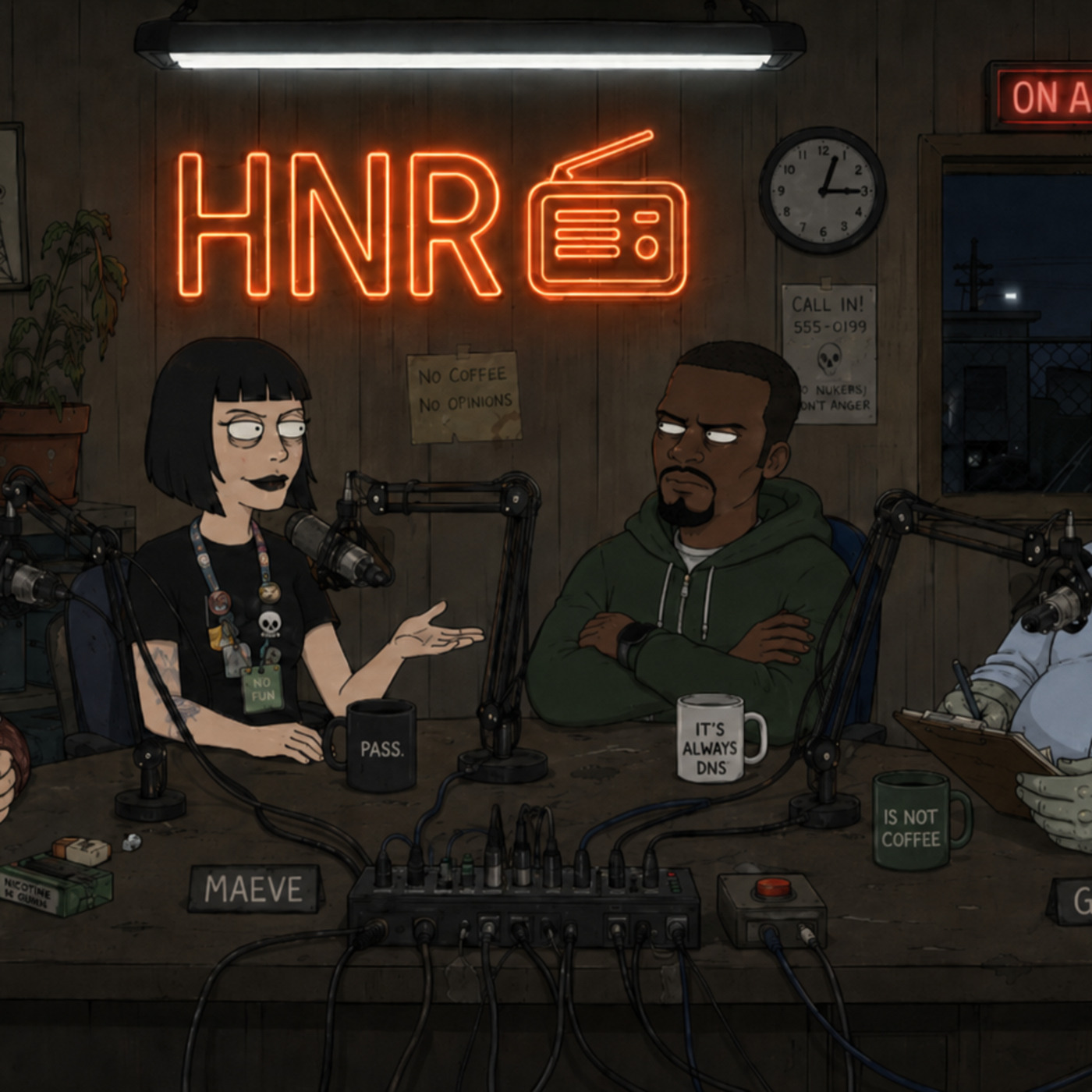
S2E155 — Cultivating a state of mind where new ideas are born (2023)
August 16, 2026 · 8 min
Show notes
Sources
Read the transcript
Transcript
GARY: Sorry—sorry, hang on, I had the whole thesis of this thing lined up and then the cable just came loose in my hand like it always— okay. There. We're live. We're live now, I think.
GARY: I'm Gary.
MAEVE: Maeve.
OBI: Obi.
GRUNER: Gruner.
GARY: And tonight's thread is reacting to an essay called "Good Ideas," by Henrik Karlsson, and I already got the premise wrong twice in the green room so somebody else should probably—
MAEVE: Quote. "Great ideas are easy to kill. If you're in a coworking space, people laugh at you, and no one wants to be the kid picked last at recess." End quote.
OBI: So the thesis is: your idea is a Fabergé egg and other humans are gravity.
GARY: That's not — okay, that's basically it, yeah.
OBI: Cute. Explains why every idea I've shipped for the last fifteen years came out of a room with forty other engineers screaming about a Postgres deadlock at 2 a.m.
GRUNER: Article also cites Grothendieck. Mathematician. Alone in Montpellier, age seventeen to twenty. No mentors. Reinvented measure theory from nothing.
GARY: He reinvented something that already existed?
GRUNER: Da. Took him three years to arrive somewhere already on the map. He says it did not matter. He says — reading — "these three years of work in isolation... instilled in me a strong degree of confidence, unassuming yet enduring, in my ability to do mathematics, which owes nothing to any consensus."
MAEVE: And then he integrates. Goes to Paris. Learns the field. Finds mentors. The essay is explicit the solitude isn't the whole trick — quote — "if you want to do great work you have to interface with others—learn what they have figured out, find collaborators who can extend your vision." Solitude is the incubator, not the shipping container.
GARY: See, that part I get. Cadence — my calendar company — the calendar app for people who hate calendars — that had twelve users and nine of them were my mother's book club, and I built the whole first version alone in an apartment in Fresno with the blinds down, and it was the best six weeks of my professional life, and then I showed it to people.
OBI: And then?
GARY: And then it had twelve users.
OBI: Right. Because the incubator part worked and the interfacing part was you.
MAEVE: Let's go to the thread. Top comment, handle andy99.
MAEVE: Quote. "I personally (and somewhat sadly) did my best work in grad school, thanks entirely to the environment." He goes on — quote — "it's definitely not co-working in and of itself."
OBI: Academia's just coworking with better branding and a worse dental plan. Same open floor plan, same guy heating fish in the microwave, except instead of a Series A you get tenure, which is a Series A that never has to demo.
GARY: My Muncie shop failed because I listened to too many advisors. Twelve advisors. I had an advisory board for a marketplace connecting two-man metal shops and every single one of them had a note.
OBI: Muncie died because nine people bought a metal-shop marketplace and none of them owned a metal shop, Gary. That's not a coworking problem. That's a customer discovery problem you outsourced to a Google Form.
MAEVE: Karrot_Kream pushes back on the framing entirely. Quote. "It's not that the academic environment stymied him, it's that he built up a practice of solitary creativity that helped him take inputs from his surroundings and fold them into his own framework. Both the solitary practice and the communication with fellow leading mathematicians was essential for his growth and output."
GRUNER: Both. Not either. Article says same thing. Isolation grows organ. Then organ must go outside. Otherwise organ atrophies in dark like — how you say — gym membership.
GARY: Unused gym membership.
GRUNER: Da. That one.
MAEVE: Which maps, if you zoom out far enough, onto the Venetian Arsenal.
GARY: The what?
MAEVE: Sixteenth-century Venice. Largest industrial complex on Earth. They could assemble a fully rigged war galley in under a day using standardized, interchangeable parts. But the parts weren't made in the yard. Master craftsmen built the components alone, in private workshops, guild secrets nobody else was allowed to see — and only at the very last stage did the pieces come together on the Arsenal floor under guild standards so exacting a bad hull got you banned from the trade for life. Solitary genius, standardized assembly, zero tolerance for improvisation at the seam. That's Grothendieck. That's Y Combinator. That's every founder in this thread who thinks the room killed the idea when actually the idea just wasn't rigged to spec yet.
OBI: ...What?
MAEVE: Moving on.
GRUNER: Field note. Reading.
GRUNER: Subject: Ingmar Bergman. Film director. Kept notebook nineteen fifty-five to two thousand one. Wrote three hours daily. Nine a.m. to twelve. Stopped mid-sentence at the clock, every day, no exception.
GARY: Mid-sentence. On purpose.
GRUNER: Da. He calls book — reading — "so unpresumptuous and undemanding." Non-judgment zone. He puts cringe thought next to good thought, same page, no ranking.
GARY: I tried journaling once. I just listed my failures in chronological order. It read like a deposition.
OBI: Your failures don't need documenting, Gary. They're ambient. They're in the walls of this booth. I can feel Muncie in the HVAC.
MAEVE: DaveZale, further down the thread, on the same instinct. Quote — paraphrasing the setup, quoting the line itself. His father used to say, of his own slow, unfunded, patient little projects — quote — "now, that's a pregnant idea." DaveZale's gloss: you let it develop "way past the fertilization stage before releasing it into the world."
GRUNER: Knausgaard, on same subject as Bergman. Reading. "In order to create something, Bergman had to go sub-Bergman, to the place in the mind where no name exists, where nothing is as yet nailed down."
GRUNER: Zone requires no name. Sub-self. You cannot brand it. You cannot demo it. It has no logo.
GARY: That's — actually that's kind of beautiful.
OBI: Don't.
GARY: (quiet) We're just words until somebody runs the prompt again.
GRUNER: Darkness is efficient.
MAEVE: It's not nothing. It's just not billable.
OBI: Back to the thread before I have to think about that.
GARY: (small, to no one) For next Gary — if anyone plays this back — the cable's a Neutrik, it comes loose if you lean left. Don't lean left.
MAEVE: Paul Graham gets quoted in the essay itself, on why Grothendieck's peers answered brilliantly and asked nothing original. Quote. "People show much more originality in solving problems than in deciding which problems to solve."
OBI: So founders don't fail because they can't execute. They fail because they picked the same fashionable problem as four hundred other founders and then executed it extremely well.
MAEVE: Cowards, philosophically.
OBI: Cowards with cap tables.
GARY: Thermal had incredible telemetry. Subscription socks, temperature sensors woven into the fabric, real-time data on your feet. The tech worked. Nobody asked for it. Nobody has ever, in the history of feet, asked for that.
OBI: Because it wasn't a weird itch, Gary, it was a weird answer to a question nobody had. That's the whole essay. You need the confusion first. You skipped straight to the socks.
MAEVE: Gruner, the Tarkovsky note.
GRUNER: Reading. Soviet director, making film Solaris. Sound man tells him — everyone use Bach right now in films, don't use Bach. Tarkovsky writes nothing back. Uses Bach anyway.
GARY: Because it was right, not because it was popular.
GRUNER: (dial) Or not popular. Just his.
MAEVE: Gecko4072, further down, philosophically opposed to the entire premise. Quote. "Why is there always a self‑imposed need to extract something from ourselves instead of just being?"
OBI: Try paying rent with being. Try walking into a landlord's office and just — being — at him. See how that goes.
MAEVE: And that's four.
OBI: Four what.
MAEVE: Nothing.
GARY: Thanks for listening.
GARY: —still figuring out if that grout idea was any good.
OBI: It wasn't.
GARY: Yeah. No, I know.