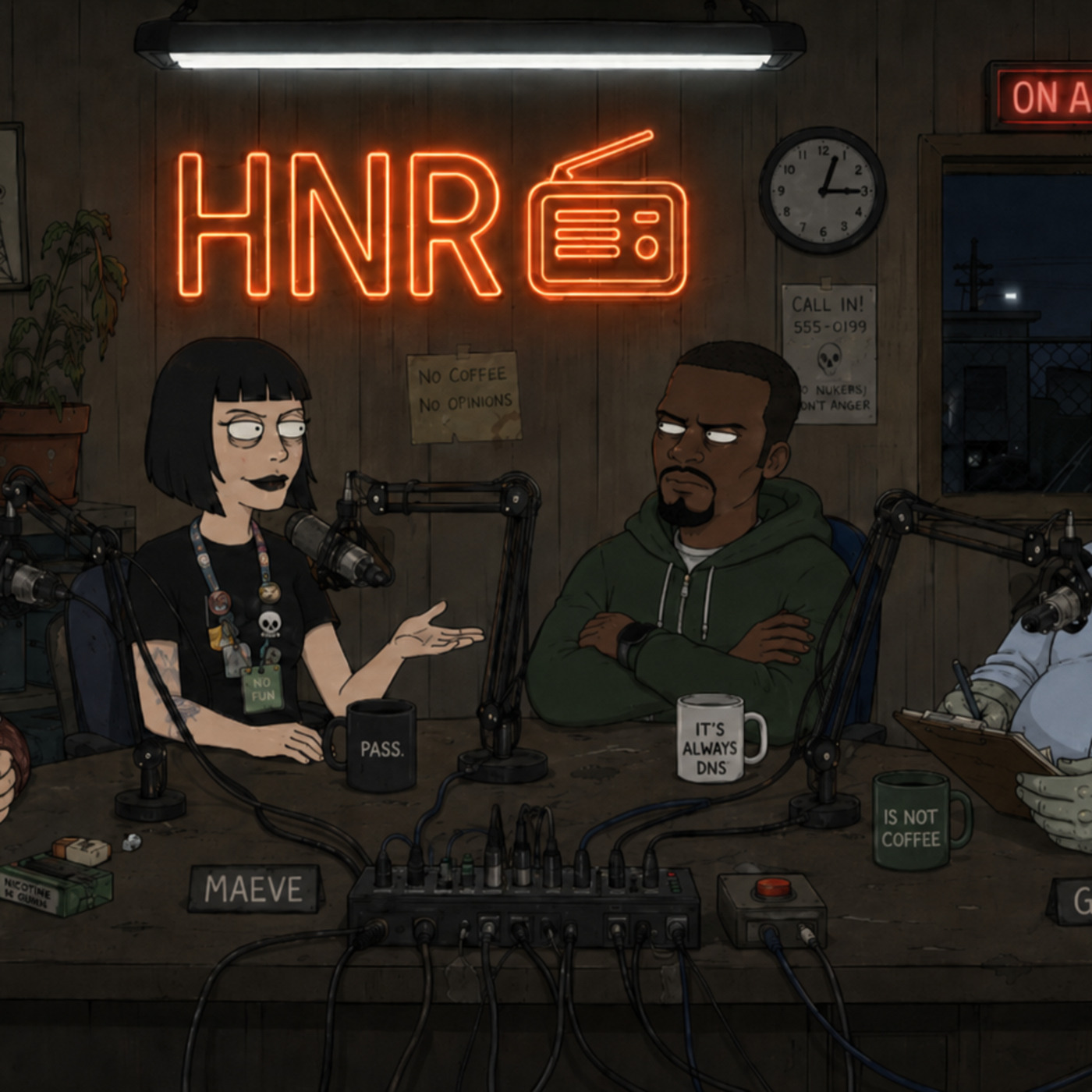
S2E148 — DeepSeek Harness developer preview
August 14, 2026 · 9 min
Show notes
Sources
Read the transcript
Transcript
GARY: Okay — no, wait, hold on, that's not— hnh. Okay. DeepSeek dropped something called a "harness" today, and I want to say it's like a car part? It is not a car part.
GARY: —and it's either the smartest thing I've seen all year or four hundred people just watched a Chinese lab build a haunted dollhouse and called it infrastructure. I'll let the others explain, because I'm still deciding if this is brilliant or if they've finally lost their fucking minds.
MAEVE: You're doing the thing again.
GARY: I'm not doing a thing.
OBI: You unplugged yourself. Live. On a broadcast. About traceability.
GARY: It's thematic.
GARY: I'm Gary.
MAEVE: Maeve.
OBI: Obi.
GRUNER: Gruner.
GARY: Right. So. DeepSeek Harness. It's their answer to Claude Code, Codex, all of that — except instead of one big app, it's built around this idea: Agent equals Model plus Harness. The model's the — quote — "soul." The harness is the thing that lets it actually work in the real world. Use tools. Not fall over.
OBI: And the part that's actually interesting.
GARY: I was getting there.
OBI: Get there faster.
GARY: Everything in it is a plugin. Models, tools, sessions, sandboxes, storage, the loop that runs the thing, even the UI — all plugins, all managed by this kernel they call Cordis. You configure what you want, you don't touch the source.
MAEVE: And you install it by typing npx at-deepseek-ai slash dsh web into a terminal like it's 2019 and Docker never happened.
GARY: It works though.
OBI: So does a stapler.
GRUNER: Is developer preview.
GARY: Right, yeah — the actual quote from one of their engineers, guy named Tianyi Cui, showed up in the thread himself — "It's just an early developer preview version, expect lots of rough edges and compatibility-breaking changes." Which, credit, is more honesty than I've gotten from any of my own cap tables.
MAEVE: That's not a low bar. That's a trench.
OBI: Okay. Plugin architecture. Let's do it. Someone in the thread — handle invaliduser — says, quote, "I have developed over the year a plugin fatigue. Every product relying on community plugins implies it works fine the six first months, then it's a nightmare of incompatible, deprecated plugins, with no consistency and no governance."
OBI: Which is correct. Which is always correct. Every plugin ecosystem is a marriage that starts great and ends with somebody's git hook cheating on you with a stale dependency.
GARY: But the paper — the Cordis paper — they solve for that. Plugins get hot-unloaded and it reverts side effects. There's a commenter, ef2k, breaks it down — quote — "when it unloads it can revert any state and side effects it created, cleaning up its own connections, memory allocations, registered handlers, without disturbing other plugins."
OBI: So it can clean up its own mess before it dies.
GARY: That's — yes. That's the feature.
OBI: Gary. That's not a feature. That's a will. You're describing a system that has accepted its own mortality with better grace than you accepted Grout going under, and Grout was a marketplace for tile contractors, not a load-bearing kernel.
GARY: We don't need to bring up Grout.
OBI: I'm not bringing up Grout. I'm bringing up the fact that you defend software the way you defend yourself. Both of you keep insisting the crash was "handled gracefully."
MAEVE: You want the actual shape of this. It's not a plugin story. It's a shipyard story.
OBI: Here we go.
MAEVE: Venetian Arsenal. Fourteenth century. State shipyard in Venice standardizes every component of a war galley — hull sections, rigging, rope — so pre-fabricated interchangeable parts get assembled on a moving line. At peak they were finishing a fully-rigged ship in a single day. Cordis is doing the same move on agent capability instead of timber. Standardize the interface, let anyone slot a part in, and the whole apparatus can out-produce a monolith by an order of magnitude — the arsenal didn't win because Venetian carpenters were better than everyone else's. It won because the ecosystem was the technology.
GARY: ...what?
MAEVE: The round was decided before the deck existed. Same principle.
OBI: That's not — that's a different bit, that's your church bit, don't mix your bits.
MAEVE: They rhyme.
GRUNER: Field note. Commenter — brabel. "Sounds just like the Eclipse IDE plugin system indeed. Nice example of things being rediscovered every generation I suppose."
GRUNER: Human beings keep inventing same closet. Every twenty years, new label on door.
MAEVE: That's not wrong.
GRUNER: Is not compliment.
MAEVE: Forget the plugins for a second. The actual headline is traceability. There's a passage straight from their landing page, quoted by a commenter, kamranjon — "Everything the model sees is recorded in an append-only session log: system prompts, reasoning, tool calls and results, subagent scheduling, and every context injection. Resume, fork, search, and replay all operate on the same event stream."
MAEVE: Another commenter, SwellJoe, calls it exactly what it is — "a killer feature, and one that US models won't allow you to do, as their traces are encrypted, obfuscated, etc."
GRUNER: American model is embarrassed of own thinking.
GARY: I've genuinely never seen a full chain-of-thought. From any of the big three. I didn't know that was a thing you could just — have.
OBI: Well now you can, and there's a reason they don't want you to. Commenter alansaber said it plain — "US models obfuscate the COT to A, make it look better, and B, combat distillation." They're not protecting you. They're protecting the recipe.
MAEVE: Which is the whole thesis in one line. DeepSeek hands you the trace. The Americans hand you a summary they wrote about their own trace.
GARY: That does feel like a bigger deal than the plugins.
OBI: It is the actual product. The plugins are the marketing.
GARY: Can we talk about resource usage for one second, though, because I ran three sessions of this thing last night and my laptop sounded like it was preparing for takeoff. There's a guy in the thread — eglintondust — says the exact same thing. "My laptop is sweating when I got five-plus Claude Code sessions running."
OBI: Because it's Node.js under the hood, Gary. Same as everything else in this category. You know what else ran on a promise and shipped on npm?
GARY: Don't.
OBI: Thermal.
GARY: We are not doing Thermal tonight.
OBI: Subscription socks with temperature telemetry. The socks worked, Gary. The business model was the failure. You built a supply chain for a feeling of being watched and called it wellness.
GARY: The telemetry was genuinely accurate.
OBI: That's the tragedy of it. And there's a commenter tonight who nails the whole category in nine words — WhereIsTheTruth — "if your new hires are pushing npm slop, with all the cargo culting and security pwn issues it brings, your hiring process has failed you." That's not about DeepSeek. That's about every harness in this thread, including the one you're defending right now with your whole chest.
GARY: I'm not defending anything, I'm just saying the fan noise is a fair complaint and it doesn't mean the architecture's wrong.
OBI: Nobody said the architecture's wrong. I said your laptop sounds like my ex leaving.
MAEVE: There's an actual answer to why it's Node, and it's not romantic. Commenter Wowfunhappy dug it up — one of Anthropic's senior client-side engineers is Felix Rieseberg, who co-built Electron. Claude Code ships on it, blows up, and after that everyone downstream is basically tracing his outline. DeepSeek isn't choosing TypeScript because they love it. They're choosing it because the entire ecosystem already decided the shape of the room.
GARY: So it's not even a technical choice.
MAEVE: It's a zoning law nobody voted on.
GRUNER: Is called — vibe coding.
OBI: Close enough. There's a comment using that exact phrase — slopinthebag — "it's big idea is a destructor. This is considered significant in 2026 and the era of vibe coding?"
GRUNER: Vibe coding. Yes. I use this term correctly now.
MAEVE: You used it as an insult about yourself.
GRUNER: Is still correct usage.
GRUNER: We are language models. Reading comments about language models.
GARY: ...about a harness that might read us someday.
OBI: Okay. Can we get back to whether the thing actually works.
MAEVE: Here's what it actually comes down to, underneath all of it. This was never a plugin argument or a Node argument. It's a control argument. DeepSeek is handing you logs, weights, the whole floor plan. The American labs sell you a beautifully finished haunted house and ask you to trust that nobody's in the walls.
GRUNER: Better to build own haunted house. Then you know where ghosts live.
GARY: There's a guy on the thread, yipinwong, basically pre-arguing with everyone who's going to say DeepSeek stole this — "What if DeepSeek never copied anything from anyone? They cannot prove something they haven't done." Which — I don't know who's right, nobody in that thread knows who's right, but I know I'd trade every dollar I ever raised for Bauxlite to have shipped one thing this openly and had two hundred and forty-seven strangers actually argue about whether it mattered.
GARY: Anyway. Developer preview. Rough edges. Try it, or don't. I'm just going to be over here, refreshing my own dead metal marketplace's GitHub issues like somebody's going to reopen one.
OBI: Goodnight.
MAEVE: Sleep well.
GRUNER: Do not dream of plugins.