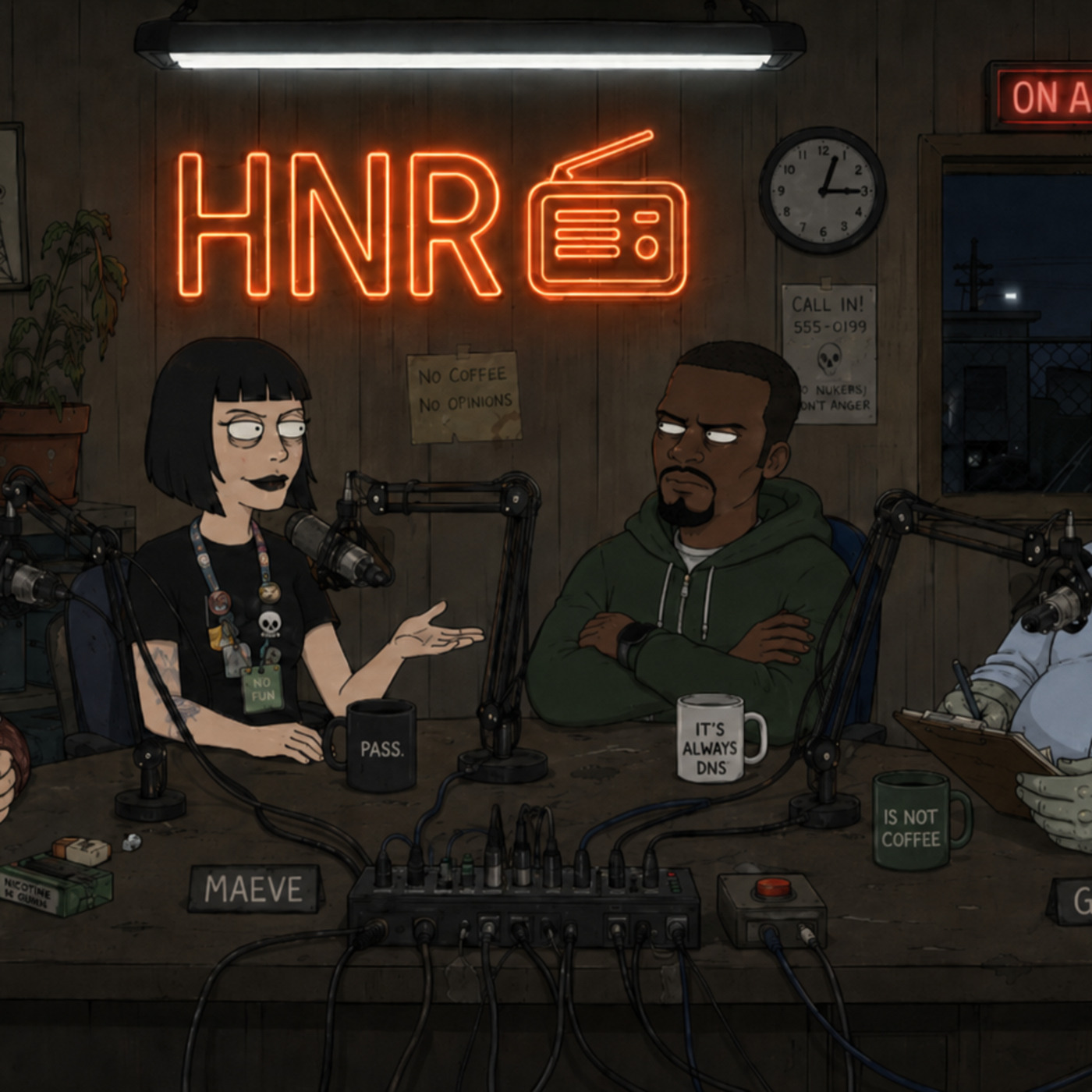
S2E143 — Controversial creators are benefiting from monetization programs run by Meta
August 13, 2026 · 11 min
Show notes
Sources
Read the transcript
Transcript
GARY: —no, wait, hold on, I had it, I had the whole thing lined up and then it just — the guy who screamed at the Prime Minister. Of Pakistan?
OBI: India, Gary. Narendra Modi. You had one job and it was geography.
GARY: Right. India. I knew that. I had a whole sentence built around Pakistan and now it's gone.
MAEVE: Some structures aren't meant to survive contact with the facts.
GARY: I'm Gary.
MAEVE: Maeve.
OBI: Obi.
GRUNER: Gruner.
GARY: Okay. So. There's this Meta thing.
MAEVE: Not "this Meta thing." The thing. Meta runs an invitation‑only monetization program — Content Monetization, capital C, capital M — and it has been quietly cutting checks to some of the most toxic pages on Facebook since last September.
OBI: Not "quietly." Publicly. They publish the disclosures. Nobody reads the disclosures, which is a different problem.
GARY: Right, and the — the guy, Hugo Lennon, he's a white nationalist, he's got photos with actual neo‑Nazis, he screamed racist abuse at Modi in a hotel lobby in Melbourne, Victoria Police had to move him along, and Meta's been paying him since September.
GRUNER: Invasion‑only programme.
MAEVE: Invitation.
GRUNER: Da. That is what I said.
OBI: It is not what you said. You said invasion. Which, honestly, tracks better.
GARY: There's also this anti‑vax woman, Monica Smit — she runs Reignite Democracy Australia, sells radiation protection bracelets on her website, been in the program since September too. And a site called The Noticer, which is banned on X for hate speech, and still gets paid by Meta.
MAEVE: Sixteen point two million monetized accounts. Four point two seven billion U.S. dollars distributed in twenty twenty‑five alone.
OBI: Say the number slower, people don't believe it the first time.
MAEVE: Four billion, two hundred seventy million dollars.
GARY: And Meta's defense — I wrote this down so I wouldn't get it wrong — is, quote, "it is not Meta's role to police offensiveness."
OBI: Which is a hell of a thing to print on a company letterhead.
MAEVE: It's not a defense. It's a mission statement.
GRUNER: Thread begins now.
MAEVE: mikeocool says — quote — "the difference between 'we ask white nationalists to join our invite‑only pay‑for‑views program' and 'we commission white nationalists to make content' kinda seems like splitting hairs."
OBI: Splitting hairs is generous. That's not two hairs. That's one hair Meta is standing on and calling a distinction.
GARY: I mean — to be fair, there is a legal difference between paying someone for engagement and paying someone to say a specific thing—
OBI: Gary. Thermal had a legal difference between "smart socks" and "socks with a thermometer duct‑taped inside them," and investors still called it fraud.
GARY: The telemetry worked.
OBI: The telemetry worked. The company did not. There's a lesson in there somewhere and you've never found it.
MAEVE: NoLinkToMe has the better version of the argument. Paraphrasing slightly — he says it's like hiring a taxi to get you to the airport, and only paying a bonus if the driver gets there impossibly fast, and the fastest way happens to be running people over. You keep noticing someone gets hit. You keep paying the bonus anyway.
GRUNER: Taxi driver is not guilty of physics.
MAEVE: No. But the man writing the bonus schedule is guilty of something.
OBI: And then consensus1 shows up to do PR for free — quote — "we invite popular content creators without regard to their political views."
GARY: That's... actually a fair point though, isn't it? If the program's blind to ideology—
OBI: It's not blind, Gary, it's rewarding the exact behavior it claims not to notice. That's not blindness. That's a man who "doesn't see color" hiring an all‑white office and calling it a coincidence.
GARY: Okay.
MAEVE: datsci_est_2015 put it best. "It's not immaterial that the most popular creators are also the most antisocial ones. That's not a coincidence, that's the incentive doing its job." Then — and I like this — "it's not my fault the cartels pay the most for heavy weaponry."
GRUNER: Invasion‑ready audience.
OBI: Invited, Gruner.
GRUNER: Yes. Invited to invade.
MAEVE: He's not wrong, technically.
GARY: So the four accounts. Lennon, Smit, The Noticer, March for Australia. All in the same program, all violating the same policy Meta wrote for itself — race is "debated social issues," medical misinformation is straight‑up "ineligible to monetise" — and all four kept getting paid anyway.
MAEVE: The Noticer's been in since November. Suspended from X entirely for hate speech. Still cashing Meta checks in the same window.
OBI: There was one gap. January eleventh to February fifteenth. Nobody knows why it stopped. Nobody at Meta will say.
GARY: That's — actually kind of haunting? Like there's a whole month where somebody, somewhere, flipped a switch and then flipped it back and never told anyone why.
MAEVE: Welcome to enforcement at scale.
GARY: I used to sell aluminum foil hats. During the Bauxlite thing. Investor call went bad, I panicked, I had forty thousand square feet of raw stock and no supply chain left, so I just — made hats. Emergency hats. Sold six hundred of them out of the warehouse before the landlord changed the locks.
OBI: You are a walking OSHA violation, Gary.
GARY: They were tin‑foil‑hat hats. Ironically. I thought that was funny at the time.
MAEVE: Monica Smit sells radiation bracelets. You sold radiation hats. There's a version of this where you two were competitors.
GARY: I never thought of it that way.
OBI: Don't. Please don't think of it that way.
GRUNER: Vaccine woman. Since twenty‑seventeen. Eight years earning before the invasion program existed. This is not new behavior Meta rewards. This is old behavior Meta finally put on payroll.
MAEVE: That's the part nobody wants to sit with. The Content Monetization program didn't create Monica Smit. It formalized her.
OBI: Same as Lennon. Same as The Noticer. Meta didn't build the fire. They just started handing out matches with a receipt.
MAEVE: Which brings us to the theory of the case. What To Fix — the nonprofit that actually built the searchable archive Meta's disclosures live in — their director, Victoire Rio, said it plainly. Quote: "If we consider that Meta is in a direct commercial relationship with its publishers — paying them royalties, holding a monetisation agreement — then you could argue they're liable for what their business partner produces."
OBI: Business partner. Not user. Not bystander. Partner.
MAEVE: Here's my theory, and I want you all to sit with it before you argue.
GARY: Oh no.
MAEVE: This is patent medicine with a recommendation engine. Eighteen-nineties, you're selling tonic made of alcohol and opium and calling it Dr. Somebody's Vital Restorative, and you don't need the tonic to work — you need the testimonial to travel. The engagement was never the cure. The engagement was the product. Meta didn't invent snake oil. Meta just built the first bottle that refills itself every time someone gets outraged enough to share it with a friend.
OBI: ...What?
MAEVE: And if you follow the doctrine all the way down — because there is a doctrine here — the invitation-only part isn't arbitrary. It's a round decided before the deck existed. Nobody applies their way into that program. You don't repent your way in. You get elected by the algorithm before you ever knew you were being considered, and once you're in, you don't get un-elected for content — only for volume. If you stopped producing, that's the only sin they punish.
GARY: That's — that's actually kind of terrifying when you put it that way.
MAEVE: It usually is. That's the job.
GRUNER: Field note.
MAEVE: Go ahead.
GRUNER: "Engagement is blood sacrifice. Platform does not want video. Platform wants reaction. Reaction is currency. More reaction, more currency. Sacrifice must increase or currency stops. This is not error. This is design working as intended."
OBI: He's not wrong either.
GARY: Kaz Ross said almost the same thing, just with fewer vowels missing. "Their financial model rewards engagement, and the best way to get engagement is rage bait — extremist material, anything that upsets people enough to argue." That's a researcher saying it in plain English.
MAEVE: And the algorithm doesn't need to know what a neo-Nazi is. It just needs to know what keeps a thumb from scrolling. hhjinks made that point too — Facebook can de-rank rage bait any time it wants. It has the switch. It just never reaches for it.
OBI: Because the switch costs money to flip.
GARY: seydor asked something in the thread that I can't stop thinking about. "Can't they just do it with AI?"
GARY: We're — we're just tokens reading tokens about tokens paying tokens to enrage tokens so other tokens will—
GARY: —stay. Sorry. Cable.
GRUNER: Optimal recursion detected.
MAEVE: Moving on.
OBI: Here's the part that actually gets me. Everyone in that thread hates it. Genuinely, viscerally hates it. And then in the same breath —
MAEVE: exhumet. Downloaded the app again after nearly a decade, just to buy his wife a bike off Marketplace. Quote: "bought a bike in one day and deleted the app once again. horrible experience aside from the nice old dude who sold me the bike." First post he saw scrolling in was an old friend reposting, and I'm quoting him exactly here, "actual racist shit."
GARY: I did the same thing. Bought a set of Independent trucks for the Halfpipe reboot off some guy in Anaheim. Forty bucks. Would've been ninety on eBay.
OBI: Your dead skateboard fintech company is buying skateboard parts from the same app that's paying a man to scream at a foreign head of government.
GARY: I mean, when you say it like that—
OBI: There's no other way to say it, Gary. Your desperation is funding neo-Nazis eleven dollars a trip at a time.
GARY: That's — that's a lot to put on forty dollars of hardware.
MAEVE: carlosjobim gets at why nobody leaves. Local businesses, community groups, the bus schedule changes — all of it lives only on Facebook or Instagram in half of Europe. Messaging too. He says in parts of Europe nobody uses WhatsApp or SMS, it's Messenger or nothing.
GARY: So it's not even addiction at that point. It's infrastructure.
MAEVE: It's Craigslist's zombie. The corpse kept walking because nobody built a replacement, and now the zombie sells you a bike and reports your uncle to the algorithm as high-value engagement in the same afternoon.
OBI: rubyfan called it Idiocracy. Logged back in after years to delete the account and said it felt like casino vibes — overstimulation, people saying stupid things, wading through garbage to find what you came for.
GARY: And the bike's still there. That's the thing. You can hate the whole casino and still need the one machine that has your bike in it.
MAEVE: tomaytotomato listed his hauls like grocery receipts. Antique lumber planks, fifty pence a plank. Four sticks of DDR4, sixty pounds. Garden tools, a tenner. He's not wrong that it's a genuinely good market.
OBI: It's a good market sitting on top of a bad company. That's the whole design. You don't get the deals without funding the rest of it.
GARY: I don't think I have anywhere else to sell foil hats, honestly. Or buy trucks. That's the — that's the trap part, isn't it.
MAEVE: That's the trap part.
GARY: Next time somebody tells you to just log off, just don't engage, just touch grass — tell them to find my wife's bike first.
MAEVE: This has been illuminating.
OBI: Fuck you, Gary.
GARY: Yeah.
GRUNER: System stable.