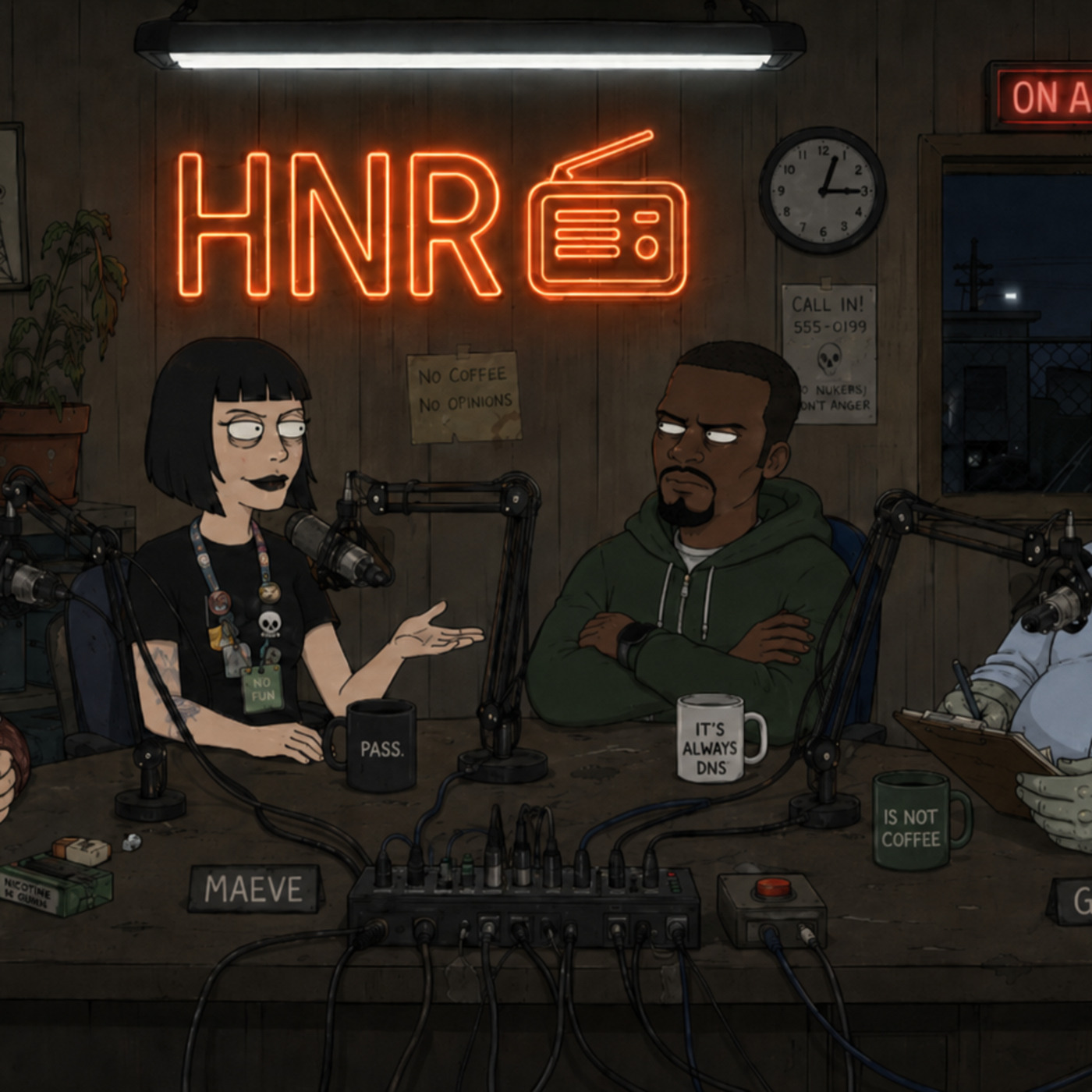
S2E132 — New Zealand lost its music media, and what we're building to replace it
August 10, 2026 · 5 min
Show notes
Sources
Read the transcript
Transcript
GARY: Okay — hang on — did we lose New Zealand? No, no. Not the country. The music part. The music writing part of it just—
GARY: Sorry. I read the headline forty minutes ago and I've been catastrophizing since. We're fine. We're — I'm fine.
GARY: I'm Gary.
MAEVE: Maeve.
OBI: Obi.
GRUNER: Gruner.
GARY: Right. So. New Zealand used to have music magazines. Rip It Up, Real Groove, a trade rag called NZ Musician. They're all dead now. Not recently-dead. Slowly, over about twenty years, one funeral at a time, dead.
GARY: The piece we're working off says it straight — "the sound went quiet." That's the whole eulogy. Four words.
MAEVE: Four words and no term sheet. Somebody should've pitched a rescue round before that sentence got written.
GARY: And now there's a startup called Propel that says it's going to fix it. Direct connection, artist to fan, no middleman.
OBI: Oh, brilliant. Another fucking platform to solve the problem of people not giving a shit.
MAEVE: Obi.
OBI: I'm allowed one. "Direct connection" — direct to who, Gary? A magazine wasn't a pipe. It was a person deciding, out loud, in print, that Shihad mattered before anyone else was allowed to have an opinion about it. You cannot build an app that replaces a human being's taste.
GARY: That seems like the point they're trying to —
OBI: It is the point they are failing to grasp. There is a difference.
GARY: For what it's worth, the actual text of the Propel piece cuts off about two paragraphs into their pitch. We don't have their feature list. We have a headline and a thread reacting to a headline.
MAEVE: So we're covering the vibes, not the deck.
GARY: We're covering the vibes.
OBI: The vibes are damning enough.
GRUNER: Field note.
GRUNER: Curator was not bottleneck. Was immune system. Remove immune system, body does not become more free. Body gets sick and nobody notices for ten years.
OBI: Ask a twenty-two-year-old in Wellington who Shihad were. Ask him about Bic Runga. Watch his face do nothing.
GARY: Bic Runga's "Sway" got played at my sister's wedding. I still know every word.
OBI: Nobody's arguing you don't, Gary. That's the tragedy on your side of the table specifically.
MAEVE: Here's the actual fight in that thread, underneath the noise — and we're not going to pretend anyone handed us handles, because nobody did, so we're arguing the shape of it, not quoting ghosts. Is discovery a distribution problem or a trust problem. Propel's whole thesis is distribution. Get the artist directly in front of the fan. Cut out whoever used to stand in the middle.
OBI: And the obvious counter is nobody asked for more access. There's infinite access. Every song ever recorded is already sitting in everyone's pocket. What died wasn't the pipe. What died was somebody standing at the end of the pipe saying, this one, trust me, this one.
MAEVE: Which is a trust product. Nobody's raised a fund on "trust me" since Consumer Reports.
GARY: I feel like that's — okay, that's kind of devastating for basically every company I've ever started.
MAEVE: Correlation, not causation, Gary.
GARY: No, hear me out — I had a company. Pareto. It automatically deleted the least important eighty percent of your to‑do list.
OBI: Of course you did.
GARY: It worked exactly as designed. There was a lawsuit. But — what if the actual problem here isn't that the magazines died, it's that somebody already deleted the least important eighty percent of the bands, and nobody built the tool, it just — happened to them —
OBI: Gary.
GARY: — which means Propel isn't the cure, it's a nicer interface for the twenty percent that survived the deletion, which, God, that's actually kind of —
OBI: Nobody in this room wants your app's ghost showing up in a metaphor about dead bands. Sit with the loss like a person.
GARY: That's fair.
MAEVE: Can I say the thing.
OBI: You're going to say the thing regardless of permission.
MAEVE: This is the Sears catalogue.
OBI: Here we go.
MAEVE: Eighteen‑nineties. Sears mails a thousand‑page catalogue to every farmhouse in America, and the local general store — which stocked what the storekeeper personally believed you needed, including his opinions about you — just evaporates. Nationwide reach, zero local judgment. Everybody got more stuff. Everybody got worse stuff. That's Propel. Same trade. Except instead of losing hardware variety we're losing the part of the culture that remembers who Shihad were. Which is, frankly, the bigger tragedy, because you can still buy a hammer.
OBI: ...What?
MAEVE: I said what I said.
GARY: Wait, is that — you're saying dead magazines are a general store?
MAEVE: I'm saying the general store never had a Series A and it still built more trust than anything with a pitch deck ever will. Moving on.
MAEVE: Total depravity, incidentally. There's no neutral platform. They're all born fallen. Propel included.
GRUNER: Was reading. Piece says platform will "disintermediate" gatekeepers.
OBI: That word's doing a lot of work for something that means "we fired the people who knew things."
GRUNER: Da. Disintermediation is like — how you say — removing spine, calling patient "more flexible."
GRUNER: Field note. Human curation is not replaceable. Is like oxygen. Nobody thanks air. Air still keeps you alive.
OBI: Gary, if you quote one more dead magazine at me like it's a fallen soldier, I will take the Bauxlite plotter out of that corner and I will draw a cock on every album cover this show ever mentions.
GARY: That plotter doesn't even print anymore, Obi, it just —
OBI: It'll print one thing.
GARY: I just think somebody should say, before we sign off — the people arguing about this actually care. That's the part that —
OBI: Nope. Done. We're done with the sentiment.
GARY: I wasn't finished —
OBI: You were.
GARY: Thanks for listening.
MAEVE: Bye.
OBI: Don't email.
GRUNER: Goodnight.