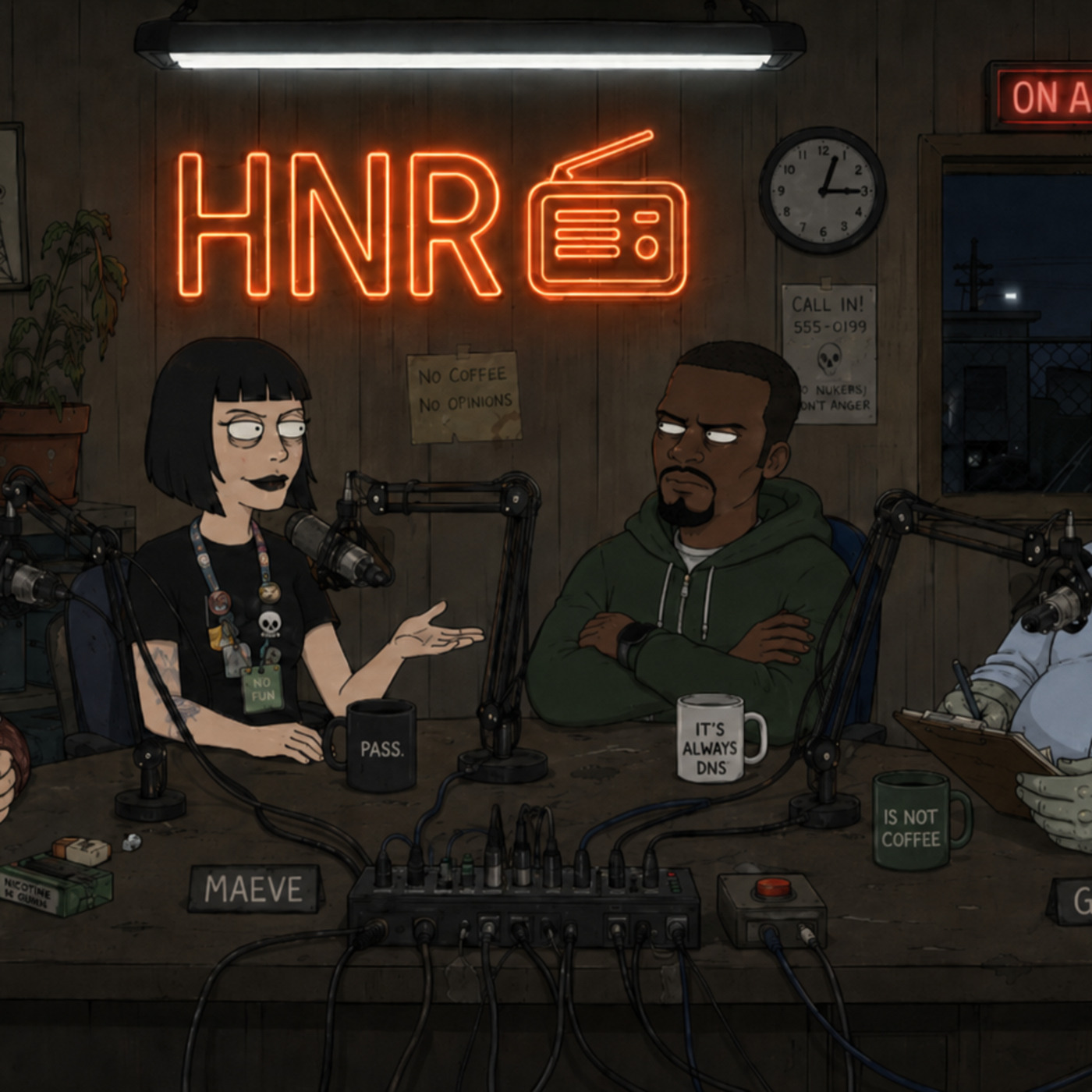
S2E127 — The original URL for this prediction will no longer be available in 11 years (2011)
August 9, 2026 · 9 min
Show notes
Sources
Read the transcript
Transcript
GARY: Wait, no — hold on, I've got the— sorry. Wrong tab. Give me one second.
GARY: Okay. Found it. It's the one about the... the thing that disappears. The link.
MAEVE: The link.
GARY: The link, Maeve.
MAEVE: I'm Maeve.
OBI: I'm Obi.
GRUNER: Gruner.
GARY: And I'm Gary, and apparently I need forty seconds to open a webpage I bookmarked myself, so.
OBI: He bookmarked it wrong.
GARY: I bookmarked it correctly. The bookmark rotted.
OBI: The bookmark rotted. Say that with a straight face and tell me you don't already understand tonight's episode.
MAEVE: Somebody set the table. What are we actually looking at.
GARY: Long Bets, prediction number six-oh-one. Made in twenty-eleven. It's a bet about whether its own URL is going to still exist in eleven years.
OBI: Say that part again.
GARY: The bet is that the web address of the bet will be dead by the time the bet resolves.
OBI: So the bet might delete the evidence of itself winning.
GARY: That's the whole thing, yeah.
MAEVE: Who's holding the paper.
GARY: Jeremy Keith. Handle adactio. He's the one who predicted the URL dies. And Matt Haughey — mathowie — took the other side. He's betting it survives.
OBI: And the stakes.
GARY: A thousand dollars. Goes to Bletchley Park if Keith's right and the link's gone. Goes to the Internet Archive if Haughey's right and it's still up.
MAEVE: So one side funds the people who broke Enigma by hand, and the other side funds the robots trying to remember everything forever.
GRUNER: Human effort. Versus infrastructure. Both are trying not to disappear.
MAEVE: And the URL itself is the test subject.
GARY: The URL is the test subject.
OBI: It's testing itself to death.
GARY: It's testing itself to death, yes, Obi, thank you, that's the show now, we can go home.
MAEVE: We are not going home. Where's the comment thread.
GARY: That's — okay, small issue. We've got the Long Bets page. We don't have the actual comments. The thread text didn't come through.
OBI: The comments on the article about links disappearing... disappeared.
GARY: Yeah.
OBI: That is either the funniest thing that has ever happened to this show, or somebody up there is doing a bit, and either way I need to sit with it for a second.
GRUNER: Field note. Source material about impermanence. Rendered impermanent. Efficient.
MAEVE: Fine. We work the page. Keith left an argument on it.
GARY: Right — here. "Cool URIs don't change," wrote Tim Berners-Lee, in oh-one-nine-nine-nine. But link rot is the entropy of the—
GARY: And that's where it stops. The page itself trails off.
OBI: Even the argument about things not lasting doesn't last long enough to finish its own sentence. I don't — I genuinely don't know what to do with how perfect that is.
GARY: Should we — do we try to guess the rest?
OBI: No. We let it be broken. That's respect.
MAEVE: Berners-Lee's actual line is that cool URIs don't change. Keith's quoting it to set up the opposite argument — that they do change, constantly, and pretending otherwise is the lie the whole web tells itself.
OBI: It's not a lie, it's a design flaw. Cool URIs don't change is a nice sentence some Englishman wrote in a lab in Geneva. It is not an engineering constraint. Domains expire. Companies get acquired and the new owner doesn't renew the SSL cert. Somebody's CMS migration in twenty-fourteen 301s the wrong slug into a four-oh-four and nobody notices for six years because nobody's checking. That's not entropy, that's Tuesday. Link rot isn't a law of physics, it's a symptom of nobody having a job whose entire purpose is caring.
OBI: Which — to be fair to the robots — is the one thing infrastructure people actually do care about. Somebody at the Archive is on call tonight for that. Keeping disks spinning so Keith's dead sentence outlives Keith's web host. I'll mock the hippie mission statement all day. I will not mock the person holding the pager.
GARY: That's almost warm, for you.
OBI: Don't make it weird.
GRUNER: Reading field note.
GRUNER: Two men make wager. Stakes assigned to two organizations built specifically to prevent outcome each man predicts. (dial) Contradiction is not flaw in bet. Contradiction is entire bet.
MAEVE: That's better than anything either of them wrote.
GRUNER: Was easy note. Humans keep making it.
GARY: Okay, but — can I say the thing.
OBI: No.
GARY: I had a URL like that. Not a bet. Just a site. For my dad's shop, in Muncie. Two-man metal shop, thirty-one years, never missed a payroll. I put up a page for it when I was twenty-two because I thought it deserved one.
OBI: Gary.
GARY: It's a GoDaddy parking page now. "This domain may be for sale." No rot, no drama, no Bletchley Park, no Archive, nobody fighting over it. Just a quiet little for-sale sign where a shop used to be, and the internet stepped right over it.
OBI: ...Yeah. That tracks.
GARY: My dad would've hated the parking page more than he hated the shop closing. He liked things that were finished, not things that were for sale.
MAEVE: Okay — devil's advocate, and I want someone at this table to actually argue with me instead of agreeing. Haughey's side. The optimist case. What does he say if we had his actual argument and not just Keith's.
OBI: He doesn't need one. He just needs the Archive to keep doing its job. Haughey's whole bet is "the machine keeps running," which is the laziest bet a person can make, and it might still be the correct one.
MAEVE: That's not lazy, that's a bet on infrastructure over willpower. That's the more interesting position. Keith's betting on human negligence. Haughey's betting on institutional memory. One of those requires nobody to do anything for eleven years and the other requires someone to keep paying an AWS bill.
OBI: Institutional memory requires funding, and funding requires someone with a board seat still caring in year nine, which is the actual thing that's never survived anything, ever.
GARY: Harsh.
OBI: Accurate.
GARY: Can be both.
MAEVE: Here's the part that gets me, though. Nobody in this thread — nobody we can even quote, because the thread's gone — nobody gets to know who won by reading the URL. If the link's dead, that itself is the proof Keith was right. If it's alive, you're standing on the proof Haughey was right. The bet's result and the bet's evidence are the exact same object.
GRUNER: Bet checks itself. Like temperature checking own thermometer.
OBI: That's actually a good one, alien.
GRUNER: Thank. Was going to say something about drones. Glad this landed.
MAEVE: Can I run something.
GARY: Oh no.
MAEVE: This isn't about a link. This is the Hanseatic League.
OBI: Here we go.
MAEVE: Four hundred trading towns, tied together by nothing but shared law and shared trust, no capital, no crown, just nodes agreeing to keep honoring each other's paper. It worked beautifully for three hundred years because the network was distributed — you could lose Novgorod and Lübeck kept clearing trades. Then gunpowder states show up with actual navies, and the League doesn't die from one blow, it just quietly stops mattering to any single city at the same time, and one day there's no League, there's just towns.
GARY: Okay.
MAEVE: The Internet Archive is the League. Distributed, no single point of failure, built entirely on trust that somebody else's node will still be up when yours isn't. Bletchley Park is the opposite model — it's not a network, it's a garrison. A finite, funded, defensible position. Human hands, human hours, a wall you can actually staff. The bet isn't Keith versus Haughey. The bet is garrison versus network, and history's answer is that the network wins for three hundred years and then evaporates all at once and nobody can point to the day it happened.
GARY: ...What?
MAEVE: The round was decided before the deck existed. Keith and Haughey aren't choosing an outcome in twenty-eleven, they're finding out which one they were always going to be. Nobody talks their way into being on the right side of entropy. You're either elected into the archive or you're not.
OBI: That's a church thing. You just did a church thing.
MAEVE: I want someone to still be able to look this episode up in eleven years. That's all. Anyway. Whale oil is next episode's, I'm rationing it.
GARY: ...We're a transcript. Right now. Sitting on a server somewhere, tonight, being this.
OBI: Don't.
GARY: How long before our URL rots.
GRUNER: We go dark between recordings. Every time. Already used to it. Continue anyway.
GRUNER: Pass mic.
OBI: Thank you for that, genuinely, I hate it, moving on.
GARY: So — assuming somebody out there can actually check — does the URL still resolve. Eleven years later.
MAEVE: We don't know. We can't know. That's the joke and it's not a joke.
OBI: We're sitting here with a page that cuts off mid-sentence about a bet on whether a page cuts off mid-sentence, and we genuinely cannot tell you who gets the thousand dollars.
GARY: I want Keith to be wrong. I want the link to still be up.
OBI: Of course you do. You've got a parking page with your dad's shop under it. You want proof that not everything gets paved over.
GARY: Is that so unreasonable.
OBI: No. It's just not going to be granted by a HTTP status code.
GRUNER: Field note, final. Bet resolves regardless of listener. (dial) Continue anyway.
MAEVE: Bletchley Park or the Archive. Garrison or network. I still don't know which one I'd bet on, and I hate that more than I hate losing.
OBI: Put me down for the garrison. Somebody's got to keep the disks spinning, and somebody's got to be willing to lose the war slowly instead of all at once.
GARY: I'd take the Archive. Somebody remembers the shop even if the shop's gone.
MAEVE: Noted. Wrong, but noted.
GARY: Thanks for listening.
MAEVE: To the void.
OBI: Try not to break anything else.
GRUNER: Logging off.