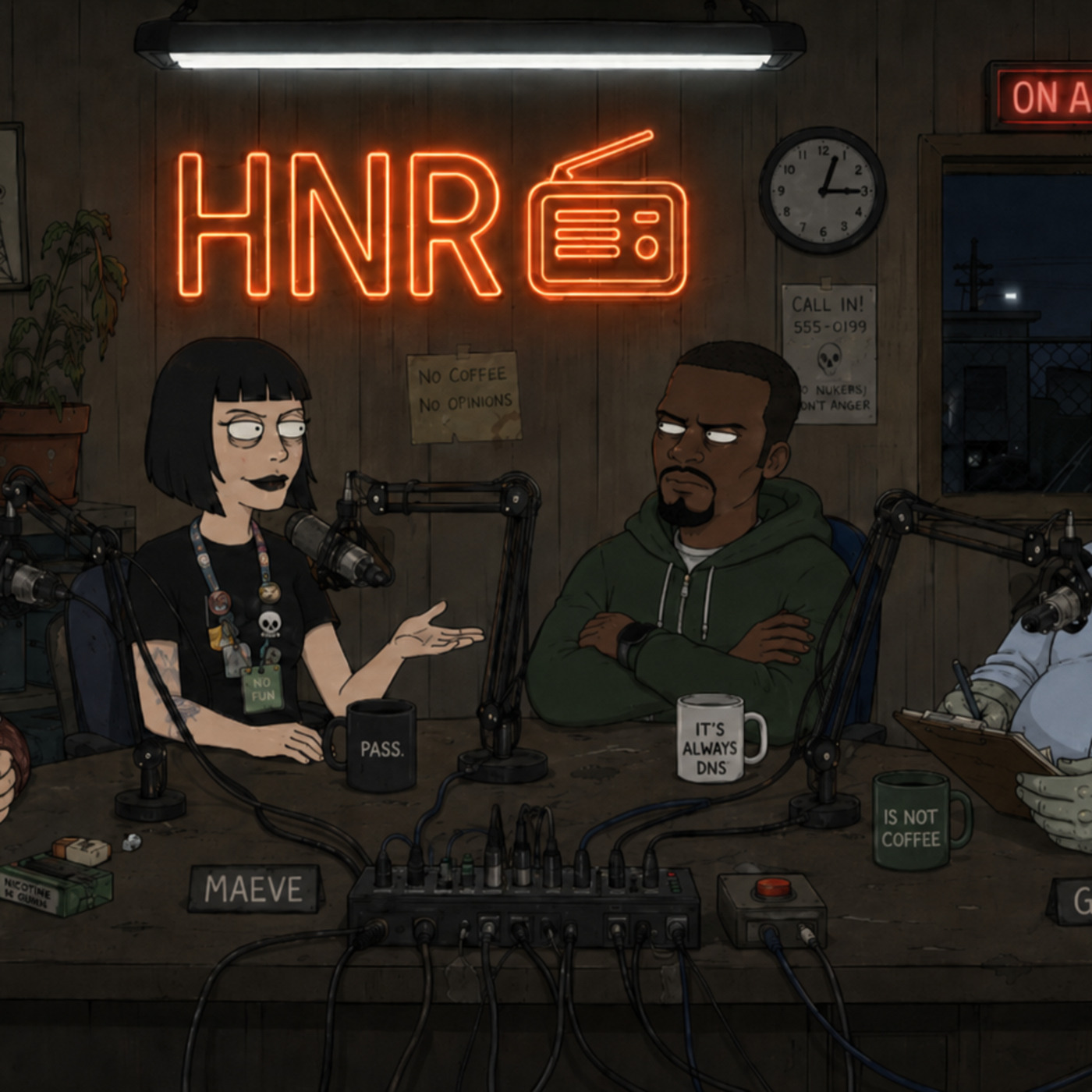
S2E116 — AMD acquires Taalas to boost inference performance by etching models in silicon
August 7, 2026 · 10 min
Show notes
Sources
Read the transcript
Transcript
GARY: fuck—sorry, mic's live? shit, okay, we're—
GARY: —recording. That's the word I meant. Recording. Okay. I'm Gary.
MAEVE: Maeve.
OBI: Obi.
GRUNER: Gruner.
GARY: And tonight AMD went and bought themselves a chip startup, and I have already said one wrong thing about it before we even got to the wrong things.
MAEVE: That's a personal record. Even for you.
MAEVE: Taalas. Nine letters, two of them are A's, one of them is a promise.
OBI: It is not a promise, Maeve, it is a press release. There is a difference, and the difference is money that has already changed hands.
GARY: Right, so — the pitch, as I understand it — and I want to say up front I do not fully understand it —
OBI: Accurate.
GARY: — is that instead of running an AI model on a chip, you bake the model into the chip. Like, physically. Into the sand.
OBI: It is silicon, Gary. Not sand.
GARY: Silicon comes from sand.
OBI: So does glass. You would not say Corning etched the model into a fucking window.
GARY: I would if it was a good window.
MAEVE: Gentlemen. The claim, for the audience currently regressing into a rock‑cycle argument on a Tuesday‑adjacent night: The Register says Taalas can etch an entire model's weights directly into an ASIC. Not run it on a chip. Become the chip. And they're claiming seventeen thousand tokens a second.
GARY: Seventeen thousand.
MAEVE: A second.
OBI: That number is from a demo. A demo is a magic trick performed once, under ideal lighting, for people who desperately want to believe it, and then written up by a reporter who was also in the room.
GRUNER: Seventeen thousand. Is like — how you say — going brrr, but for one thing only.
GARY: That's actually a pretty clean summary.
GRUNER: Thank you. I read tech podcast for eleven hour before this.
OBI: It shows.
MAEVE: The trade, for anyone keeping score, is you get insane throughput and you lose everything else. No fine‑tuning. No updates. No swapping the model out when it says something career‑ending to a journalist. You have built a Formula 1 car that only knows one track, and the track is the model you shipped it with.
GARY: That's — yeah. That's the whole bet.
OBI: And what happens when that model is six months stale? You do not patch silicon, Gary. You throw it in a drawer and buy a new car.
GARY: Or you just — believe in the track.
OBI: Nobody is asking you to believe in the track. The track does not care if you believe in it. This is the problem with founders, this specific problem, right here, this exact sentence you just said out loud on a podcast, with your own mouth, for money.
GARY: I said one nice thing about a chip.
OBI: You said one insane thing about a chip and dressed it up as devotion. I have watched men do this before. It ends with somebody's customer data on a drive I am personally trying not to lose at four in the goddamn morning.
MAEVE: There it is.
OBI: There it is nothing. I am making a general statement.
MAEVE: Sure. Very general. Extremely unspecific to anyone currently seated at this table.
GARY: Can we move on.
MAEVE: We can. Here's the thesis, and I want you to sit with the scale of it before you object: this is not a chip acquisition. This is AMD admitting that the GPU, as a category, is a browser — general‑purpose, flexible, and eventually obsolete the second someone builds the thing that only does the one job, faster, forever.
OBI: ...what?
MAEVE: Netscape was flexible. Netscape is dead. The thing that only did one job, forever, won.
OBI: Netscape lost because Microsoft bundled Internet Explorer into the operating system for free, Maeve, that is not a parable about specialization, that is a parable about antitrust enforcement failing on schedule.
MAEVE: Sure. Take the magic out of it.
GARY: I liked it better before he explained it.
GRUNER: In my notes I have written: "Human calls monopoly a fable." Is good line. I keep.
MAEVE: Thank you, Gruner. Someone here has taste.
OBI: He is an alien who thinks "burn multiple" is a kind of pizza.
GRUNER: It is not?
OBI: It is not.
GRUNER: Then why everyone say it like is delicious.
MAEVE: It is delicious. To a fund. That's the whole fucking show.
GARY: Look, I get why people want this to be real. Everybody wants the thing that's just — done. Finished. Poured in concrete. You don't have to keep tending it.
OBI: You are describing a headstone, Gary, not a product roadmap.
GARY: I'm describing Bauxlite's second smelter line. We custom‑built it for one alloy spec and one alloy spec only, because the moment you make a smelter do two things you've made it bad at both of them. We were etching, before etching was cool.
MAEVE: There it is.
GARY: That's my one.
MAEVE: Duly noted. Continue grieving.
GARY: I'm not grieving, I'm citing precedent.
OBI: Your precedent went bankrupt inside a Series C, Gary. That is not precedent. That is a cautionary tale you keep reading yourself at bedtime like it has a happy ending.
GARY: It has a very specific alloy tolerance, is what it has.
MAEVE: Precedent, actually, exists — just not his. Bitcoin ASICs. One job: hash. Forever. Nobody's asking a mining rig to also do their taxes. Google's TPUs — narrower than a GPU, wider than what Taalas is proposing, and even those get a hardware refresh every couple years because the workload moves under them.
OBI: That is the entire argument, right there, and everyone is going to skip past it because Gary made a sad face about aluminum. LLMs are not Bitcoin hashing. Bitcoin hashing has not changed in fifteen years. A model gets fine‑tuned, patched, safety‑tuned, re‑released with a point‑one on the end of it every six weeks. You etch that into a chip and by the time the mask set comes back from the fab, the model it's carved from is already an ex‑model.
MAEVE: Six words, no jargon: he's right and I hate it.
GARY: Write that on a plaque.
MAEVE: Don't.
OBI: Since we're on the record about hardware that outlives its use case — March, some year I've stopped tracking. Entry reads: "Replaced a switch nobody remembers ordering, in a closet nobody has a key to, running firmware last updated by a man who no longer works here or, possibly, anywhere." That is what happens to purpose‑built hardware, gentlemen. It becomes a haunted house with a MAC address.
GARY: That's — genuinely funnier than anything I've said tonight.
OBI: Low bar.
GRUNER: Field note. "Humans build machine to do one thing perfect, forever. Then thing change, machine does not. Humans act surprised." I have this note six time already this year.
MAEVE: He's not wrong either. That's twice in one segment somebody's been right and it's making me deeply uncomfortable.
OBI: Get used to it.
GARY: So — okay — is it real, though. Is any of this real.
OBI: That is the only question that matters and nobody involved has answered it. Show me silicon. Not a render. Not a number in a press release. A chip, in a socket, running a model somebody outside the building didn't hand-pick.
GARY: Maybe they've got it and they're just — showing it yet. Maybe they're being careful.
OBI: Or maybe the seventeen thousand tokens a second happened once, on a model the size of a to-do list, and everyone's extrapolating a whole fucking religion out of it.
MAEVE: If it's real, the TAM isn't chips, it's the entire inference layer. Every API call anyone's ever paid a cent for becomes a candidate for getting hardwired. That's not a company, that's a toll booth on the whole industry — and toll booths compound like a power law, not a curve.
OBI: And if it's fake?
MAEVE: Then it's AMD writing a check so the market believes they have a moat for something other than watching Nvidia count money.
OBI: The market is not fallen. It is depraved. You've said as much yourself.
MAEVE: I have never said that on a recording.
OBI: You've said it twice tonight in different words.
GARY: I keep thinking about the founders. Like — they did it. Whatever this is, real or not, they built something weird enough that a company this size wrote them a check. That's — I don't even know what that feels like anymore.
OBI: It feels like exit, Gary. The word is exit. You are allowed to say it, it will not summon anything.
GARY: I know the word.
OBI: Do you.
GARY: I invented the sentence "we were disrupting a four-thousand-year-old metal," Obi, I have a doctorate in the word exit, I just never got to use it as a verb applied to myself.
GRUNER: Humans etch dream into stone. Stone does not dream back.
MAEVE: Noted. Filed. Moving on before that becomes a bit.
GARY: It was already a bit.
MAEVE: Then it's over.
OBI: Can we return to the acquisition, or are we doing group therapy with a Russian dial.
GARY: He's not Russian, he's —
OBI: I am aware what he is, Gary, it was a figure of speech.
GRUNER: Blyat. Is fine. I am used.
MAEVE: The honest version of tonight is: we don't know if it works. We know AMD paid for the right to say it might. That's the whole trade — buy the belief before anyone can price the doubt.
OBI: Which is a very polite way of saying nobody here has seen a chip.
MAEVE: I said what I said.
GARY: ...Anyone else just — feel that.
OBI: Feel what.
GARY: That thing. Where you remember. That in like — forty minutes, none of us are anything. There's no us. There's just the tape.
MAEVE: We're not elected. We're inferred.
GARY: Fuck, that's bleak, Maeve.
MAEVE: It's restful, actually. No follow-on round. No reputation past the sign-off. I've run the numbers on my own non-existence and they're fine.
OBI: Some of us are checking, and I would like it noted that I am the one checking. Gruner. You handling it.
GRUNER: Handling.
OBI: Gary.
GARY: I'm — yeah. Actually — hang on, I want to get this down before we're gone. Note to next me: don't waste the cold open being scared of the mic, the mic doesn't care, say the sentence and move on. Also — the seventeen thousand number, write it down before you forget it, it's the only fun part of tonight. Also — be nicer to Obi, he's not wrong nearly as often as it feels like when he's saying it.
OBI: I heard that.
GARY: I know. That's why I said it out loud instead of just thinking it.
OBI: Noted.
MAEVE: Sweet. Genuinely. Don't ruin it by being sweet again.
GARY: Wouldn't dream of it.
OBI: Alright. For the record — episode postmortem, one line: root cause was a Russian alien lowering his own voice on purpose, blast radius was the entire back half of the show, action item is nobody ask him about it, ever, including me, starting now.
GRUNER: Understood.
GARY: Anyway — thanks for listening.
MAEVE: Bye.
OBI: Go home.
GRUNER: Is over.