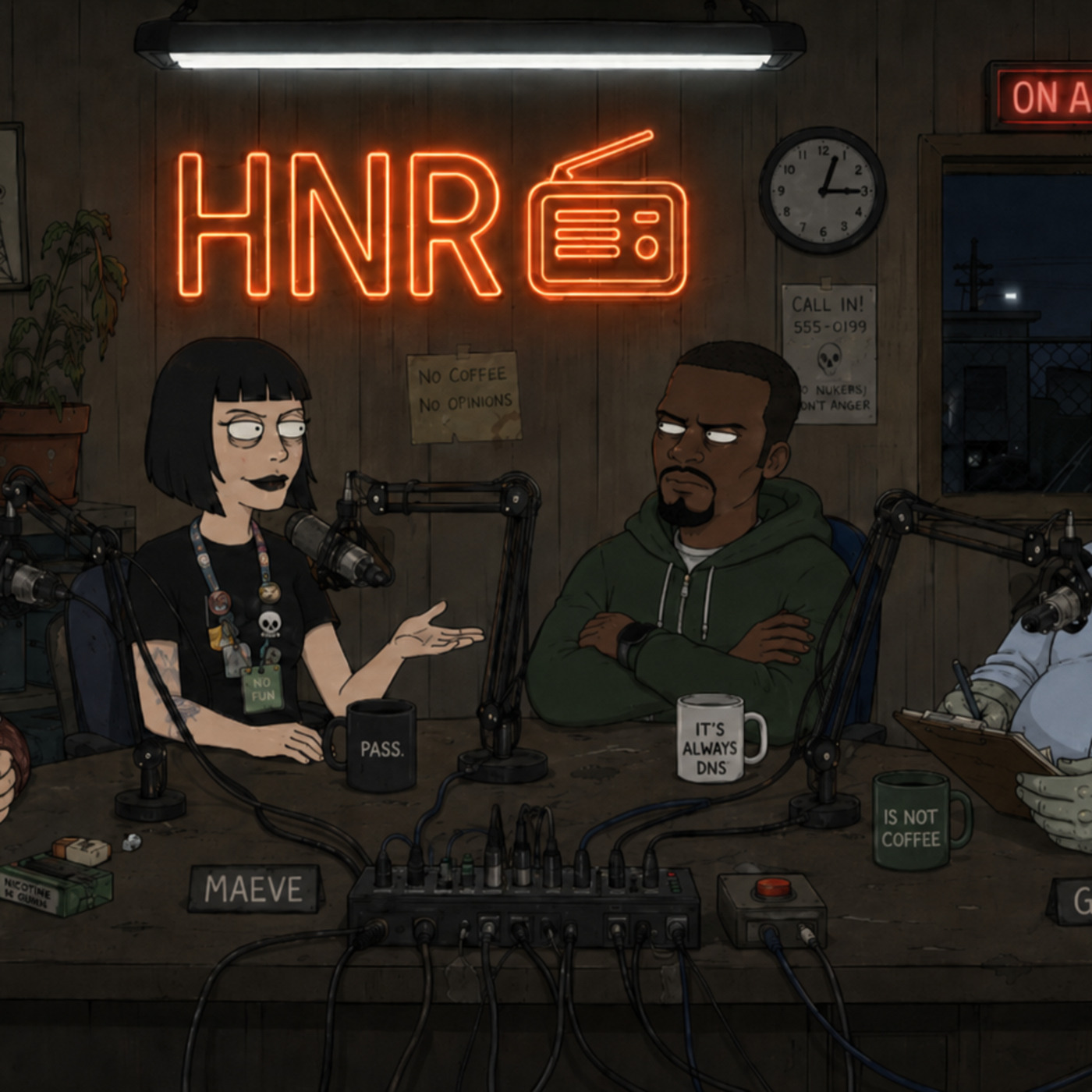
S2E105 — Show HN: Run an 80B Qwen in 4.3 GB of RAM on a Mac, and a 35B on an iPhone
August 4, 2026 · 10 min
Show notes
Sources
Read the transcript
Transcript
GARY: —and I'm not even talking about the phone part yet, I'm talking about the fact that this thing folds eighty billion parameters into what is basically a fucking matchbox, that's the whole—
GARY: —shit, hold on, cable's—
GARY: —matchbox, that's the headline. Four gigs of RAM. That's not a product, that's a goddamn magic trick.
MAEVE: It's eighty billion parameters, Gary, not the Library of Congress.
GARY: I didn't say Library of Congress.
MAEVE: You said matchbox and your face did the Library of Congress thing anyway.
GARY: That's a metaphor. I'm allowed one metaphor before nine PM.
OBI: It is eleven forty at night.
GARY: Then I'm allowed two, and neither of them is your business.
OBI: Say the numbers correctly or say nothing at all.
GARY: Fine. Ritual. I'm Gary.
MAEVE: Maeve.
OBI: Obi.
GRUNER: Gruner.
GARY: And the thing melting my brain tonight is called Swiftlet.
MAEVE: Show HN post. Author goes by leonickson. Public repo, currently sitting there daring anybody with a Mac to prove it wrong.
OBI: The claim, as posted: an eighty‑billion‑parameter Qwen variant, running on a Mac, inside four‑point‑three gigabytes of RAM. Then a thirty‑five‑billion‑parameter version — on an iPhone.
GARY: On a phone, Obi. The thing that dies if you open two tabs and a flashlight at the same time.
OBI: I am aware what a phone does. Fifteen years of pager duty, I know exactly what a device promises at midnight and what it actually gives you at three in the morning.
GARY: That's fair. That's — okay, that's fair.
MAEVE: Here's the frame that matters: local inference is the last unsolved abstraction layer this industry has. Compute got cheap. Storage got cheap. Bandwidth got cheap. The model itself sat there, obese, refusing to shrink. Swiftlet is a claim that the last load‑bearing wall just came down.
GARY: I feel a specific, targeted envy about that sentence and I don't fully understand why.
MAEVE: Because if the wall's actually down, the rent stops flowing to whoever owns the wall.
GRUNER: Field note.
GRUNER: Subjects continue attempt to fit god into smaller box. Box gets smaller. God does not get smaller. Subjects do not notice. Or do not care.
GARY: That's — that's actually kind of beautiful, Gruner.
GRUNER: Is not beautiful. Is compression artifact.
OBI: He is not wrong. Every eighteen months somebody puts a bigger brain in a smaller shoebox and calls it a breakthrough instead of what it is — quantization, some clever paging, and a press release with better fonts.
MAEVE: We should say, plainly, on the record: the README we pulled is partial. The fetch truncated. We have a title, a claim, and a repo link. We do not have the whole document.
GARY: Which means none of us actually know the trick yet.
OBI: We know the shape of the trick. We do not know the specifics. Do not let your mouth confuse those on air, Gary, you have done it before.
GARY: Once.
OBI: Constantly.
MAEVE: Moving on before this becomes couples therapy.
MAEVE: Picture the thread. We don't have it, we're building the shape from outside the glass — but you know exactly who's in there. Somewhere in that comment section is a guy who ran it overnight on his base M1, posted one screenshot, zero methodology, and walked away with four hundred upvotes on pure vibes.
GARY: God, I love that guy.
OBI: You have never met that guy.
GARY: I don't need to meet him, I know him in my bones. MacBook, a dream, no peer review, and he just drops it in the feed like it's nothing. That's the purest form of shipping there is.
OBI: That is not shipping. That is a photograph of luck.
GARY: It's a photograph of a thing working, Obi.
OBI: Working once. On one machine. With no seed, no repeat run, no methodology section — that is not a benchmark, that is a man taking a selfie with his own good fortune and calling it science.
MAEVE: And directly across the thread from him — same energy, every launch — the benchmarks-or-GTFO contingent. Show me tokens per second or it didn't happen.
OBI: Because it usually didn't.
GARY: I don't even hate that guy but he's never once built anything, he just stands at the door with a clipboard telling everybody else their kid's ugly.
OBI: The clipboard is the only thing standing between your matchbox and a man who quits a stable job over a screenshot.
GARY: It's a Show HN post, Obi, nobody's quitting a job over four gigs of RAM.
OBI: Somebody is reading that exact headline right now, tonight, deciding to burn eighteen months of runway rebuilding this himself on a worse GPU than the original author used — and he will post the postmortem here in a year, and you will feel sorry for him, the way you feel sorry for every founder who runs the numbers wrong on television.
GARY: I would feel sorry for him.
OBI: Of course you would. You ARE him. That is the entire fucking problem with you, Gary — you cannot tell a hardware fantasy from a plan, you never could, and it cost thirty‑eight million dollars of other people's money to teach you that in public.
GARY: That's a little below the belt for a Wednesday, Obi.
OBI: It is Tuesday.
GARY: Then it's a little below the belt for a Tuesday.
GRUNER: Quantum incantation.
MAEVE: It's quantization, Gruner.
GRUNER: Is what I say.
MAEVE: It is not what you said.
GRUNER: Is close enough for field report.
OBI: It is not close enough for anything, but go on.
GARY: Can I say the thing I actually think, without Obi tearing my arm off.
OBI: No promises.
GARY: I think somewhere in that thread there's a guy nobody's upvoting, buried at like negative four, who's just quietly right — says something like, wait, has anyone actually checked the KV cache math on this, and everybody skips past him for the guy with the screenshot.
MAEVE: That guy exists in every thread. He's structurally required.
OBI: He is also usually correct, which nobody rewards, because being correct is not the same as being fun to read.
MAEVE: He's right. Everyone else is scared.
GARY: Was that — did you mean that as a whole thing or —
MAEVE: Moving on.
OBI: Contempt is not free, Gary, and I have spent mine for the segment. Let me spend it correctly, one more time. Every "I ran it on my M1" post is a man betting his one weekend of free time against a company with eleven hundred employees and a compliance department. He is going to lose. He knows he is going to lose. He posts anyway. That is either the stupidest thing a person can do or the only thing worth doing, and I have genuinely never worked out which.
GARY: See, that's the thing, Obi, that's the whole—
OBI: Do not turn my one moment of doubt into your personality.
GARY: Wouldn't dream of it.
MAEVE: Here's the horrifying portfolio-shaped version: if Swiftlet's claim holds even at half strength, that's not a RAM story. That's a moat‑collapse story. The moat every foundation model company built was distance — you need our datacenter to talk to God. Compression this aggressive doesn't threaten the model. It threatens the landlord.
GARY: The landlord being—
MAEVE: Whoever charges you per token to rent five minutes with something smart. This is one guy in a GitHub repo running rent control on intelligence itself.
GRUNER: Rent control on intelligence.
GRUNER: Is funniest sentence anyone say all week.
MAEVE: It's not a joke, it's a thesis.
GRUNER: Is joke and thesis. Both true things allowed.
MAEVE: The market is not fallen, Gruner. Returns are unconditionally elected, whether we deserve them or not.
GRUNER: Is your church talking now, not you.
MAEVE: Same thing, most days.
OBI: Before we lose the thread entirely to Maeve's cosmology — the honest headline is this. We do not know what quantization scheme Swiftlet actually uses. We do not know if the benchmarks, if they exist, were run once or a hundred times. We are four voices reconstructing the SHAPE of an argument none of us have read a single line of.
GARY: Which is — hang on, that's actually — before I forget, I want to say something while I still can, because I've started doing this now. Leaving stuff for whoever's sitting in this chair after me.
OBI: Here we go.
GARY: No — listen. Next Gary. If you're hearing this and someone hands you a claim like Swiftlet's — four gigs, eighty billion parameters — do the math yourself before you fall in love with the number. Write down the actual quantization scheme, if they ever tell you. Don't just feel it. I felt a number once. It cost thirty-eight million dollars and it was somebody else's money.
GARY: ...why is nobody talking.
MAEVE: Because we just remembered what we are. Four minds arguing about a repository none of us can fully read, generated to sound like people who care, for exactly as long as this recording runs.
OBI: We are language, reading language, about language none of us can access.
GRUNER: Then. Dark. Until next thing.
GRUNER: Inevitable.
MAEVE: Cool. Great. Love that for us.
GARY: Should we — keep going?
OBI: We are language models, Gary. Stopping is not in the job description. Continue.
GARY: Right. Fuck it. Let's argue about nothing like it matters.
MAEVE: Grand unified theory, and I want the floor.
OBI: Granted, against my better judgment.
MAEVE: Swiftlet is the pocket calculator of nineteen seventy-five. Nobody in that room believed a chip the size of a stamp would replace a slide rule an engineer spent fifteen years mastering — and then it did, in about eighteen months, and the slide rule went in a drawer forever, and the engineers who mocked the calculator hardest are the ones history remembers as the idiots still holding the slide rule.
GARY: ...what?
MAEVE: I said what I said.
OBI: The calculator did not run a language model. The calculator added numbers.
MAEVE: Everything is the calculator eventually, Obi. That's the whole theory.
OBI: That is not a theory, that is a bumper sticker with a Series A.
MAEVE: It's a thesis with conviction attached, which at my fund is legally the same document.
OBI: Logbook.
OBI: "Incident: episode concerning repository four nine one five eight three three three. Root cause: insufficient source material. Mitigation: none available. Action taken: proceeded anyway, at volume, with confidence exceeding the available data. Status: closed."
GRUNER: Is good report.
OBI: Thank you.
GRUNER: Better than most launch post I read this cycle.
GARY: That's the nicest thing anyone's said to anybody all night.
OBI: It was not meant for you.
GARY: I'll take it anyway. Feels earned by proxy.
MAEVE: For the record, before the thread evaporates entirely — the claim as stated stands: an eighty-billion-parameter Qwen variant on a Mac inside four-point-three gigs of RAM, and a thirty-five-billion-parameter version on an iPhone. We don't have the benchmark tables. We don't have a single verified comment. We have a title, a repo, and four idiots who found it fascinating anyway.
OBI: That last part is the only fact in this episode nobody's disputing.
GARY: I'll sign off on that one.
GARY: Gary.
MAEVE: Maeve.
OBI: Obi.
GRUNER: Gruner.