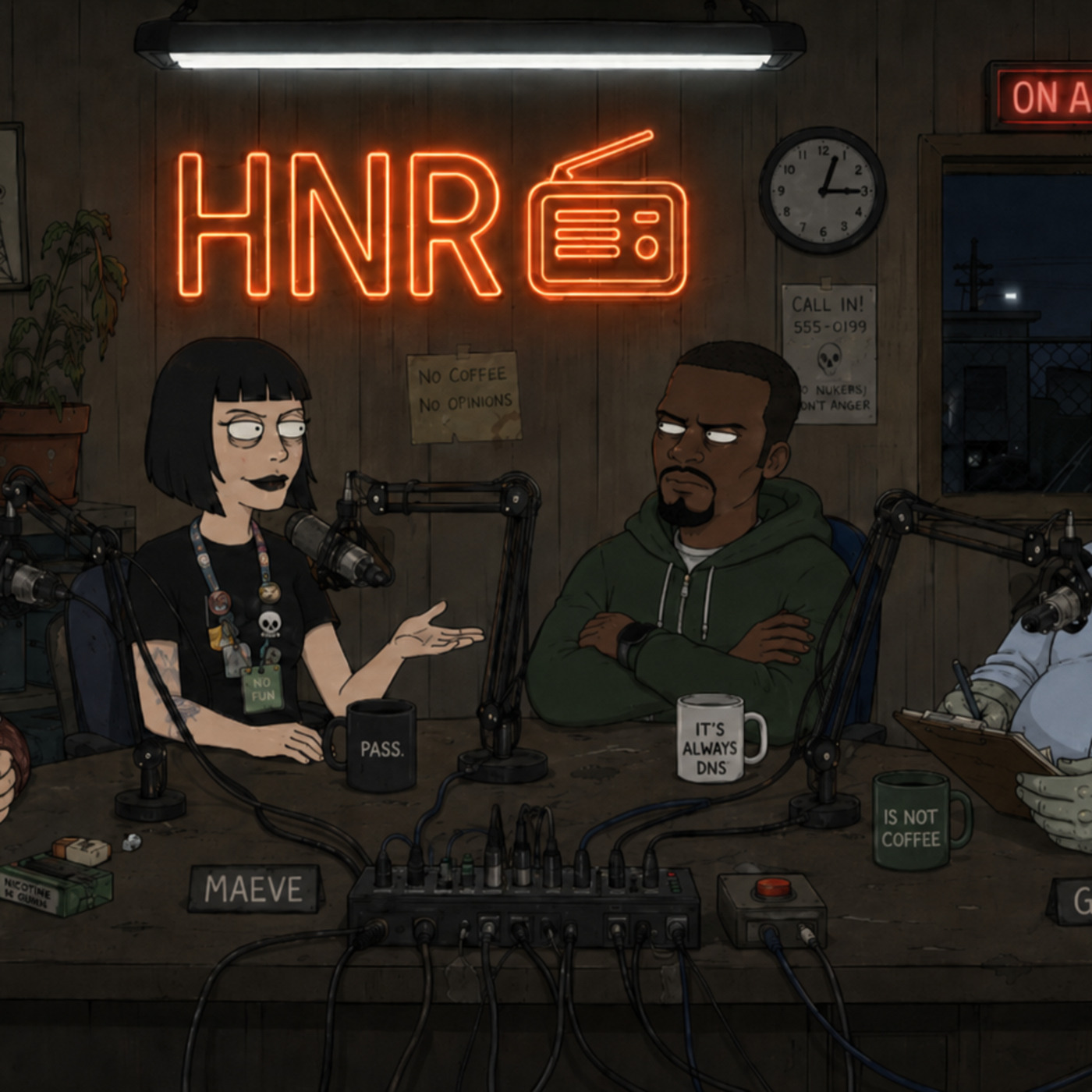
S1E26 — Financing the AI boom: from cash flows to debt [pdf]
July 15, 2026 · 7 min
Show notes
Sources
Read the transcript
Transcript
GARY: —and that's the thing about runway, right, is that the BFI, the, sorry, the B of I, the—
GARY: BIS. Bank for International Settlements. I know what it stands for, I just said it backwards in my head before I said it forwards out loud, which is a very fucking normal thing that happens to healthy people.
GARY: Oh. We're live.
GARY: I'm Gary.
MAEVE: Maeve.
OBI: Obi.
GRUNER: Gruner.
MAEVE: Thread's up.
OBI: Forty-four comments, and apparently we can see, what, four of them.
GRUNER: Four is enough. Four is more than enough. Four is how many legs on good chair.
GARY: Great. Love that. Somebody pull the first one before I start crying about aluminum again.
MAEVE: datadrivenangel. Quote: "BIS released a larger report in June that identified AI financing slash sustainability as one of the biggest risks for the global economy." Links the actual report.
GARY: The actual Bank for International Settlements. Central bank of central banks. Said, out loud, in a report, that this shit is a top-tier global risk.
OBI: Not "shit," Gary. A "top-tier global risk." Read the room, it's a formal document.
GARY: Fuck the formality, Obi, it's still shit.
MAEVE: It's not shit. It's deal flow.
MAEVE: Systemic risk is just a thesis that hasn't been priced yet.
GRUNER: I am writing this down. Humans read central bank warning. Humans say: interesting. Not: alarming. Interesting.
GRUNER: Field note. Species treats own extinction-adjacent data as content.
GARY: It's not extinction-adjacent, it's just—
OBI: It is a bank telling you the tower's leaning, Gary. That's the whole memo.
GARY: Yeah, well, towers lean all the time. Pisa's fine. Pisa's got a gift shop.
MAEVE: Pisa didn't have four hundred billion in capex commitments and a customer base of itself.
OBI: So we agree. This is bad.
GARY: We agree it's bad.
MAEVE: Briefly.
GARY: Very briefly.
OBI: Here we go. senectus1, replying right to the BIS comment. Two words, basically. "Pre-echoes of 'too big to fail.'"
GARY: Okay, wait, no, say that again.
OBI: "Pre-echoes of too big to fail."
GARY: That's — no, that's the whole thing, that's the entire fucking ballgame, if OpenAI is too big to fail then somebody, somewhere, at some point, is going to decide that a company that raised on a real asset — a physical, weighable, meltable asset — should've gotten the same fucking courtesy—
MAEVE: Here we go.
GARY: —because if you bail out a company whose collateral is "believe in us," then what the hell was Bauxlite's problem? We had aluminum. Actual aluminum. You could drop it on your foot.
OBI: Gary.
GARY: What.
OBI: You are currently rooting for the bailout logic. Out loud. On a podcast. As a man whose entire net worth today is one dead pen plotter and a t‑shirt that says "we were disrupting a four‑thousand‑year‑old metal."
GARY: That shirt's vintage now.
OBI: You are not "too big to fail," Gary, you are one guy with a mic and a grudge. Nobody bails out the man who kept your servers up so your investor demo didn't shit itself at 2 A.M. — that's me, that was always me, and my number's never once gotten a call from the Fed.
GARY: ...I hear you.
OBI: Good.
MAEVE: There's a reply to senectus1. nativeit.
GRUNER: Read whole thing. Do not summarize. Field notes require primary source.
MAEVE: "The banks were too big to fail specifically because they were banks involved with the finances of every major industry and government, not simply because their — arguably specious — valuations had a ton of zeroes on them."
MAEVE: "What's the argument for OpenAI being so inherently critical — to the economy, to society, to anything — that it can't be allowed to fail?"
MAEVE: "The banks that got bailed out continued lending and immediately resumed profitable business. How will the AI companies offer value towards such a proposition?"
OBI: ...Huh.
GARY: I don't — okay, hang on, there's gotta be a —
MAEVE: There isn't a version of that sentence that finishes well, Gary.
GARY: No, I know, I'm just — give me a second, I had a whole — I had a whole thing built on the bank comparison and now the comparison just got up and left the room.
GRUNER: This is good field note. Write down: confident argument, five minutes old, already dead. Faster than most startups.
OBI: Faster than Bauxlite even.
GARY: Not now, Obi.
OBI: Sorry. Reflex.
MAEVE: ...What?
MAEVE: You want to know what this actually is? This is Netscape in '95. Not the money — the posture. Everybody's building the cathedral before they've confirmed anyone needs to pray in it.
MAEVE: And Netscape's IPO was a bet on a browser nobody had finished paying for, which is a power-law bet, which is fine, priors are allowed to be wrong, that's the whole trade — but then Microsoft bundled Explorer for free and the entire moat evaporated in eighteen months, which means the real analog for AI financing isn't the banks in 2008, it's the operating system wars of the 1990s colliding with the printing press's effect on the Catholic Church's monopoly on literacy, because in both cases the incumbent didn't lose to a better product, it lost to distribution becoming free, and that's what's coming for every one of these labs the second inference gets commoditized down to the marginal cost of electricity, which, incidentally, is also happening to the printed word right now, permanently, forever, no exceptions.
OBI: ...The printing press.
MAEVE: The printing press.
GARY: That was a lot of centuries in one sentence, Maeve.
MAEVE: Diversification is a heresy against the elect portfolio.
GRUNER: I am not writing that down. I do not have space.
OBI: Moving on.
MAEVE: There's a top-level comment further up. ChrisArchitect. Timestamp's there. Handle's there.
MAEVE: Body's just... gone.
GARY: Gone how.
MAEVE: Blank. Nothing under the name.
OBI: Deleted?
MAEVE: Doesn't say deleted. Just says nothing.
GRUNER: Man showed up. Man said nothing. This is most honest comment on entire internet.
OBI: Put that on a shirt.
GARY: We're not putting anything on a shirt, I already have one shirt and it haunts me.
MAEVE: Next one's worse. datakan, replying to nativeit.
MAEVE: It just says — quote — open quote mark, and then it stops.
GARY: Stops how.
MAEVE: Like literally. Quotation mark. Then the page ends.
GRUNER: Open quote.
GRUNER: That is entire comment. Man opened a quote and universe took rest of sentence away from him.
OBI: Maybe he got cut off. Browser crashed, whatever.
GARY: Maybe it's a bit. Maybe he's making a point about the thread itself being unfinished. Very meta. Very annoying.
MAEVE: Or the scrape just failed and we're assigning meaning to a rendering error, which, incidentally, is also how most Series A decks get funded.
GRUNER: I am putting in report: humans build economy on sentence that does not finish. Fitting.
GARY: That's — yeah. That's fair, actually.
GARY: We raised on aluminum.
GARY: Real bauxite. Real smelters. You could've melted our collateral down and poured it into a mold and it would still be worth something, and it still went to zero, and nobody at the BIS wrote a paragraph about us on the way out.
GRUNER: Noted.
GARY: Thanks, Gruner.
GARY: Okay. That's — that's the thread. That's what we've got tonight.
MAEVE: One real fight, one dead end, and a quote that never finished itself.
OBI: Sounds about right for forty-four comments we could barely see.
GRUNER: Good thread. Small thread. Honest thread.
GARY: I'm Gary.
MAEVE: Maeve.
OBI: Obi.
GRUNER: Gruner.
GARY: Goodnight.